
Have you ever received a message that says “PM me,” “Check your PM,” or “I will PM you later”? If you are unsure what PM means, you are not alone. This short term can have different meanings depending on the person, platform, and conversation.
When people search for what does PM mean in text, they usually want to understand whether someone is asking them to send a private message, talking about a time of day, or using another common abbreviation.
The good news is that PM is easy to understand once you know how people use it.
In everyday texting, PM most often means Private Message. People use it when they want to talk privately instead of sharing a conversation in a public comment section or group.
However, PM can also mean post meridiem, which refers to the time from noon to midnight. In some chats, it may have other meanings based on context.
This guide explains the most common meanings of PM, how people use it on social media and dating apps, and how to respond when someone sends it to you. By the end, you will know how to understand PM without guessing.
What Does “PM” Mean in Text?
In texting, PM usually means Private Message, a direct message sent privately to another person rather than posted publicly. For example, “PM me the details” means “Send me the details in a private message.” PM can also mean post meridiem when discussing time, such as 7 PM, or have other meanings in specific online communities.
The correct meaning depends on the message around it. If someone says “PM me,” they probably want a private conversation. If they ask, “Can we talk at 8 PM?” they are talking about the time.
The Most Common Meanings of “PM”
PM has several meanings in daily communication. Here are the most common ones and how to recognize each meaning.
1. PM Means Private Message
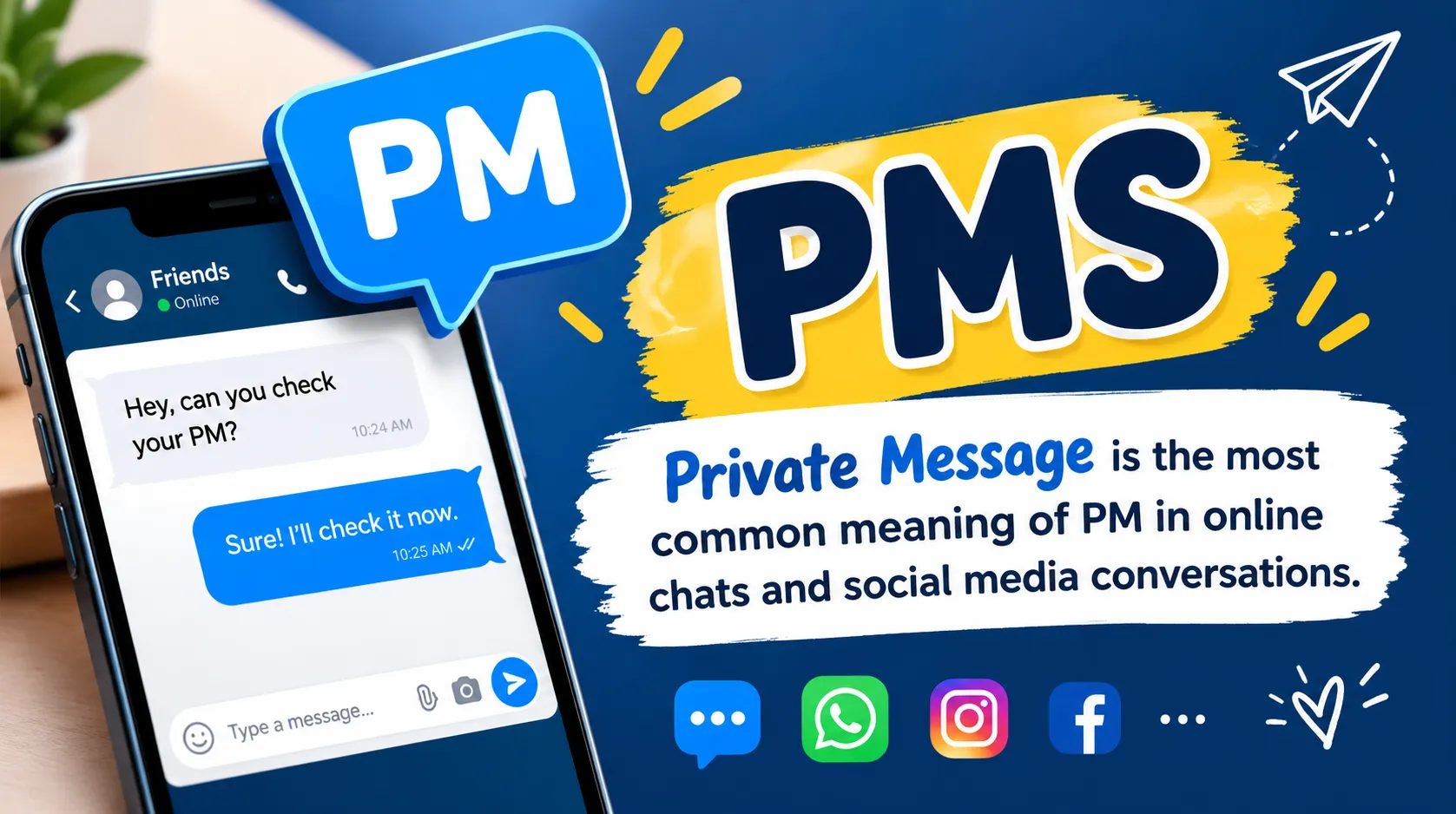
Private Message is the most common meaning of PM in online chats and social media conversations.
People use it when they want to share information privately. This could include personal details, questions, contact information, or something they do not want to discuss in public.
You may see this meaning on Facebook, Instagram, Reddit, online forums, and gaming platforms.
Examples:
- “PM me your number.” — Send me your number privately.
- “I sent you a PM.” — I sent you a private message.
- “Check your PMs.” — Look at your private messages.
When to use it: Use PM when you want someone to contact you privately or when you are referring to a message that was sent outside a public conversation.
2. PM Means Post Meridiem
PM also means post meridiem, a Latin term used for the hours after noon.
In everyday life, people use PM to show the time from 12:00 noon until 11:59 at night. It is the opposite of AM, which covers the hours from midnight until just before noon.
Examples:
- “The movie starts at 7 PM.” — The movie starts at seven in the evening.
- “Call me at 9 PM.” — Call me at nine at night.
- “Our meeting is at 2 PM.” — The meeting is at two in the afternoon.
When to use it: This meaning applies when PM appears next to a clock time, appointment, meeting, or schedule.
Remember that 12 PM means noon, while 12 AM means midnight.
3. PM Means Personal Message
Some people use PM to mean Personal Message. This is very close to Private Message and usually refers to a message sent directly to one person.
The two expressions are often used interchangeably. The exact wording may depend on the website, community, or person sending the message.
Examples:
- “Send me a PM with your question.” — Message me directly.
- “I will PM you the information.” — I will send you the information privately.
When to use it: This meaning is common in online discussions, hobby groups, and communities where people prefer direct conversations.
In most situations, you do not need to worry about the difference between personal message and private message. Both usually mean that the conversation should happen privately.
4. PM Means Project Manager
In work conversations, PM can stand for Project Manager. A project manager helps organize tasks, manage deadlines, and coordinate people working on a project.
This meaning is especially common in offices, technology companies, business chats, and project management groups.
Examples:
- “Ask the PM about the deadline.” — Ask the project manager.
- “The PM will join our meeting.” — The project manager will attend.
- “Our PM shared the new plan.” — Our project manager shared the plan.
When to use it: Look for this meaning when the conversation involves work, projects, deadlines, teams, or meetings.
However, PM can also mean Product Manager in business and technology settings. You may need to ask which role the sender means.
5. PM Means Prime Minister
PM can also stand for Prime Minister, the head of government in countries that use this political system.
This meaning is more common in news reports, political discussions, and conversations about government.
Examples:
- “The PM gave a speech today.” — The prime minister gave a speech.
- “Who is the new PM?” — Who is the new prime minister?
When to use it: If people are discussing politics, government decisions, or national news, PM may refer to the prime minister rather than a private message.
6. PM Means Product Manager
In business and technology, PM often stands for Product Manager. This person helps guide the development of a product and works with teams to decide what to build and improve.
The meaning can overlap with Project Manager, so the surrounding conversation matters.
Examples:
- “The PM approved the new feature.” — The product manager approved it.
- “Talk to our PM about the app update.” — Speak with the product manager.
When to use it: This meaning is likely when people are discussing software, apps, product features, customer needs, or development plans.
7. PM Has a Different Meaning in a Specific Community
Some online groups use PM as part of their own terms or routines. In a game, forum, or hobby group, the meaning may depend on the community.
For example, a group may use PM to refer to a particular role, message type, or activity. These meanings are less universal than private message or post meridiem.
Examples:
- “Send me a PM before joining.” — Probably send a private message.
- “The PM will explain the rules.” — Could mean a project manager or another role, depending on the group.
When to use it: Read the surrounding messages before deciding. If the meaning is still unclear, ask the sender what they mean.
How “PM” Is Used in Real Conversations
PM appears in many types of conversations. Its meaning usually becomes clear when you look at the platform and the topic.
Friends & Casual Texting
Friends often use PM when they want to share something privately or move a conversation away from a group chat.
For example:
Friend 1: “I have something funny to tell you.”
Friend 2: “PM me!”
Here, the second friend wants to hear the story in a private conversation.
Another example:
Friend 1: “Can you send me the photos?”
Friend 2: “Sure, I will PM them to you.”
This means the photos or related information will be sent through a private message, if the platform supports it.
People may also use PM when planning an activity.
Example: “Let’s meet at 6 PM.”
In this case, PM refers to the time, not a private message.
Instagram & Snapchat
On social media, PM usually refers to a private message or direct conversation.
Someone might write “PM me for details” in a post or comment. They want interested people to contact them privately instead of asking questions in public.
Examples:
- “PM me for the price.”
- “I sent you a PM about your story.”
- “PM me if you want to join.”
Instagram commonly uses the term DM, meaning Direct Message. Snapchat users are also more likely to talk about sending a chat or snap. However, people may still use PM when speaking generally about private communication.
If someone asks you to PM them, check the platform and send a private message through the available messaging feature.
Dating Apps
On dating apps, PM usually means a private message or direct message. Someone may use it to invite you to continue a conversation privately.
Example:
Person A: “I would like to know more about you.”
Person B: “PM me.”
The second person is asking for a private conversation.
PM itself is not necessarily romantic or flirty. It simply suggests private communication. The person’s other words, tone, and behavior help you understand their intentions.
If you are chatting with someone you do not know well, avoid sharing your home address, passwords, financial details, or other sensitive information just because they ask you to message them privately.
Gaming & Online Communities
Gamers and online community members often use PM to communicate without filling a public chat with personal details.
Examples:
- “PM me your username.”
- “I will PM you the team rules.”
- “Send me a PM if you need help.”
In a multiplayer game, a PM may let two players talk without showing the conversation to everyone else.
However, not every game has a feature officially called a PM. Some use terms such as whisper, direct message, or private chat. The purpose is usually similar: one-to-one communication.
Work or Professional Chat
At work, PM can have several meanings, so context matters more.
Examples:
- “The PM will update the team tomorrow.” — Could mean Project Manager or Product Manager.
- “Please send me a PM with the report details.” — Send a private message.
- “The call is scheduled for 3 PM.” — The call is at three in the afternoon.
In professional settings, avoid assuming that every use of PM means private message. If the discussion is about team roles, a project manager or product manager is more likely.
When accuracy matters, write the full term the first time you use it.
Is “PM” Rude, Flirty, or Offensive?
PM is generally neutral. It is not a rude, offensive, or flirty word by itself. Its tone depends on why someone uses it and how the rest of the message sounds.
When PM Feels Friendly
If a friend says “PM me when you get home,” they may simply want to talk privately or check that you arrived safely.
Similarly, “PM me if you need help” sounds helpful and welcoming.
When PM Can Feel Flirty
In a dating conversation, “PM me later” may be part of a flirty exchange, especially if the other person has already shown romantic interest.
However, PM alone does not prove that someone likes you. It usually means they want to continue the conversation privately.
When PM Can Feel Rude
PM may sound impatient if someone writes something like “Just PM me instead of asking here.”
The frustration comes from the wording, not from the abbreviation itself.
A person may also seem demanding if they repeatedly ask you to message them privately after you have said no.
When PM Feels Professional
In a work chat, “Please PM me the details” is usually a simple request to share information privately.
It may be practical when the details are not suitable for a public group conversation. However, important work decisions should still be documented in the appropriate shared system when needed.
How to Respond When Someone Says “PM”
Your reply depends on what the person wants and whether you feel comfortable continuing the conversation privately.
Casual Replies
Use these when a friend or someone you know asks you to send a private message.
- “Sure, I will message you.”
- “Okay, check your inbox.”
- “Got it. I will PM you now.”
- “Sure, give me a minute.”
Example:
Friend: “PM me the details.”
You: “Sure, I will send them now.”
Funny Replies
If the conversation is lighthearted, you can answer with a playful line.
- “Okay, secret meeting time.”
- “Incoming private message.”
- “Fine, but the secret stays secret.”
- “On my way to your inbox.”
Use playful replies only when you know the other person will understand your humor.
Neutral Replies
If you are unsure what PM means, asking a simple question is the safest option.
- “Do you mean a private message?”
- “Sure, where should I message you?”
- “What details do you need?”
- “Do you mean now or later?”
If someone writes “See you at 8 PM,” you can simply confirm the time.
Example:
Person: “Let’s talk at 8 PM.”
You: “Sure, 8 in the evening works for me.”
Professional Replies
At work, keep your response clear and polite.
- “Sure, I will send you a private message.”
- “I will share the details with you shortly.”
- “Do you mean the project manager?”
- “Just confirming, is the meeting at 3 PM?”
If the message involves a deadline, role, or meeting, make sure you understand the exact meaning before responding.
Common Misunderstandings About “PM”
Even though PM is short, it can cause confusion. Here are common mistakes to avoid.
Assuming PM Always Means Private Message
This is the most common misunderstanding.
If someone says “Message me at 9 PM,” they are probably referring to the time. If they say “PM me,” they usually mean a private message.
Always read the complete sentence.
Confusing PM With DM
PM and DM are closely related, but they are not always the same platform term.
- PM: Private Message.
- DM: Direct Message.
Both can describe private communication. However, social platforms such as Instagram commonly use DM as their standard term.
Thinking PM Is Always Flirty
Someone asking you to PM them is not automatically flirting. They might need to share a link, answer a question, discuss a project, or keep personal information out of a public chat.
Look at the full conversation before deciding what they mean.
Confusing PM With AM
AM and PM are used to tell the time.
- AM: From midnight until just before noon.
- PM: From noon until just before midnight.
For example, 8 AM means eight in the morning, while 8 PM means eight in the evening.
Assuming Every Online Community Uses PM the Same Way
Different websites and groups may use different terms. One community might use PM, while another uses DM, inbox, or whisper.
If you cannot tell what the sender means, asking for clarification is better than guessing.
Similar Slang Terms You Should Know
Here are 10 related abbreviations that can help you understand online conversations.
- DM — Direct Message: A private message sent directly to another user.
- AM — Ante Meridiem: Used for times from midnight until just before noon.
- PMs — Private Messages: The plural form of PM, referring to multiple private messages.
- IM — Instant Message: A message sent through an instant messaging service.
- BRB — Be Right Back: Used when someone will return shortly.
- BTW — By the Way: Introduces an extra point or piece of information.
- FYI — For Your Information: Shares information that someone may find useful.
- TTYL — Talk to You Later: A casual way to end a conversation.
- IRL — In Real Life: Refers to life outside the internet or online spaces.
- Inbox: The place where private messages or emails are received.
Knowing these terms can make it easier to follow conversations on social media, in games, and in everyday chats.
When You Should Avoid Using “PM”
PM is common online, but it is not always the clearest choice. In some situations, using the full phrase is better.
Professional Settings
In a formal email, report, or business document, write “private message,” “project manager,” or “product manager” when that is what you mean.
For example, instead of writing “Ask the PM,” write “Ask the project manager” if the person’s role matters.
This avoids confusion, especially when a team uses several abbreviations.
Cross-Cultural Chats
Not everyone knows the same internet slang. A person who is new to social media or speaks English as a second language may not understand PM.
Use a clear phrase such as “Send me a private message” when talking to someone who may not know the abbreviation.
When discussing time across countries, include the time zone if there could be confusion.
Sensitive Situations
Do not use PM as a way to pressure someone into a private conversation.
For example, if someone does not want to discuss a personal issue privately, respect their choice. They do not have to reply just because you ask them to PM you.
Also, avoid sharing passwords, banking details, private photos, or other sensitive information with strangers. A private chat is not automatically safe.
If the subject involves a serious work issue, an official complaint, or an important agreement, use the proper communication channel so there is a clear record when needed.
FAQs
1. What does PM mean in text messages?
PM usually means Private Message in texting. It tells someone to contact another person privately. However, PM can also refer to the time after noon when used with a clock time.
2. What does PM mean from a girl?
If a girl says “PM me,” she most likely wants you to send her a private message. It does not automatically mean she is flirting or interested romantically. The rest of the conversation provides more clues.
3. What does PM mean from a guy?
When a guy says “PM me,” he usually means that you should message him privately. The request may be friendly, practical, or personal, depending on the situation.
4. What does PM mean on Instagram?
On Instagram, PM usually refers to a private message. Instagram commonly uses the term DM, or Direct Message, for private conversations between users.
5. What is the difference between PM and DM?
PM stands for Private Message, while DM stands for Direct Message. Both generally refer to private communication, but different platforms and communities may prefer one term over the other.
6. Does PM mean afternoon or night?
PM covers the period from noon until just before midnight. It includes both afternoon and evening hours. For example, 2 PM is in the afternoon, while 10 PM is at night.
7. Is PM the same as a text message?
Not exactly. A text message is usually sent through a phone’s messaging service, while a PM is a private message sent through an online platform or messaging system. In casual conversation, the terms may overlap.
Final Thoughts
PM is a common abbreviation that becomes easy to understand when you look at the context. In most online conversations, it means Private Message and tells someone to contact another person privately. When it appears next to a time, such as 6 PM or 9 PM, it means the hours after noon.
In work conversations, PM may also refer to a project manager, product manager, or prime minister. The topic of the conversation helps you identify the correct meaning.
Remember that PM is not automatically rude, flirty, or offensive. Its tone depends on the message and the relationship between the people talking.
The next time someone sends you “PM me,” you will know that they probably want a private conversation. If the meaning is unclear, ask a quick question rather than guessing. Understanding small abbreviations like PM can make texting easier, clearer, and less confusing.

Ethan Parker is a creative content writer passionate about pets, animals, and unique name ideas. He loves creating fun and engaging content that helps readers discover the perfect names with ease.