
If someone texts you “ngl, that was really good,” you may wonder what they are trying to say. Is it slang? Is it short for a longer phrase? Does it change the tone of the message?
These questions are common because texting slang changes the way people talk online. Words are often shortened to save time, sound casual, or show emotion. One of the most common examples is NGL.
If you have searched for what does ngl mean in text, the simple answer is that NGL usually means “not gonna lie.” People use it before saying something honest, personal, surprising, or sometimes blunt.
For example, someone might text, “NGL, I really liked that movie.” Here, the person is saying that they are being honest about their opinion.
But NGL can do more than simply mean “not gonna lie.” Its tone can change depending on the conversation. It can introduce a compliment, criticism, joke, confession, or honest reaction.
This guide explains what NGL means, how people use it, what it means on social media and dating apps, and how you can reply without misunderstanding the message.
What Does “What Does NGL Mean in Text” Mean in Text?
In texting, NGL means “not gonna lie.” It is used when someone wants to sound honest or direct. Most often, it introduces a true opinion, feeling, reaction, compliment, or criticism. Depending on the context, NGL can also make a message sound casual, playful, surprised, or slightly blunt.
Common interpretations include:
- Not gonna lie — the standard meaning.
- Honestly — used to introduce a real opinion.
- To be honest — similar to saying “TBH.”
- I have to admit — often used before a surprising statement.
For example:
“NGL, this is better than I expected.”
This means:
“Honestly, this is better than I expected.”
The Most Common Meanings of “What Does NGL Mean in Text”
Although NGL has one main meaning, people use it in several ways. The exact feeling depends on what comes after it.
1. NGL Means “Not Gonna Lie”
This is the standard and most common meaning.
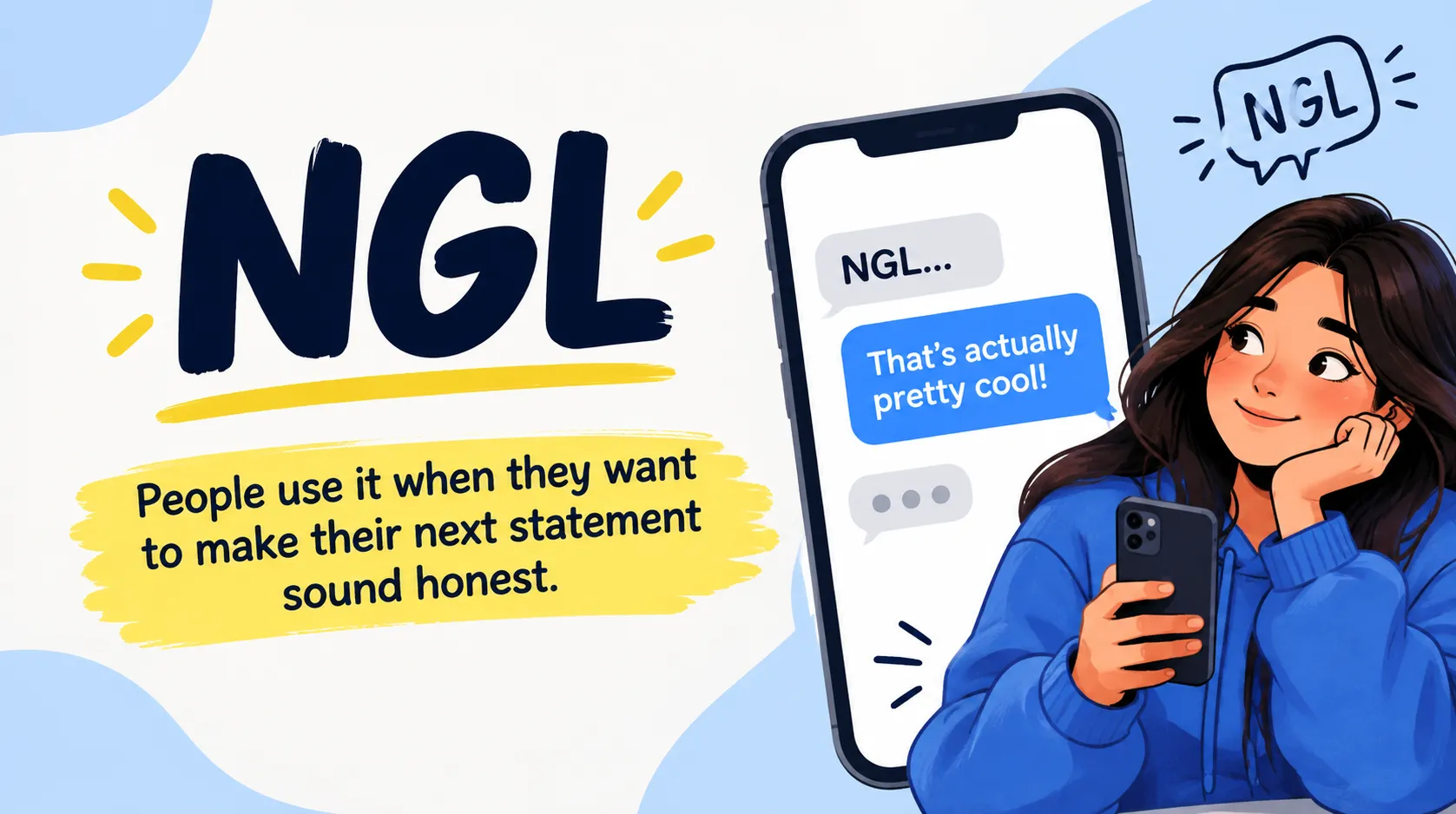
People use it when they want to make their next statement sound honest.
Example:
“NGL, I was nervous before the test.”
The person is simply saying that they are being honest about feeling nervous.
Another example:
“NGL, I forgot about the meeting.”
Here, NGL adds an honest and casual tone to the confession.
2. NGL Means “Honestly”
NGL can often be replaced with “honestly” without changing the basic meaning.
Example:
“NGL, your idea makes sense.”
This can also be written as:
“Honestly, your idea makes sense.”
The use of NGL makes the sentence feel more like casual online conversation.
3. NGL Can Introduce a Compliment
People often use NGL before saying something positive.
Example:
“NGL, you look great today.”
The person is emphasizing that the compliment is genuine.
Another example:
“NGL, that was a really good presentation.”
In this case, NGL adds a feeling of sincerity.
4. NGL Can Introduce Criticism
NGL is not always positive. It can also come before a negative opinion.
Example:
“NGL, that update made the app worse.”
The person is giving an honest opinion.
Another example:
“NGL, I didn’t really enjoy the movie.”
The phrase makes the statement sound direct but still casual.
5. NGL Can Introduce a Surprise
People also use NGL when something turns out differently than expected.
Example:
“NGL, I thought you were going to lose.”
This means the speaker honestly expected a different result.
Another example:
“NGL, I didn’t think the food would be that good.”
The phrase highlights the speaker’s honest surprise.
6. NGL Can Introduce a Personal Feeling
NGL can make it easier to share a feeling.
Example:
“NGL, I miss those days.”
Or:
“NGL, I’m a little worried.”
The phrase can make the message feel more open and personal.
How “What Does NGL Mean in Text” Is Used in Real Conversations
NGL appears in many online conversations. The meaning stays close to “not gonna lie,” but the tone can change based on where it is used.
Friends & Casual Texting
Friends often use NGL when sharing opinions, jokes, stories, or personal thoughts.
Example:
“NGL, I almost didn’t come.”
Or:
“NGL, that was the funniest thing I’ve seen all week.”
With friends, NGL usually feels relaxed and natural. It can make a statement sound less formal and more conversational.
Someone might also use it before a small confession:
“NGL, I ate the last slice.”
The phrase can make the confession sound funny rather than serious.
Instagram & Snapchat
NGL is common in social media comments, captions, replies, and direct messages.
Someone might comment:
“NGL, this photo is amazing.”
Or send:
“NGL, your story made me laugh.”
On social media, NGL often adds emphasis to an opinion. It can make a compliment feel more personal or a reaction feel more genuine.
It can also appear in captions:
“NGL, this was one of my favorite days.”
The meaning is still “not gonna lie.”
Dating Apps
On dating apps, NGL can be used to make a message sound honest, confident, or playful.
For example:
“NGL, your profile caught my attention.”
Or:
“NGL, I wasn’t expecting to match with you.”
The phrase itself is not automatically romantic or flirty. The rest of the message creates that tone.
For example:
“NGL, you have a great smile.”
This sounds like a compliment.
But:
“NGL, I don’t think we’re a good match.”
This is honest but not romantic.
So, when you see NGL on a dating app, read the complete message instead of assuming that NGL itself is flirty.
Gaming & Online Communities
Gamers and online communities often use NGL when talking about games, players, updates, or their own performance.
Examples:
“NGL, that boss was easy.”
“NGL, your aim is really good.”
“NGL, I thought our team was done.”
It can also be used after a match:
“NGL, that was a close game.”
In these situations, NGL usually means that the person is sharing their genuine reaction.
Work or Professional Chat
NGL is mainly casual slang, so it is less suitable for formal work communication.
A coworker might use it in a relaxed team chat:
“NGL, that presentation went really well.”
But in a formal email, it is better to write:
“To be honest, I think the presentation went very well.”
Or:
“I believe the presentation went very well.”
The meaning is similar, but the second versions fit professional communication better.
Is “What Does NGL Mean in Text” Rude, Flirty, or Offensive?
NGL is not normally rude, flirty, or offensive by itself. Its tone depends on the words around it and the relationship between the people talking.
When NGL Feels Positive
NGL often feels positive when it introduces a compliment or friendly opinion.
“NGL, you’re really good at this.”
“NGL, that outfit looks great.”
The phrase can make the compliment sound more honest.
When NGL Feels Negative
NGL can sound negative when it introduces criticism.
“NGL, that wasn’t very good.”
“NGL, you should have told me earlier.”
These messages may feel blunt because the speaker is preparing to give a direct opinion.
When NGL Feels Flirty
NGL can be part of a flirty message, but it does not automatically make a message romantic.
For example:
“NGL, I’ve been thinking about you.”
The sentence may feel flirty because of the message itself, not because of NGL.
When NGL Feels Funny
NGL is also popular before jokes and playful confessions.
“NGL, I came here mostly for the snacks.”
The phrase adds a casual sense of honesty.
The best way to understand the tone is to look at the complete sentence, the previous messages, and the relationship between the people.
How to Respond When Someone Says “What Does NGL Mean in Text”
Your response should match the tone of the original message.
Casual Replies
If a friend says:
“NGL, that game was amazing.”
You could say:
“Honestly, yeah.”
Or:
“Same, I loved it.”
If they say:
“NGL, I was scared.”
You could respond:
“I could tell.”
Funny Replies
If the conversation is playful, you can answer with humor.
Someone says:
“NGL, I ate your fries.”
You might reply:
“Confession accepted.”
Or:
“I knew it.”
The exact response depends on your relationship and the situation.
Neutral Replies
If you want to keep things simple, respond directly to the actual statement.
For example:
“NGL, I don’t like that design.”
A neutral response could be:
“That’s fair. What would you change?”
This keeps the conversation focused on the topic.
Professional Replies
If someone uses NGL in a casual work chat, you can answer normally without copying the slang.
For example:
“NGL, I think we need more time.”
A professional response could be:
“I agree. Let’s review the timeline.”
You do not need to use NGL just because the other person used it.
Common Misunderstandings About “What Does NGL Mean in Text”
NGL is simple, but its tone can still be misunderstood.
NGL Does Not Always Mean Something Negative
Some people think NGL usually comes before criticism. That is not true.
It can introduce a compliment:
“NGL, you’re really good at cooking.”
It can also introduce excitement:
“NGL, I’m excited for tomorrow.”
The following words determine the main message.
NGL Does Not Automatically Mean Someone Is Lying
NGL means “not gonna lie,” but it does not prove that the person is telling the truth.
It is a slang phrase used to frame a statement as honest. You should still understand the message based on its context.
NGL Is Not the Same as LOL
NGL and LOL serve different purposes.
NGL means “not gonna lie.”
LOL means “laughing out loud” and is commonly used to show amusement or a light tone.
A person can use both:
“NGL, that was hilarious lol.”
Here, NGL introduces the honest opinion, while LOL adds a playful tone.
NGL Is Similar to TBH, But Not Identical in Every Sentence
TBH means “to be honest.”
NGL means “not gonna lie.”
They are often interchangeable:
“TBH, I like it.”
“NGL, I like it.”
Both communicate honesty.
However, people may choose one based on their personal texting style.
NGL Does Not Always Need a Serious Statement After It
NGL can introduce something very small or funny.
“NGL, I’m hungry.”
There is no major confession here. It is simply a casual way to emphasize the speaker’s real feeling.
Similar Slang Terms You Should Know
Here are some common texting terms related to NGL:
- TBH — “To be honest.” Used before an honest opinion.
- IMO — “In my opinion.” Shows that something is a personal view.
- IMHO — “In my humble opinion.” A softer version of IMO.
- FR — “For real.” Used to show agreement or seriousness.
- ISTG — “I swear to God.” Used for strong emphasis.
- LOL — “Laughing out loud.” Shows amusement or a joking tone.
- IDK — “I don’t know.” Used when someone is unsure.
- IKR — “I know, right?” Shows strong agreement.
- BTW — “By the way.” Used to introduce another point.
- FYI — “For your information.” Used to share useful information.
- RN — “Right now.” Refers to the current moment.
- WBU — “What about you?” Used to ask the same question back.
Learning these terms can make online conversations easier to understand, especially when people use several slang words in one message.
When You Should Avoid Using “What Does NGL Mean in Text”
NGL is useful in casual texting, but there are situations where another phrase is clearer.
Professional Settings
Avoid NGL in formal emails, job applications, business proposals, official messages, and important workplace documents.
Instead of:
“NGL, we need more time.”
Use:
“To be honest, we need more time.”
Or:
“I believe we need additional time.”
Clear language is usually better in professional writing.
Cross-Cultural Chats
Not everyone knows English texting slang. If you are talking to someone who may not understand internet abbreviations, writing the full phrase can prevent confusion.
Instead of:
“NGL, that’s surprising.”
You can write:
“Honestly, that’s surprising.”
The second version is easier for more people to understand.
Sensitive Situations
Avoid slang when discussing serious problems, emotional issues, complaints, or important misunderstandings.
For example, instead of:
“NGL, this is really bad.”
A clearer message would be:
“I am concerned about what happened.”
This reduces the chance that your words will sound dismissive or overly casual.
FAQs
What does NGL mean in text?
NGL usually means “not gonna lie.” It is commonly used before an honest opinion, feeling, reaction, compliment, or criticism.
What does NGL stand for in texting?
NGL stands for “not gonna lie.” It is a common internet abbreviation used in casual conversations.
Is NGL a good or bad word?
NGL is neither good nor bad by itself. It is a casual abbreviation. The tone depends on the statement that follows it.
Is NGL flirty?
NGL is not automatically flirty. It can appear in a romantic or playful message, but the surrounding words determine whether the message is actually flirty.
What does NGL mean on Instagram?
On Instagram, NGL still means “not gonna lie.” People may use it in comments, captions, replies, and direct messages to introduce an honest reaction or opinion.
What is the difference between NGL and TBH?
NGL means “not gonna lie,” while TBH means “to be honest.” Both are commonly used to introduce an honest thought and can often be used in similar situations.
Can I use NGL in a professional email?
It is usually better to avoid NGL in formal professional writing. Use “to be honest,” “honestly,” or a direct statement instead.
Final Thoughts.
NGL is one of the most common abbreviations in casual online communication. Its main meaning is “not gonna lie,” and people use it to introduce an honest opinion, feeling, reaction, compliment, criticism, or confession.
If someone says, “NGL, I loved it,” they are simply saying, “Honestly, I loved it.”
The important thing is to look at the full message. NGL itself does not tell you whether someone is being positive, negative, funny, serious, or flirty. The words around it and the situation create the real tone.
You can use NGL naturally with friends, on social media, in gaming communities, and in casual chats. For formal work messages or sensitive conversations, writing the full phrase is usually clearer.
Once you know what NGL means, it becomes much easier to understand modern texting slang and respond in the right way.
