
You get a text that says, “You really think you can beat me JSP,” and suddenly you stop. Is the person joking? Are they being serious? Or does “JSP” mean something completely different?
This is why people search for jsp meaning in text. The short form can be confusing because the same three letters can have different meanings in different chats.
In casual English conversations, JSP is often used as a playful shortcut, while French-speaking users may use lowercase “jsp” to mean “I don’t know.” In technology, JSP can also refer to a web development term.
The good news is that you usually do not need to guess. The words around JSP, the language of the conversation, and the type of chat can tell you what the sender means.
This guide explains the main jsp meaning in text, how it appears on social media, how its tone changes, how to reply, and when you should avoid using it.
By the end, you will be able to understand JSP without overthinking a three-letter message.
What Does “JSP Meaning in Text” Mean in Text?
In casual English texting, JSP can mean “Just Playing,” meaning the person is joking, teasing, or not being serious. Depending on context, JSP may also be used for “Just Saying.” In French texting, lowercase “jsp” commonly comes from “je sais pas,” meaning “I don’t know.” In technology, JSP has a completely different meaning related to web pages.
The key point is simple: context decides the meaning.
For example:
- “You are so annoying JSP” can mean “Just Playing.”
- “That outfit is not your best look JSP” may mean “Just Saying.”
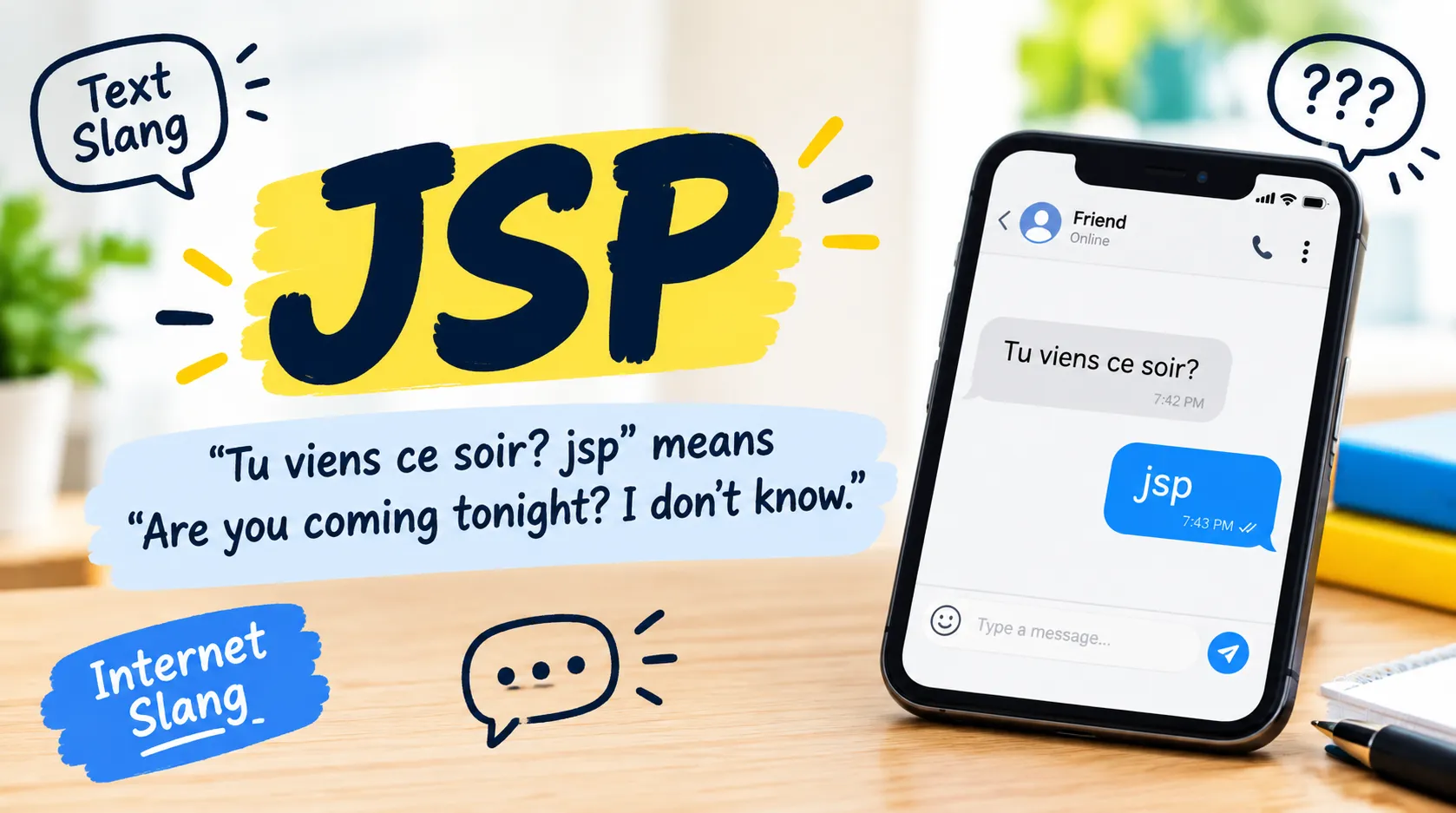
- “Tu viens ce soir? jsp” means “Are you coming tonight? I don’t know.”
- “I am learning JSP” may refer to web development.
So, never judge JSP by the three letters alone.
The Most Common Meanings of “JSP Meaning in Text”
JSP does not have one fixed meaning in every online conversation. Here are the main meanings you may see.
1. Just Playing
In casual English texting, Just Playing is one of the common meanings associated with JSP. It tells someone that the previous message was a joke, tease, or playful comment rather than a serious statement. Current slang guides commonly describe this use in texts, DMs, social media, and gaming chats.
Example:
“You are banned from choosing the movie tonight JSP.”
The person is not really banning you. They are joking.
Another example:
“I’m deleting your number JSP.”
Here, JSP tells the reader not to take the statement literally.
This meaning is especially useful when a text could sound too serious without voice tone or facial expressions.
2. Just Saying
Some users use JSP as a short form of Just Saying. This meaning usually appears after an opinion, comment, or criticism.
Example:
“That phone is way too expensive JSP.”
The sender is giving an opinion and adding a casual ending.
Another example:
“You should probably leave earlier next time JSP.”
The sender may be trying to make the advice sound less direct.
However, this meaning is less clear-cut than “Just Playing.” Online slang is not standardized, so some people may understand JSP differently. That is why the surrounding sentence matters. Some current sources specifically list “Just Saying” as an English texting interpretation.
3. Je Sais Pas
In French texting, jsp commonly means “je sais pas,” which means “I don’t know.” It comes from the casual spoken form of “je ne sais pas.” French users often leave out “ne” in everyday speech, and texting makes the shorter version even easier to type.
Example:
“Tu sais où il est? jsp.”
In English:
“Do you know where he is? I don’t know.”
This meaning is very important because someone using French may have no idea that English-speaking users interpret JSP as “Just Playing.”
If the conversation is in French, jsp = I don’t know is usually the meaning to consider first.
4. JavaServer Pages
In programming and web development, JSP can refer to JavaServer Pages, a technology used to create dynamic web pages with Java-based applications.
This meaning has nothing to do with texting slang.
For example:
“I need to fix this JSP file.”
A programmer is probably talking about a web development file or technology, not saying “Just Playing.”
Modern Java documentation and technology discussions may also use the term Jakarta Server Pages, so technical readers may encounter JSP in that context as well.
The rule is easy:
Chat with friends = likely slang.
French chat = likely “I don’t know.”
Programming chat = likely a web technology.
How “JSP Meaning in Text” Is Used in Real Conversations
The meaning can change based on the people, platform, and topic. Here is how JSP may appear in different online spaces.
Friends & Casual Texting
Friends often use short forms because they already understand each other’s style.
JSP may appear after a joke, tease, or playful threat.
Example:
“You owe me pizza now JSP.”
The message sounds serious at first, but JSP can show that the sender is only joking.
Another example:
“I’m never talking to you again JSP.”
Here, the sender may be using JSP to soften a dramatic statement.
Still, context matters. If the conversation is already tense, adding JSP does not automatically make a message funny.
A serious statement followed by “JSP” can sometimes confuse the reader even more.
Instagram & Snapchat
Instagram and Snapchat are built around quick messages, comments, stories, and short replies. Because of that, abbreviations can appear often.
You may see JSP in:
- Direct messages
- Story replies
- Comments
- Private group chats
- Short captions
- Replies between friends
For example:
“You really posted that JSP.”
Depending on the relationship, this could be playful teasing.
A person may also write:
“That was actually a good post JSP.”
In this case, the meaning may be closer to “Just Saying,” especially if the sender is adding an opinion.
On social media, the message around JSP is more important than the letters themselves.
Dating Apps
Dating conversations can make slang harder to understand because people do not always know each other’s tone.
Someone might write:
“You’re trouble JSP.”
If the conversation is playful, the sender may mean “Just Playing.”
But if someone writes:
“You reply after five hours every time JSP.”
The message may feel more like a real complaint, even if JSP is added at the end.
This is a good example of why context matters. A short abbreviation cannot completely change the meaning of a message.
If you are unsure, a simple reply can clear things up:
“Haha, are you joking?”
That is often better than guessing.
Gaming & Online Communities
Gaming chats move quickly, so short slang terms can be useful.
A player might say:
“I’m taking your loot JSP.”
If the player is clearly joking, JSP may mean “Just Playing.”
You may also see JSP mixed with other short forms such as:
- JK
- LOL
- IDK
- NGL
- TBH
- FR
Gaming communities can develop their own slang, so a term that makes sense in one group may have a different meaning in another.
If JSP appears during a technical discussion about servers or code, however, do not assume it is slang. In a programming community, JSP may refer to web development.
Work or Professional Chat
JSP is usually less suitable in professional communication when the meaning is not clear.
For example:
“The report looks wrong JSP.”
A coworker may not know whether you are joking, criticizing the report, or referring to something else.
In a workplace, clearer wording is safer:
“I think the report may need a few changes.”
If you are talking to developers, JSP may have its technical meaning instead.
For example:
“The JSP page is not loading correctly.”
That is a technical statement, not internet slang.
The same three letters can therefore have very different meanings depending on the workplace conversation.
Is “[Keyword]” Rude, Flirty, or Offensive?
JSP is not automatically rude, flirty, or offensive. Its tone comes mainly from the sentence around it, the relationship between the people, and the situation.
When JSP means “Just Playing,” it is usually meant to show that the sender is joking.
For example:
“You’re the worst teammate ever JSP.”
Between close friends, this may be harmless teasing.
But the same words can feel rude when said to someone you barely know.
When JSP Feels Positive
JSP may feel positive when:
- The conversation is already friendly.
- The sender is clearly joking.
- The message follows a playful comment.
- Both people normally use slang.
- The topic is light.
When JSP Can Feel Negative
It can feel negative when:
- The message contains an insult.
- The sender is discussing a serious issue.
- The relationship is already tense.
- The joke targets something personal.
- The reader does not understand the abbreviation.
This is a basic rule of texting: an abbreviation cannot fix a bad message.
Adding “JSP” after an insulting comment does not guarantee that the other person will laugh.
Can JSP Be Flirty?
Sometimes, yes, but JSP itself is not a standard flirting abbreviation.
For example:
“You look way too good today JSP.”
If two people are already flirting, the sentence may feel playful or teasing.
But the same message between coworkers or strangers may have a different effect.
So, do not assume JSP means someone is flirting. Look at the whole conversation.
How to Respond When Someone Says “JSP Meaning in Text”
Your reply should match the tone and context.
Casual Replies
If a friend uses JSP after a joke, you can keep the conversation relaxed.
Examples:
“Haha, I knew you were joking.”
“Sure you were.”
“Yeah right.”
“I’m not believing you.”
Funny Replies
If you want to joke back:
“Too late. I already believed you.”
“Nice save.”
“You almost got me.”
“That excuse came fast.”
These replies work best when the conversation is already playful.
Neutral Replies
If you are unsure what the person means:
“What do you mean by JSP?”
“Wait, what does JSP mean here?”
“Are you joking?”
There is nothing wrong with asking. In fact, asking can prevent a bigger misunderstanding.
Professional Replies
If JSP appears in a work conversation and you are unsure, stay clear and direct.
You could say:
“Could you clarify what you mean by JSP?”
If the person is using the technical term, they can explain the specific context.
Common Misunderstandings About “JSP Meaning in Text”
JSP creates confusion because several meanings can share the same three letters.
Mistake 1: Assuming It Always Means “Just Playing”
This is one of the biggest mistakes.
In French texting, jsp commonly means “I don’t know.”
So if someone writes:
“Jsp, peut-être demain.”
They are not saying “Just Playing.” They are saying something closer to:
“I don’t know, maybe tomorrow.”
Mistake 2: Assuming JSP Always Means “Just Saying”
Some English-language sources use JSP for “Just Saying,” while others use it for “Just Playing.”
That difference shows why there is no single universal answer.
Read the full sentence before deciding.
Mistake 3: Thinking JSP Is Always Slang
It is not.
In programming, JSP has a technical meaning related to server-side web pages.
For example:
“This JSP page needs an update.”
That sentence has nothing to do with social media slang.
Mistake 4: Reading Too Much Into the Tone
A person using JSP is not automatically angry, flirty, sarcastic, or rude.
Text removes many natural tone signals, so readers often fill in the missing emotion themselves.
Before reacting, look at:
- What was said before JSP?
- Who sent it?
- What language are they using?
- What platform are you on?
- Is the conversation casual or technical?
Those clues usually solve the mystery.
Similar Slang Terms You Should Know
If you are learning online texting language, these terms can help you understand similar messages.
JK
JK means “Just Kidding.” It is commonly used to show that the previous statement was a joke.
LOL
LOL means “Laughing Out Loud.” It can show genuine laughter or simply make a message feel lighter.
NGL
NGL means “Not Gonna Lie.” People use it before giving an honest opinion.
TBH
TBH means “To Be Honest.” It often introduces a direct opinion.
IDK
IDK means “I Don’t Know.” It is one of the most common ways to show uncertainty in English texting.
IDC
IDC means “I Don’t Care.” Depending on context, it can sound casual or dismissive.
FR
FR means “For Real.” It is often used to agree with someone or stress that something is serious.
IMO
IMO means “In My Opinion.” It makes it clear that the statement is a personal view.
IRL
IRL means “In Real Life.” It is often used when comparing online activity with offline life.
BTW
BTW means “By The Way.” It is used when adding another point to a conversation.
WYD
WYD means “What You Doing?” It is a casual way to ask what someone is doing.
These terms are usually easier to understand because their meanings are more stable. JSP is different because its meaning can change with language and context.
When You Should Avoid Using “JSP Meaning in Text”
JSP can be useful in casual chats, but there are situations where spelling out the full meaning is much clearer.
Professional Settings
Avoid unexplained slang in:
- Business emails
- Job applications
- Client messages
- Formal reports
- School assignments
- Official documents
Instead of:
“The design is confusing JSP.”
Write:
“I think the design could be clearer.”
Clear writing is more useful than saving a few keystrokes.
Cross-Cultural Chats
Be careful when talking to people from different language backgrounds.
A French speaker may understand jsp as “je sais pas,” while an English speaker may read it as “Just Playing.”
If the meaning matters, use the full phrase.
Sensitive Situations
Avoid slang when discussing:
- Relationships
- Breakups
- Arguments
- Money
- Health concerns
- Personal problems
- Serious complaints
If someone is upset, “JSP” may make your message harder to understand.
For serious topics, direct words are usually better.
FAQs
What does JSP mean in text?
JSP can have several meanings. In casual English texting, it may mean “Just Playing,” while some users use it for “Just Saying.” In French texting, “jsp” commonly means “je sais pas,” or “I don’t know.”
What does JSP mean on Snapchat?
On Snapchat, JSP may be used as casual slang, including “Just Playing.” However, the exact meaning depends on the message and the person using it. Read the conversation before deciding what it means.
What does JSP mean on Instagram?
On Instagram, JSP can be used in DMs, comments, and casual chats. It may mean “Just Playing” or “Just Saying,” while French-speaking users may use it to mean “I don’t know.”
Is JSP a rude word?
No. JSP is not automatically rude. Its tone depends on the words around it and the relationship between the people. A playful message may feel friendly, while a harsh message can still feel rude even when JSP is added.
Does JSP mean “Just Playing” or “Just Saying”?
It can mean either one in English slang. “Just Playing” fits a joke or tease, while “Just Saying” may fit an opinion or comment. Because usage is not fully standardized, context is important.
What does lowercase “jsp” mean in French texting?
In French texting, jsp commonly means “je sais pas,” or “I don’t know.” It is a casual abbreviation used in messages and online conversations.
What does JSP mean in programming?
In programming, JSP traditionally refers to JavaServer Pages, a web development technology. This technical meaning is completely different from texting slang. You can identify it by looking at the technical context around the term.
Final Thoughts.
The main jsp meaning in text depends on context. In casual English conversations, JSP can be used to mean “Just Playing” or, for some users, “Just Saying.”
In French chats, jsp commonly means “je sais pas,” or “I don’t know.” In programming, JSP refers to a completely different technical concept.
The safest way to understand JSP is to look at the full message instead of focusing only on the abbreviation.
If it follows a joke, “Just Playing” may fit. If it follows an opinion, “Just Saying” may make more sense.
If the chat is in French, “I don’t know” may be the answer. And if the conversation is about code, JSP probably has nothing to do with slang.
When replying, match the tone of the conversation. If you are unsure, simply ask what the sender means. Three letters are not worth a misunderstanding.
