
Have you ever received a message that says “mmcht” and wondered what the person was trying to say? You may see it in a text message, a TikTok comment, an Instagram DM, or a conversation with friends.
At first, it can look like a random group of letters. However, it can express a clear reaction when you understand how people use it.
The main thing to know is that MMCHT is usually a written version of a teeth-smacking or lip-smacking sound. People may use it to show annoyance, disbelief, disapproval, or a strong reaction to something they have heard. It can be similar to saying “Seriously?”,
“Really?”, or “You cannot be serious!” The exact feeling depends on the conversation.
People search for “what does mmcht mean in text” because this expression does not work like common abbreviations such as LOL or BRB. It represents a sound and an attitude rather than a fixed sentence. That is why understanding the situation is important.
In this guide, you will learn what MMCHT means, how people use it in everyday chats, whether it is rude or flirty, and how to respond when someone sends it to you.
What Does “MMCHT” Mean in Text?
MMCHT is an informal text expression that represents a teeth-smacking or lip-smacking sound. People use it to react to something surprising, annoying, unbelievable, or disappointing. It can express disbelief, disapproval, or attitude. Depending on the conversation, it may sound playful between friends or rude during an argument.
Unlike LOL, which stands for “laughing out loud,” MMCHT does not have one widely accepted full form. It is better understood as a written reaction sound. This use is described in earlier online slang references and reporting about the expression.
For example:
Person A: You really forgot my birthday again?
Person B: Mmcht…
Here, the response may show disappointment or annoyance.
Another example:
Person A: I can finish ten burgers in one sitting.
Person B: MMCHT, boy, stop playing!
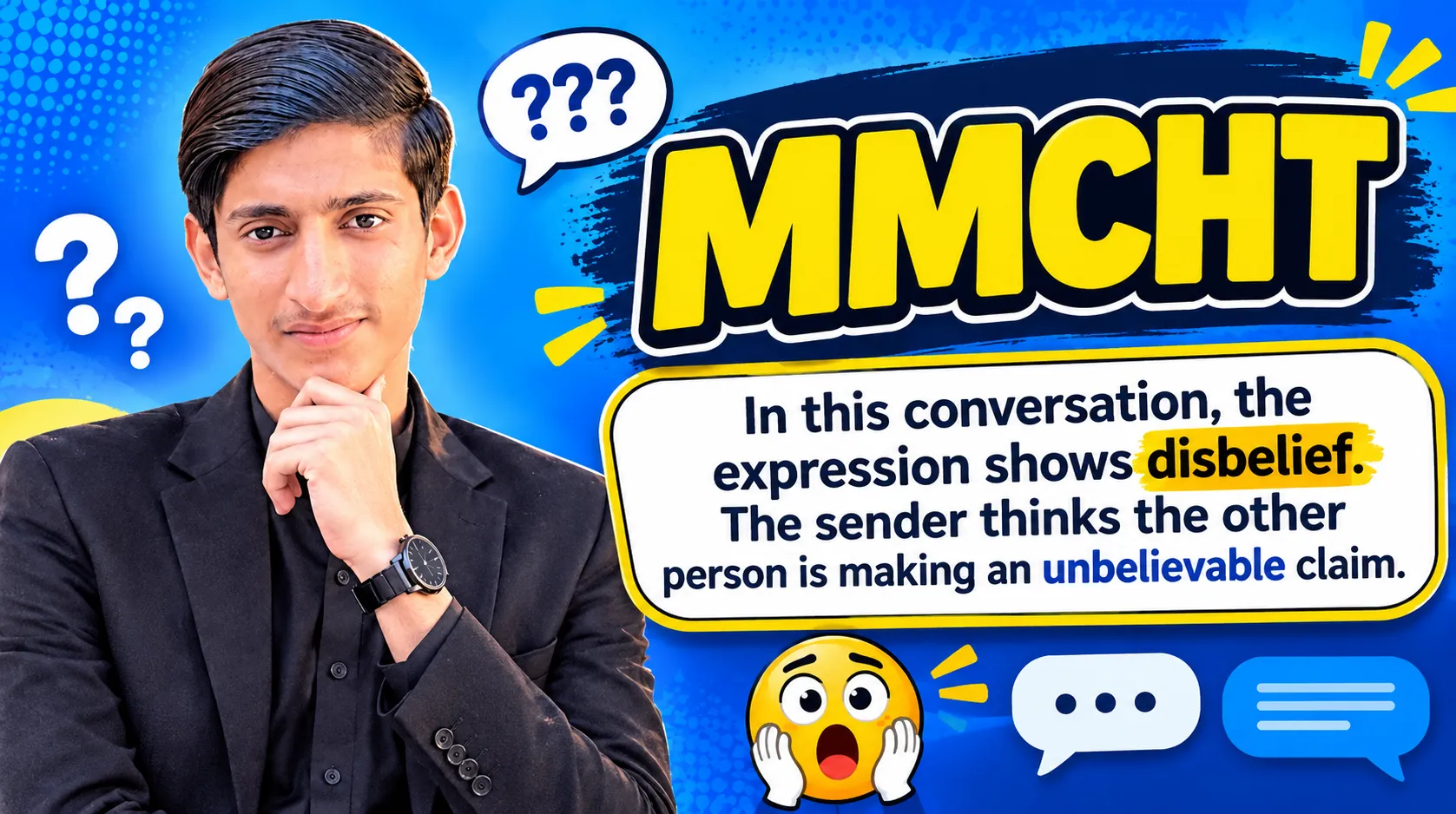
In this conversation, the expression shows disbelief. The sender thinks the other person is making an unbelievable claim.
The key point is that MMCHT does not always mean the same thing emotionally. The words around it, the relationship between the people, and the way it is written all help explain its meaning.
The Most Common Meanings of “MMCHT”
MMCHT does not have several confirmed, standard full forms. Instead, it can express different feelings depending on how someone uses it. Here are the most common interpretations.
1. Disbelief or Surprise
One common use of MMCHT is to show that someone does not believe what another person has said.
Imagine your friend tells you something that sounds impossible. You might type “mmcht” to show that you are surprised or doubtful.
Example:
Friend: I finished all my homework in five minutes.
You: MMCHT, all of it?
In this case, MMCHT means something like “Really?” or “I find that hard to believe.”
It can be a playful reaction rather than a serious accusation. Friends often use expressions like this when joking with each other.
2. Annoyance or Frustration
MMCHT can also show that someone is irritated. The expression may suggest that the person is tired of hearing excuses or dealing with a repeated problem.
Example:
Person A: I forgot to bring your book again.
Person B: Mmcht. You always do this.
Here, the sender sounds frustrated because the same problem has happened more than once.
The expression can communicate annoyance without using a long sentence. However, it may make the message sound more emotional or confrontational.
3. Disapproval or Disappointment
Sometimes, MMCHT is used when someone does not approve of another person’s words or actions.
It can show that the sender is unimpressed or thinks someone has made a poor choice.
Example:
Friend: I lied to my teacher so I could skip the test.
You: Mmcht, that was not a good idea.
The reaction suggests disapproval. It is similar to making a disapproving sound in a face-to-face conversation.
4. A Playful or Dramatic Reaction
MMCHT can also be used between friends for humor. The sender may not be truly angry. Instead, they may be acting shocked, teasing someone, or adding drama to a conversation.
Example:
Friend: I ate your fries while you were away.
You: MMCHT! You did not!
The expression adds a dramatic reaction. Both friends may understand that it is a joke.
This meaning is especially likely when the conversation is lighthearted and the people regularly tease each other.
How “MMCHT” Is Used in Real Conversations
The meaning of MMCHT can change with the situation. Here is how it may appear in different types of online conversations.
Friends & Casual Texting
Friends may use MMCHT when someone says something unbelievable, makes a silly excuse, or does something annoying.
Because friends often understand each other’s humor, the expression can be playful rather than insulting.
Example 1:
Alex: I woke up at noon and still feel tired.
Sam: MMCHT, what time did you sleep?
Example 2:
Mia: I told everyone I was ready, but I have not even taken a shower.
Zara: Mmcht, you are unbelievable.
In both examples, the expression adds attitude to the reply. The first sounds surprised, while the second sounds teasing.
If your friend sends MMCHT after you tell a story, consider the full conversation before assuming they are angry.
Instagram & Snapchat
On Instagram and Snapchat, MMCHT may appear in direct messages, story replies, or conversations about photos and posts.
Someone might use it to react to surprising news, an unexpected picture, or a statement they find hard to believe.
Example 1:
You: I finally met my favorite singer yesterday.
Friend: MMCHT, for real?
Example 2:
You: She said she never saw my message, but she replied to my story.
Friend: Mmcht, that is suspicious.
In the first example, the expression shows surprise. In the second, it communicates doubt or disbelief.
There is no separate, universally accepted Instagram or Snapchat definition for MMCHT. Its meaning comes from the way the sender uses it.
Dating Apps
In dating conversations, MMCHT can sound playful, doubtful, disappointed, or annoyed. The relationship and the topic matter more than the platform.
For example, someone might use it to react to a bold claim, a surprising confession, or an excuse that sounds unbelievable.
Example 1:
Person A: I am actually a great cook.
Person B: MMCHT, prove it!
This response sounds playful and may invite the other person to continue the conversation.
Example 2:
Person A: Sorry, I forgot we had plans again.
Person B: Mmcht. Okay.
This response may suggest frustration or disappointment.
MMCHT is not automatically a sign of romantic interest. If someone uses it while flirting, look at their other messages and the overall tone before deciding what they mean.
Gaming & Online Communities
In gaming chats and online communities, people often react quickly to surprising moves, unbelievable claims, or unexpected results.
MMCHT may be used as an informal reaction when a teammate makes a questionable decision or an opponent claims something that seems impossible.
Example 1:
Player A: I won that match without using any special abilities.
Player B: MMCHT, no way!
Example 2:
Player A: That was definitely not my fault.
Player B: Mmcht, sure.
The first example shows disbelief, while the second may sound sarcastic.
However, MMCHT is not a standard gaming command or a universal gaming acronym. Different groups may use it in their own ways.
Work or Professional Chat
MMCHT is generally not a good choice for formal work messages. It can sound dismissive, sarcastic, or disrespectful, especially when discussing a mistake or disagreement.
For example:
Coworker: I forgot to send the report.
Reply: MMCHT.
This reply does not clearly explain the problem and may make the coworker feel judged.
A more professional response would be:
“Thanks for letting me know. Please send the report as soon as possible.”
If you see MMCHT in a workplace chat, do not assume it has a formal business meaning. It may simply be an informal reaction between colleagues who know each other well.
Is “MMCHT” Rude, Flirty, or Offensive?
MMCHT is not automatically rude, flirty, or offensive. Its tone depends on the situation and the sender’s intention.
When MMCHT Sounds Rude
It may sound rude when someone uses it to dismiss another person’s opinion, show strong disapproval, or express irritation.
For example:
Person A: I worked hard on this project.
Person B: Mmcht. You could have done better.
Here, the response sounds judgmental because it dismisses the other person’s effort.
It can also feel disrespectful when someone uses it during a serious conversation instead of explaining what is bothering them.
When MMCHT Sounds Playful
Among close friends, MMCHT may be a joking reaction to a silly story, an unbelievable claim, or a harmless mistake.
For example:
Friend A: I am the best singer in the world.
Friend B: MMCHT, who told you that?
This response is teasing rather than seriously insulting. The friends’ relationship helps establish the tone.
When MMCHT Sounds Flirty
MMCHT is not a standard flirting abbreviation. However, someone may use it playfully in a romantic conversation to tease the other person or react to a bold statement.
For example:
Person A: You know you missed me.
Person B: MMCHT, who said that?
This could be playful flirting if both people already have a teasing relationship. It could also be a simple expression of disbelief.
Do not treat MMCHT alone as proof that someone likes you.
Why Context Matters
The same expression can communicate different feelings depending on the situation. A short reply may seem harmless to one person but dismissive to another.
Before judging the tone, consider:
- What was said before MMCHT?
- Is the conversation serious or playful?
- Does the sender often tease you?
- Did the message follow an argument or disagreement?
- Does the sender usually communicate in a dramatic way?
These clues can help you understand the message without jumping to conclusions.
How to Respond When Someone Says “MMCHT”
If someone sends you MMCHT, you do not need to overthink it. Choose a reply that fits your relationship and the conversation.
Casual Replies
Use these when you are chatting with friends and want to keep the conversation going.
- “What do you mean?”
- “Why are you making that sound?”
- “Wait, what?”
- “You do not believe me?”
- “Tell me what is wrong.”
Example:
Friend: MMCHT.
You: What? I did not even say anything!
Funny Replies
If the conversation is playful, a humorous answer can keep things light.
- “Here we go again.”
- “I can explain!”
- “Why are you judging me?”
- “Let me defend myself.”
- “You have so much to say without words.”
Example:
Friend: MMCHT, you ate my last slice of pizza.
You: I plead not guilty.
Use a funny reply only when you are reasonably sure the other person is joking.
Neutral Replies
If you are unsure about the tone, ask a simple question instead of guessing.
- “What do you mean by that?”
- “Are you serious?”
- “Did I do something wrong?”
- “Is something bothering you?”
- “Can you explain?”
Example:
Person: Mmcht.
You: Is something wrong, or are you joking?
This gives the other person a chance to explain what they meant.
Professional Replies
If MMCHT appears in a work-related conversation, focus on the actual issue instead of responding with more slang.
- “Could you clarify your concern?”
- “Is there something you would like me to address?”
- “Please let me know if there is a problem.”
- “I am happy to discuss this further.”
Example:
Coworker: MMCHT.
You: Could you clarify what concerns you about the report?
A clear response helps prevent a casual expression from turning into a workplace misunderstanding.
Common Misunderstandings About “MMCHT”
Because MMCHT is informal and does not have one fixed full form, people can easily misunderstand it. Here are some common mistakes to avoid.
Assuming It Is a Standard Acronym
Not every group of capital letters stands for a sentence. MMCHT is commonly used as a written reaction sound, not as an acronym with one confirmed expansion.
Avoid inventing a full form unless the sender or a specific community has explained one.
Thinking It Always Means Anger
MMCHT can show annoyance, but it can also express surprise, disbelief, disappointment, or playful disbelief.
For example, “MMCHT, no way!” may sound amused or surprised rather than angry.
Assuming It Is Always Flirting
Some people use MMCHT while teasing someone they like. However, it does not automatically show attraction or romantic interest.
Look at the rest of the conversation before deciding that the sender is flirting.
Confusing It With Similar Expressions
MMCHT may feel similar to “tsk,” “smh,” or “seriously?” because these expressions can communicate disapproval or disbelief.
However, they are not identical. MMCHT represents a mouth- or teeth-smacking reaction, while other expressions have their own common meanings.
Ignoring the Relationship
A close friend may use MMCHT as a joke, while someone you barely know may use it to show disapproval.
The relationship between the sender and receiver can make a big difference in how the message feels.
Similar Slang Terms You Should Know
These common texting expressions can help you understand messages that show surprise, disbelief, annoyance, or disapproval.
- SMH: Shaking my head; often used to show disappointment or disbelief.
- Tsk: A written representation of a sound that can express disapproval or annoyance.
- LOL: Laughing out loud; often used to show amusement.
- OMG: Oh my God; used to express surprise, excitement, or shock.
- WTF: What the heck or a stronger version of the phrase; expresses shock, confusion, or anger.
- FR: For real; used to show agreement or ask whether something is true.
- IDK: I don’t know; expresses uncertainty.
- TBH: To be honest; introduces an honest opinion or statement.
- ISTG: I swear to God; used to add emphasis, frustration, or seriousness.
- BRUH: An informal reaction to something surprising, frustrating, or ridiculous.
- SMDH: Shaking my damn head; expresses stronger disappointment or disbelief.
- NGL: Not gonna lie; introduces an honest thought or opinion.
These expressions are more widely recognized in everyday texting than MMCHT. However, their exact tone can still change with the conversation.
When You Should Avoid Using “MMCHT”
Although MMCHT can be useful in casual conversations, there are times when it is better to choose clearer words.
Professional Settings
Avoid using MMCHT in emails, job applications, formal group chats, client messages, and serious workplace discussions.
The expression may make you sound dismissive without explaining your concern.
Instead of writing:
“MMCHT, this report is wrong.”
Write:
“I noticed a few issues in the report. Could we review them together?”
This makes your point clear and respectful.
Cross-Cultural Chats
People from different backgrounds may not recognize MMCHT or understand the sound it represents. Even if they know the expression, they may interpret it differently.
If you are chatting with someone unfamiliar with this slang, use direct language to avoid confusion.
For example, instead of replying “Mmcht,” you could say, “I am surprised by that” or “I am not sure I agree.”
Sensitive Situations
Avoid using MMCHT when someone is sharing personal problems, discussing a serious mistake, or asking for support.
A teeth-smacking reaction can sound judgmental when the other person needs understanding.
For example, if a friend says they are having a difficult day, replying with MMCHT may make them feel ignored.
A more caring response would be:
“I am sorry you are going through that. Do you want to talk about it?”
The best choice depends on what the other person needs from the conversation.
FAQs
What does MMCHT mean in text?
MMCHT usually represents a teeth-smacking or lip-smacking sound. It can show disbelief, annoyance, disapproval, or surprise, depending on the conversation.
What is the full form of MMCHT?
MMCHT does not have one widely accepted full form. It is generally used as a written reaction sound rather than a standard acronym that stands for a fixed sentence.
What does MMCHT mean on TikTok?
On TikTok, MMCHT may be used as a reaction to something unbelievable, annoying, questionable, or surprising. The exact meaning depends on the video, comment, and conversation.
Is MMCHT rude in text messages?
It can sound rude if it is used to dismiss someone or express strong disapproval. Between close friends, it may simply be playful teasing.
What does MMCHT mean from a girl?
The basic meaning does not change based on gender. A girl may use MMCHT to show disbelief, annoyance, disappointment, or playful attitude. The surrounding conversation helps explain her intention.
Does MMCHT mean someone is flirting?
Not necessarily. It may be used in a playful or flirty conversation, but the expression alone does not prove romantic interest. Consider the person’s other messages and behavior.
How should I reply when someone texts MMCHT?
You can ask, “What do you mean?” or “Are you serious?” If the conversation is playful, you can respond with a joke. If it seems serious, ask whether something is wrong.
Final Thoughts.
MMCHT is an informal texting expression that usually represents a teeth-smacking or lip-smacking sound. People use it to show disbelief, annoyance, disapproval, disappointment, or a dramatic reaction.
Its meaning is not based on one fixed sentence. Instead, it depends on what happened in the conversation and how the sender wants to sound. Between friends, it can be funny and playful. During an argument, it may sound dismissive or rude. In a romantic conversation, it may be teasing, but it does not automatically mean flirting.
If someone sends you MMCHT, look at the surrounding messages before deciding how to respond. When the meaning is unclear, asking a simple question is usually the best choice.
Understanding expressions like MMCHT can make online conversations easier. You do not need to memorize every slang term. Just pay attention to context, consider the other person’s feelings, and use clear language whenever a message could be misunderstood.

Ethan Parker is a creative content writer passionate about pets, animals, and unique name ideas. He loves creating fun and engaging content that helps readers discover the perfect names with ease.