
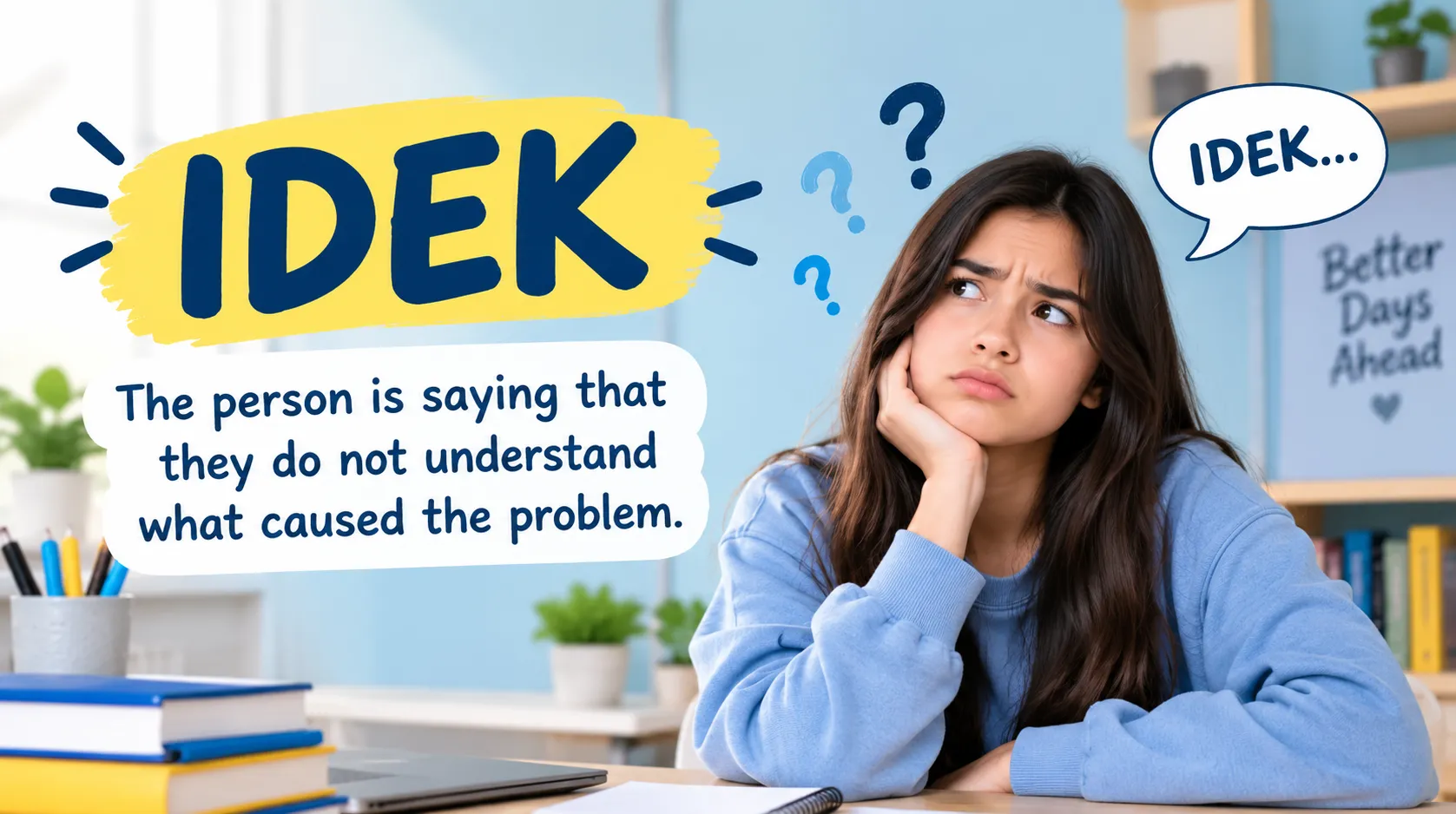
When someone sends you a message like “idek what happened” or simply “IDK,” it can be easy to wonder what they mean. If you see IDEK for the first time, you may not know whether it is a typo, a joke, or another piece of internet slang.
People often search what does idek mean in text because texting slang can change quickly. Short words and phrases are common on social media, messaging apps, gaming chats, and online communities.
IDEK is one of those short forms that can make a message look confusing at first.
The good news is that IDEK is simple once you know the words behind it. It usually adds a stronger feeling to the common abbreviation “IDK.”
The exact feeling can change based on the conversation, the person using it, and the words around it.
In this guide, you will learn what IDEK means, how people use it, what tone it can have, how to respond, and when it may be better to avoid it. You will also see simple examples that make the meaning clear.
What Does “What Does IDEK Mean in Text?” Mean in Text?
IDEK usually means “I Don’t Even Know” in text messages. It is an informal slang abbreviation used when someone does not know an answer, feels confused, or does not understand something. It can also show surprise, frustration, disbelief, or uncertainty. In some conversations, it simply means the person has no idea what is happening.
The main meaning is:
- I Don’t Even Know — the most common meaning.
- I have no idea — used to show strong uncertainty.
- I am confused — used when something does not make sense.
- I really do not know — can add extra emotion to “IDK.”
For example:
“IdeK why she left.”
This means:
“I don’t even know why she left.”
The word “even” gives the phrase a little more emotion than the shorter “IDK.”
The Most Common Meanings of “IDEK”
I Don’t Even Know
This is the standard meaning of IDEK.
Someone may use it when they genuinely do not know the answer to a question. The word “even” adds emphasis, making the uncertainty sound stronger.
Example:
“What time does the movie start?”
“IDEK.”
Here, the person simply does not know.
I Have No Idea
IDEK can also express “I have no idea.” This meaning is very common when someone is unsure about a situation.
Example:
“Why is the website not working?”
“IDEK. It was fine five minutes ago.”
The person is saying that they do not understand what caused the problem.
I’m Really Confused
Sometimes IDEK is less about missing information and more about confusion.
Example:
“Everyone suddenly started leaving. IDEK what’s going on.”
The person may have seen what happened but still cannot understand why it happened.
I Don’t Even Know What to Say
In some conversations, IDEK can show that someone is emotionally unsure about what to say.
Example:
“He apologized after everything he did. IDEK.”
The person may not literally be asking a question. Instead, IDEK shows that they are shocked, confused, or unable to explain their feelings.
Strong Uncertainty or Frustration
IDEK can also make uncertainty sound stronger than plain “IDK.”
Compare these:
“IDK what happened.”
and:
“IDEK what happened.”
The second version can sound more emotional. It may suggest that the situation is especially confusing.
The meaning still depends on context. IDEK does not automatically mean the person is angry or upset.
How “IDEK” Is Used in Real Conversations
Friends & Casual Texting
IDEK is very common between friends because it is informal and quick to type.
Friends may use it when talking about plans, people, school, entertainment, or random daily events.
Example:
“Are we still going out tonight?”
“IDEK. Nobody has confirmed yet.”
Another example:
“Why did Sam delete that post?”
“IDEK lol.”
In this type of conversation, IDEK usually has a relaxed tone. It does not need to be taken too seriously.
People may also write it in lowercase as idek. Lowercase texting is common and usually does not change the meaning.
Instagram & Snapchat
IDEK is also used on social media platforms such as Instagram and Snapchat.
Someone might use it in a direct message, story reply, comment, or private conversation.
Example:
“Which picture should I post?”
“IDEK, they both look good.”
Here, the person is simply unsure which choice is better.
It can also appear in captions or replies:
“IDEK how this happened.”
This could express surprise about something unexpected.
Because social media conversations are usually informal, abbreviations such as IDEK fit naturally there.
Dating Apps
People may use IDEK while chatting on dating apps when they are unsure about a person, a plan, or a situation.
Example:
“Are you still interested in meeting this weekend?”
“IDEK yet. My schedule is crazy.”
In this example, IDEK shows uncertainty. It does not automatically mean “no.”
Another example is:
“IDEK what to think about that.”
This could mean the person is unsure how to understand something that happened during the conversation.
When dating, context matters a lot. A short “IDEK” may sound different from “IDEK haha” or “IDEK anymore.” The extra words can change the emotional tone.
Gaming & Online Communities
Gamers and members of online communities often use short abbreviations to communicate quickly.
IDEK may appear in game chats, Discord conversations, forums, or group messages.
Example:
“Where did the boss go?”
“IDEK.”
Another example:
“IDEK how we won that match.”
Here, IDEK may show surprise rather than confusion.
The player knows the team won but is surprised by how it happened.
Work or Professional Chat
IDEK is sometimes used in workplace messaging, especially in very casual teams. However, it is not usually the best choice for formal communication.
For example, a close team might have a casual chat like:
“Do we have the updated file?”
“IDEK. Maybe ask Alex.”
Friends or coworkers who know each other well may understand this easily.
However, in an email to a manager, customer, client, or business partner, it is better to write:
“I’m not sure.”
or:
“I don’t have that information yet.”
Professional communication usually benefits from clear language rather than internet abbreviations.
Is “IDEK” Rude, Flirty, or Offensive?
IDEK is not normally rude, flirty, or offensive by itself. It is mainly a casual abbreviation for “I don’t even know.”
Its tone depends on the surrounding words and the relationship between the people.
For example:
“IDEK haha, maybe ask her.”
This sounds casual and friendly.
But:
“IDEK. Figure it out yourself.”
can sound annoyed or dismissive.
The abbreviation has not changed. The rest of the message changed the tone.
When IDEK Feels Positive
IDEK can feel light or playful when used with friendly wording.
Example:
“IDEK 😂 that was so random.”
In a casual chat, the person may simply be laughing at a strange situation.
When IDEK Feels Negative
IDEK may sound negative when it is sent as a very short reply during an argument.
Example:
“Why did you do that?”
“IDEK.”
Depending on the conversation, the answer could sound frustrated, tired, or dismissive.
Can IDEK Be Flirty?
IDEK is not naturally a flirty abbreviation. However, someone can use it inside a flirty conversation.
For example:
“IDEK why I keep smiling when you text me.”
The phrase itself still means “I don’t even know,” but the full sentence has a romantic tone.
This is an important point: slang does not always carry the entire emotional meaning of a message. Context does.
How to Respond When Someone Says “IDEK”
Your response should depend on what the person is talking about.
Casual Replies
If a friend says:
“IDEK what we should do tonight.”
You could say:
“Same. Let’s decide later.”
Or:
“No idea here either.”
Funny Replies
If the conversation is playful, you can respond with humor.
For example:
“IDEK either. We’re both lost.”
Or:
“Well, that makes two of us.”
A funny reply works best when the original conversation is already relaxed.
Neutral Replies
If you want to keep things simple:
“No worries.”
or:
“That’s okay. We can check.”
This works when you do not want to add much emotion.
Professional Replies
If someone uses IDEK in a work conversation, you can still reply clearly.
For example:
“No problem. I’ll check and let you know.”
Or:
“Thanks. I’ll find out.”
You do not need to copy their slang. Clear language is often better in professional settings.
Common Misunderstandings About “IDEK”
Thinking IDEK Is a Typo
A person seeing IDEK for the first time may think it is a typing mistake.
It is not usually a typo. It is a common texting abbreviation meaning “I Don’t Even Know.”
Thinking IDEK Means Only “I Don’t Know”
IDEK is close to IDK, but the word “even” can add emphasis.
IDK:
“I don’t know.”
IDEK:
“I don’t even know.”
The second can sound more strongly uncertain or confused.
Assuming the Person Is Angry
A short IDEK does not automatically mean anger.
For example:
“IDEK what happened lol.”
This can be completely casual.
Look at the entire message and the conversation before deciding what emotion the person has.
Assuming IDEK Is Always Negative
IDEK can be neutral, funny, surprised, confused, or frustrated.
The surrounding words usually give you the strongest clue.
Confusing IDEK With Similar Slang
People sometimes confuse IDEK with other abbreviations such as IDK, IDC, or IKR.
These have different meanings:
- IDK = I don’t know.
- IDEK = I don’t even know.
- IDC = I don’t care.
- IKR = I know, right?
Knowing the difference can help you avoid misunderstanding a message.
Similar Slang Terms You Should Know
IDK — Means “I don’t know.” It shows that someone does not have an answer.
IDC — Means “I don’t care.” It shows a lack of concern or interest.
IKR — Means “I know, right?” It shows strong agreement with something another person said.
TBH — Means “to be honest.” It is often used before a personal or direct opinion.
NGL — Means “not gonna lie.” It is used when someone wants to make a statement sound honest or direct.
IMO — Means “in my opinion.” It shows that the following statement is a personal view.
IDRC — Means “I don’t really care.” It is similar to IDC but can sound slightly less direct.
WYM — Means “what you mean?” or “what do you mean?” It is used when someone does not understand a message.
FR — Means “for real.” It is often used to show agreement or emphasize that something is true.
SMH — Means “shaking my head.” It can show disappointment, disbelief, or frustration.
IK — Means “I know.” It is often used as a quick response to show that someone already understands.
LMAO — Means “laughing my ass off.” It is used online to show strong amusement.
When You Should Avoid Using “IDEK”
IDEK is useful in casual texting, but it is not suitable for every situation.
Professional Settings
Avoid IDEK in formal emails, job applications, business proposals, customer support messages, and important workplace communication.
Instead of:
“IDEK what happened.”
write:
“I’m not sure what happened.”
Instead of:
“IDEK where the file is.”
write:
“I’m not sure where the file is, but I’ll check.”
This sounds clearer and more professional.
Cross-Cultural Chats
Not everyone understands English texting slang.
If you are speaking with someone who is learning English, IDEK may create confusion.
Using the full phrase “I don’t know” or “I’m not sure” can make your meaning easier to understand.
This is especially useful when the conversation involves important information.
Sensitive Situations
Be careful with short slang replies during serious conversations.
If someone is discussing a personal problem, loss, conflict, or another sensitive topic, replying only with:
“IDEK.”
may seem cold even if you did not mean it that way.
A fuller response can show more care.
For example:
“I honestly don’t know what to say, but I’m here for you.”
This gives the other person more context and emotional support.
FAQs
What does IDEK mean in text?
IDEK usually means “I Don’t Even Know.” People use it in casual texts and online chats when they do not know something or feel confused about a situation.
What is the difference between IDK and IDEK?
IDK means “I don’t know,” while IDEK means “I don’t even know.” IDEK can add more emphasis and may suggest stronger confusion or uncertainty.
Is IDEK a bad word?
No. IDEK is not a bad word or offensive term. It is an informal abbreviation. Its tone depends on the conversation and the words around it.
What does IDEK mean on Snapchat?
On Snapchat, IDEK normally means “I don’t even know.” It is often used in casual messages when someone is confused, unsure, or does not have an answer.
Can IDEK be used in a romantic conversation?
Yes. IDEK can appear in romantic or dating conversations, but it is not a romantic abbreviation by itself. The surrounding message gives it the romantic meaning.
Is IDEK the same as IDC?
No. IDEK means “I don’t even know,” while IDC means “I don’t care.” They express different ideas and should not be treated as the same abbreviation.
Should I use IDEK in professional messages?
Usually, no. IDEK is informal internet slang. In professional messages, phrases such as “I’m not sure” or “I don’t have that information yet” are clearer and more appropriate.
Final Thoughts.
IDEK is a simple texting abbreviation that usually means “I Don’t Even Know.” People use it when they do not know an answer, feel confused, or want to show stronger uncertainty.
It is common in casual conversations, social media messages, gaming chats, and dating conversations. The meaning is usually easy to understand once you look at the context.
IDEK is not automatically rude, negative, or offensive. A short message can sometimes sound cold, but the real tone depends on the situation, relationship, and words around it.
The easiest way to remember it is:
IDEK = I Don’t Even Know.
If someone sends you “IDEK,” they are usually saying that they have no idea or are unsure about something. When you are texting friends, the abbreviation is perfectly natural. For work, formal messages, or serious conversations, using complete words can make your meaning clearer.
Understanding small slang terms like IDEK can make online conversations much easier. Instead of guessing what a message means, you can look at the abbreviation, check the context, and understand the feeling behind it.

Ethan Parker is a creative content writer passionate about pets, animals, and unique name ideas. He loves creating fun and engaging content that helps readers discover the perfect names with ease.