
You get a text that says, “idc,” and you may wonder what the person really means. Are they angry? Do they truly not care? Or are they simply using a short way to answer? This is why many people search what does idc mean in text when they see it in a message, comment, or social media post.
In most everyday chats, IDC means “I don’t care.” It is a common texting abbreviation used to show that someone does not care about a choice, topic, result, or situation. However, the feeling behind it can change based on the conversation.
For example, “idc where we eat” may sound relaxed, while “idc what you think” can sound rude or dismissive. The same three letters can therefore have different emotional effects.
This guide explains what IDC means, how people use it, when it sounds rude, and how to respond. By the end, you will know exactly what someone means when they text “idc.”
What Does “What Does IDC Mean in Text” Mean in Text?
IDC means “I don’t care” in text messages. People use it when they want to say that something does not matter to them or that they have no strong preference. Depending on context, IDC can sound casual, neutral, annoyed, dismissive, or slightly rude. It is common in texting, social media, gaming, and casual online chats.
The most common interpretation is:
- I don’t care — the standard meaning.
- I have no preference — used when either choice is fine.
- It does not matter to me — often neutral.
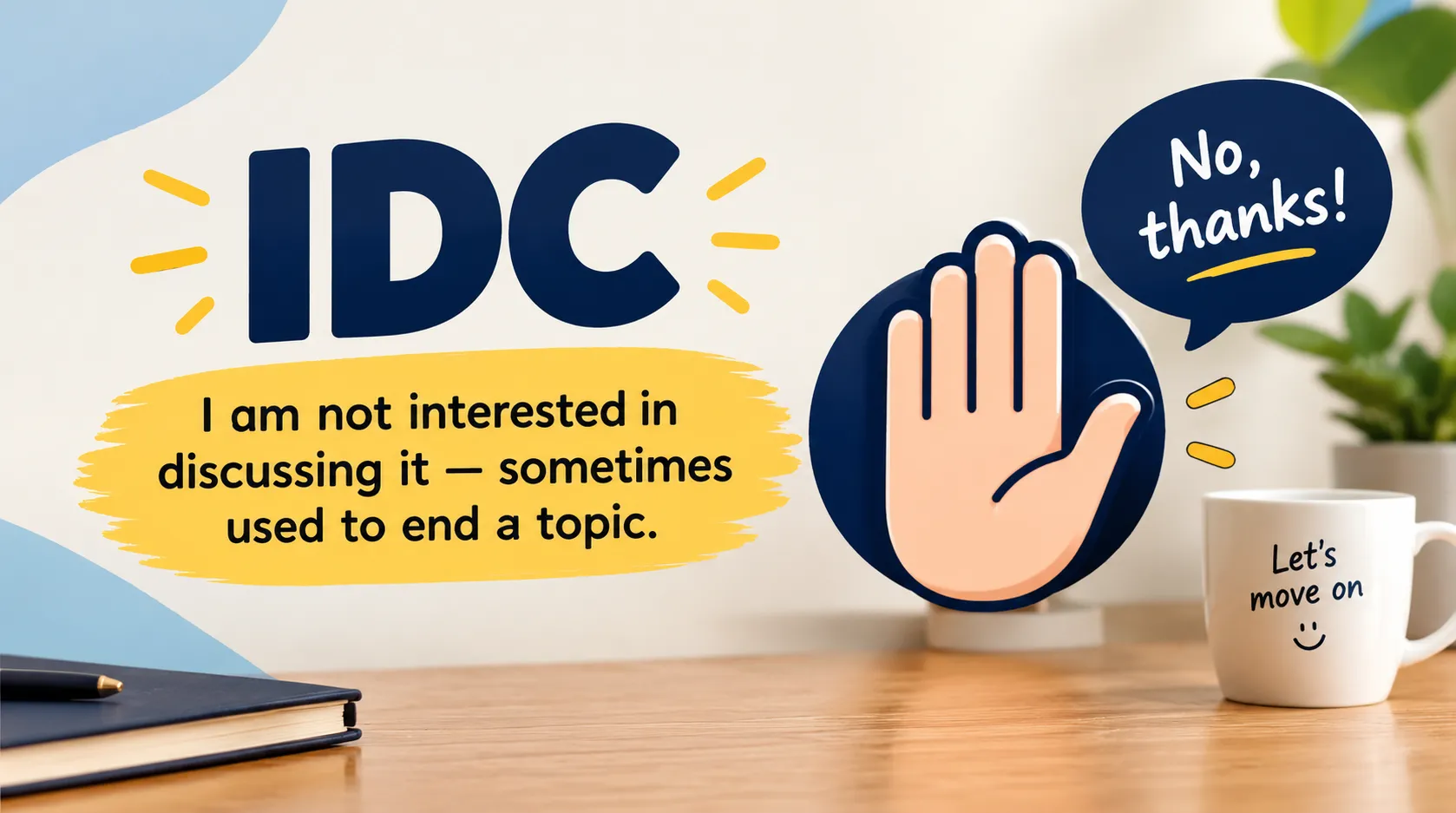
- I am not interested in discussing it — sometimes used to end a topic.
The surrounding words and the relationship between the people usually tell you which meaning is intended.
The Most Common Meanings of “What Does IDC Mean in Text”
1. I Don’t Care
The main meaning of IDC is “I don’t care.”
Someone may use it when they do not have an opinion about something or do not think the subject is important.
Example:
“Do you want pizza or burgers?”
“idc, you choose.”
Here, IDC is not necessarily rude. The person is simply saying that either option is fine.
2. I Have No Preference
IDC can also mean that someone is happy with any option.
This use is common when making plans with friends.
Example:
“What movie should we watch?”
“idc, pick one.”
The person is not saying that they dislike the movie choices. They are saying that they do not mind which one you select.
3. It Does Not Matter to Me
Sometimes IDC means something similar to “it doesn’t matter to me.”
This can be a calm and simple response.
Example:
“Should we go at 6 or 7?”
“idc, either time works.”
The meaning here is closer to “I’m fine with either.”
4. I Don’t Want to Talk About It
In some conversations, IDC is used to show that the person wants to stop talking about a subject.
Example:
“Why did you delete the message?”
“idc. Forget it.”
Here, IDC may carry frustration or annoyance. The meaning is not simply about having no preference. It can signal that the person does not want to continue the discussion.
5. A Dismissive Response
IDC can sometimes dismiss another person’s opinion.
Example:
“Everyone thinks you made the wrong choice.”
“idc what they think.”
This sounds stronger than “either choice is fine.” It shows that the speaker does not want other people’s opinions to affect them.
6. A Sign of Frustration
The meaning of IDC can become emotional when someone is already upset.
Example:
“You never listen to me.”
“idc anymore.”
This may suggest emotional tiredness, anger, or frustration.
The exact meaning depends on the complete conversation, not just the abbreviation.
How “What Does IDC Mean in Text” Is Used in Real Conversations
Friends & Casual Texting
IDC is very common between friends because casual conversations often use short forms.
Friends may use it when making plans, choosing food, talking about entertainment, or discussing small decisions.
Example:
Friend: “Beach or mall?”
You: “idc, both sound good.”
In this situation, IDC is usually harmless.
Another example:
“idc what we eat tonight.”
This can simply mean that the person wants the other person to choose.
However, punctuation can change the tone.
Compare:
“idc lol”
with:
“IDC.”
The first may feel relaxed or playful. The second may feel more serious or cold.
Instagram & Snapchat
On Instagram and Snapchat, IDC can appear in DMs, comments, captions, replies, and private conversations.
Someone might reply:
“idc what people say.”
This means the person is saying that other people’s opinions do not affect them.
You may also see IDC in discussions about photos, trends, outfits, relationships, or social situations.
Example:
“People are going to talk.”
“idc honestly.”
Here, the person is showing confidence or a lack of concern.
Still, you should not assume that every IDC message is aggressive. Social media users often shorten phrases simply because texting is faster.
Dating Apps
IDC can appear in dating conversations, but tone matters more here because the people may not know each other well.
For example:
“Where do you want to go?”
“idc, you pick.”
This can mean the person is flexible.
But:
“Do you actually want to meet?”
“idc.”
would sound much colder.
In dating, a short IDC reply may be read as a lack of interest even when that was not the sender’s intention.
If you want to avoid confusion, a longer response such as “I’m good with whatever you choose” is clearer.
Gaming & Online Communities
Gamers and online communities often use short abbreviations because conversations move quickly.
IDC may be used when discussing a game choice, team, character, strategy, or another player’s opinion.
Example:
“Which map do you want?”
“idc.”
This usually means the player has no preference.
It can also be used during arguments:
“You should have used a different character.”
“idc, I had fun.”
In this case, the speaker is saying that they are not worried about the criticism.
Because gaming chats can be fast and direct, IDC may sound less serious than it would in a personal conversation.
Work or Professional Chat
IDC is understood in professional environments, but it is usually better to avoid it.
A message like:
“idc which file you use”
could sound careless or disrespectful.
A better version would be:
“Either file works for me.”
Or:
“I’m fine with whichever option you prefer.”
The meaning stays almost the same, but the tone is more professional.
IDC is mainly a casual texting abbreviation. In workplace communication, clear and polite wording is safer.
Is “What Does IDC Mean in Text” Rude, Flirty, or Offensive?
IDC is not automatically rude, flirty, or offensive. Its tone depends heavily on context.
When IDC Sounds Neutral
IDC can be completely neutral when someone has no preference.
Example:
“Tea or coffee?”
“idc, either is fine.”
There is little negative feeling here.
When IDC Sounds Rude
IDC can sound rude when it dismisses someone’s feelings or opinion.
Example:
“I spent hours working on this for you.”
“idc.”
This response may feel harsh because the speaker appears to ignore the other person’s effort.
Another example:
“Your comments hurt me.”
“idc.”
Here, IDC can sound dismissive because it rejects the emotional concern.
When IDC Sounds Angry
Repeated or capitalized IDC can make the tone stronger.
For example:
“IDC. Stop asking me.”
This clearly sounds frustrated.
Capital letters do not always mean anger, but in short messages they can make the response feel more forceful.
Is IDC Flirty?
IDC itself is not a flirty abbreviation.
However, a person can use IDC in a playful or teasing conversation.
For example:
“You choose the restaurant.”
“idc, as long as I’m with you.”
The romantic meaning comes from the full sentence, not from IDC itself.
Is IDC Offensive?
IDC is not normally considered a swear word or an offensive abbreviation. However, it can be hurtful when used to dismiss someone’s feelings, concerns, or opinions.
The same words can therefore feel harmless in one conversation and disrespectful in another.
How to Respond When Someone Says “What Does IDC Mean in Text”
Your response should depend on the situation and the person’s tone.
Casual Replies
If a friend says:
“idc, you choose.”
You can reply:
“Okay, I’ll pick.”
Or:
“Cool, I’ve got it.”
These responses keep the conversation simple.
Funny Replies
If your friend is clearly joking, you can answer playfully:
“Wow, such strong feelings.”
Or:
“Your decision-making skills are impressive.”
A funny reply works best when you already know the person’s sense of humor.
Neutral Replies
If you are not sure what they mean, ask directly:
“Do you mean either option is fine?”
This is useful because IDC can sometimes sound cold.
You can also say:
“No problem. I’ll decide.”
Professional Replies
If IDC appears in a work-related conversation, stay calm and focus on the actual decision.
For example:
“Understood. I’ll go with the first option.”
Or:
“Thanks. I’ll choose the option that fits the project.”
There is no need to copy the informal tone.
If IDC Feels Rude
If someone says IDC after you share something important, you can calmly ask:
“Are you saying it doesn’t matter, or would you rather not discuss it?”
This gives the other person a chance to explain.
Common Misunderstandings About “What Does IDC Mean in Text”
Assuming IDC Always Means Anger
Not every IDC message is angry.
“idc where we sit.”
may simply mean the person has no preference.
Always consider what was being discussed before deciding that someone is upset.
Thinking IDC Means “I Hate This”
IDC does not normally mean “I hate this.”
If someone says:
“idc what movie we watch,”
they may be fine with every option.
“I hate this” would express a much stronger opinion.
Confusing IDC With IDK
IDC and IDK are different.
- IDC = I don’t care
- IDK = I don’t know
For example:
“Where should we go?”
“idc.”
means the person has no preference.
But:
“Where should we go?”
“idk.”
means the person does not know what to choose or where to go.
Confusing IDC With IDGAF
IDGAF also expresses a lack of concern, but it is much stronger and contains profanity.
IDC is generally less aggressive.
Assuming Short Replies Are Always Negative
Some people naturally use very short messages.
Someone who sends “idc” may simply prefer quick texting. Look at their normal communication style before reading too much emotion into one abbreviation.
Ignoring the Rest of the Message
The words around IDC are important.
Compare:
“idc, anything is fine.”
and:
“idc, do whatever you want.”
The first sounds more relaxed. The second can sound annoyed or dismissive.
Similar Slang Terms You Should Know
IDK
IDK means “I don’t know.” It shows uncertainty or a lack of information.
IDC
IDC means “I don’t care.” It shows a lack of concern or preference.
IDGAF
IDGAF means “I don’t give a f***.” It is a much stronger and more vulgar way to express that you do not care.
TBH
TBH means “to be honest.” It is often used before a personal or honest opinion.
NGL
NGL means “not gonna lie.” People use it before saying something they want to present as honest.
IMO
IMO means “in my opinion.” It introduces a personal view.
IMHO
IMHO means “in my humble opinion.” It is another way to introduce an opinion, often with a softer tone.
IDTS
IDTS usually means “I don’t think so.” It shows disagreement or doubt.
Whatever
Whatever can mean that someone does not care or has no preference, but it can sound dismissive depending on tone.
Meh
Meh shows that someone feels neutral, unimpressed, or not very interested.
IKR
IKR means “I know, right?” It is used to agree strongly with another person’s statement.
When You Should Avoid Using “What Does IDC Mean in Text”
Professional Settings
Avoid IDC in formal emails, business messages, customer support, interviews, and important workplace discussions.
Instead of:
“idc which one.”
write:
“Either option works for me.”
This sounds clearer and more respectful.
Cross-Cultural Chats
Not everyone interprets texting abbreviations in the same way.
Someone who is still learning English may understand “I don’t care” as a much stronger statement than you intended.
If the conversation is important, use the full sentence.
Sensitive Situations
Avoid IDC when someone is discussing grief, relationships, serious problems, personal feelings, or other sensitive subjects.
For example, if someone tells you:
“I’m really worried about what happened.”
Responding with “idc” can be deeply dismissive.
Even if you mean “I don’t know what to say,” IDC does not communicate that meaning.
When You Need to Be Clear
Short slang is useful when the meaning is obvious. But when there could be confusion, write the complete thought.
Instead of:
“idc.”
try:
“I don’t have a preference.”
That removes much of the possible negative tone.
FAQs
What does IDC mean in text?
IDC usually means “I don’t care.” It can mean that someone has no preference or that something does not matter to them.
Is IDC rude in texting?
IDC is not always rude. It can be neutral when someone has no preference, but it may sound rude when used to dismiss another person’s feelings or opinion.
What does IDC mean from a girl?
IDC has the same basic meaning regardless of who sends it: “I don’t care.” The tone depends on the conversation and the words around it.
What does IDC mean from a guy?
It generally means “I don’t care.” It could show no preference, lack of interest, frustration, or dismissal depending on the context.
What is the difference between IDC and IDK?
IDC means “I don’t care,” while IDK means “I don’t know.” IDC describes a lack of concern; IDK describes a lack of knowledge.
Is IDC a bad word?
No. IDC is not a swear word. However, saying “I don’t care” can still sound rude or hurtful in certain situations.
Can IDC be used in professional messages?
It is better to avoid IDC in professional communication. Phrases such as “Either option works for me” sound clearer and more respectful.
Final Thoughts
So, what does IDC mean in text? In most cases, IDC means “I don’t care.” It is a common texting abbreviation used when someone has no preference, does not feel concerned about something, or does not want to focus on a topic.
The important part is the context. “idc, you choose” can be completely casual, while “idc what you think” can sound dismissive. The relationship between the people, the subject being discussed, and the rest of the message all help explain the intended tone.
IDC is useful for quick conversations with friends, social media chats, gaming, and other casual settings. For work, sensitive topics, or conversations where tone matters, using the full phrase is usually clearer.
Understanding slang is not only about knowing what each abbreviation stands for. It is also about understanding how the words feel in a real conversation. When you pay attention to context, you can avoid misunderstandings and choose the right response.

Ethan Parker is a creative content writer passionate about pets, animals, and unique name ideas. He loves creating fun and engaging content that helps readers discover the perfect names with ease.