
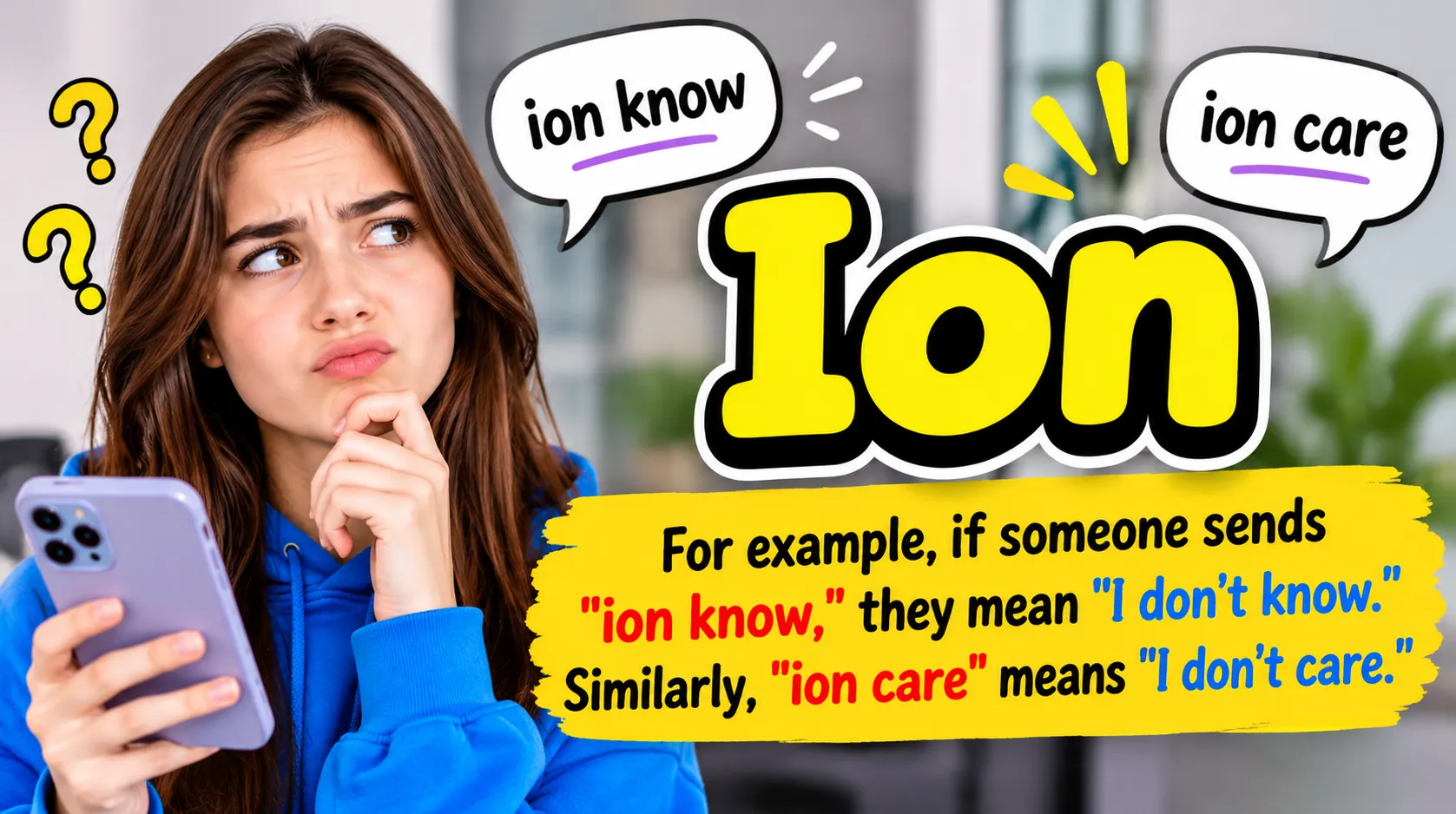
Have you ever received a message like “ion know,” “ion care,” or “ion wanna go” and wondered what the word “ion” actually means? If you have, you are not alone.
Many people see this short expression on Snapchat, Instagram, TikTok, and in everyday text messages. At first, it can look like a spelling mistake or a word related to science.
However, in modern texting, ion usually means “I don’t.” It is an informal way of writing how some people pronounce the words “I don’t” in casual speech. For example, “ion know” means “I don’t know.”
People often search for what does ion mean in text because its meaning can change slightly depending on the message and conversation. It may express confusion, disagreement, a lack of interest, or simply an honest answer.
In this guide, you will learn what ion means, how people use it on social media, whether it sounds rude, and how to respond when someone sends it.
You will also discover common examples and similar slang terms so you can understand modern texting more easily.
What Does “Ion” Mean in Text?
In texting and online conversations, ion means “I don’t.” It is an informal spelling based on the way some people pronounce the phrase when speaking quickly. People use it to save typing time and make their messages sound more natural and relaxed.
For example, if someone sends “ion know,” they mean “I don’t know.” Similarly, “ion care” means “I don’t care.”
Here are a few common ways people use ion:
- I don’t know: Shows that someone does not have an answer.
- I don’t care: Shows that something does not matter to them.
- I don’t want to: Explains that someone is not interested in doing something.
- I don’t think so: Shows doubt or disagreement.
The exact meaning depends on the words that come after ion.
For example:
Person A: Are you coming to the party?
Person B: Ion think so.
This means the person does not think they will attend the party.
Ion is common in casual texting, especially among people who use informal internet language. It is not standard English, so it is better suited to conversations with friends than formal writing.
The Most Common Meanings of “Ion”
Although ion usually means “I don’t,” people use it in different situations. The words following it help explain the sender’s feelings and intentions.
Let’s look at the most common uses.
1. Ion Means “I Don’t”
This is the main meaning of ion in text messages. People use it as a shorter, more casual way to write “I don’t.”
It often appears before verbs such as know, want, think, or feel.
Examples:
- “Ion understand this question.” = I don’t understand this question.
- “Ion like that movie.” = I don’t like that movie.
- “Ion remember his name.” = I don’t remember his name.
- “Ion wanna leave.” = I don’t want to leave.
In these examples, ion makes the message sound relaxed and conversational.
2. Ion Know Means “I Don’t Know”
One of the most popular expressions is “ion know.” People use it when they are unsure about something or cannot provide an answer.
It can express confusion, uncertainty, or a lack of information.
Examples:
Friend: What time does the movie start?
You: Ion know. Check the website.
Friend: Why did she leave early?
You: Ion know, maybe she was busy.
The expression does not always mean the person refuses to answer. Sometimes they genuinely do not know the information.
3. Ion Care Means “I Don’t Care”
Another common expression is “ion care.” It means that something is not important to the sender or does not affect their feelings.
Depending on the situation, it can sound relaxed, confident, or slightly rude.
Examples:
- “Ion care what they say.” = I don’t care what they say.
- “Ion care about the score.” = I don’t care about the score.
- “Ion care which movie we watch.” = I don’t care which movie we watch.
The tone depends on the conversation. Someone might use it to show that they are easygoing, while another person might use it to show frustration.
4. Ion Wanna Means “I Don’t Want To”
People also use ion before wanna to express that they are not interested in doing something.
“Wanna” is an informal form of “want to,” so “ion wanna” means “I don’t want to.”
Examples:
- “Ion wanna go outside.” = I don’t want to go outside.
- “Ion wanna talk right now.” = I don’t want to talk right now.
- “Ion wanna argue with you.” = I don’t want to argue with you.
This expression is especially common in casual conversations between friends.
5. Ion Think Means “I Don’t Think”
When someone writes “ion think,” they are usually expressing doubt or sharing an opinion.
It can also be used to disagree without sounding too direct.
Examples:
- “Ion think that’s a good idea.” = I don’t think that’s a good idea.
- “Ion think he will come.” = I don’t think he will come.
- “Ion think so.” = I don’t think so.
The sender may be uncertain rather than completely disagreeing.
How “Ion” Is Used in Real Conversations
Ion appears across different social media platforms and messaging apps. Its meaning usually stays the same, but the situation can change how it sounds.
Here is how people use it in different online spaces.
Friends & Casual Texting
Friends often use ion when chatting about daily activities, plans, school, games, or personal matters.
It makes messages sound less formal and more like everyday speech.
Examples:
Friend 1: Are you coming to my house today?
Friend 2: Ion know yet.
Friend 1: Do you want pizza?
Friend 2: Ion care, anything is fine.
Friend 1: Did you finish your homework?
Friend 2: Nah, ion feel like doing it.
In these conversations, ion is simply a casual way to express an opinion or answer a question.
It can also make a message shorter. Instead of typing “I don’t know,” someone can write “ion know.”
However, friends should still consider how their words sound. A short message can sometimes seem cold if the other person expects a detailed answer.
Instagram & Snapchat
On Instagram and Snapchat, ion is often used in direct messages, story replies, comments, and captions.
People may use it to react to pictures, answer questions, or express their feelings.
Examples:
- “Ion even know what to post today.”
- “Ion care about the comments.”
- “Ion wanna be on social media today.”
- “Ion know why this is so funny.”
You may also see ion in replies to Instagram stories.
For example:
Person A posts: “Should I cut my hair?”
Person B replies: “Ion think you should.”
Here, the sender means they do not think cutting the hair is a good idea.
On Snapchat, someone might write “ion know” when replying to a question or “ion wanna streak today” when they do not feel like sending a snap.
The expression is informal and works best when both people understand texting slang.
Dating Apps
Ion can also appear in conversations on dating apps when people discuss relationships, feelings, plans, and personal preferences.
Its tone depends heavily on the message.
Examples:
Person A: Do you like talking to me?
Person B: Yeah, ion usually talk this much.
Person A: Are you looking for a serious relationship?
Person B: Ion know yet. Just seeing where things go.
Person A: Do you want to meet this weekend?
Person B: Ion wanna rush things.
In dating conversations, ion does not automatically show a lack of interest.
For example, “ion wanna rush things” may mean the person wants to take the relationship slowly.
However, “ion care” can sound dismissive if someone is discussing something important.
Pay attention to the full message instead of judging someone’s feelings based on one abbreviation.
Gaming & Online Communities
Gamers and online community members often use ion while chatting during matches, discussing strategies, or talking with teammates.
Fast conversations make short expressions useful.
Examples:
- “Ion know where the enemy is.”
- “Ion have enough coins.”
- “Ion wanna play another round.”
- “Ion think we can win this match.”
You may see these messages in Discord servers, gaming chats, and multiplayer games.
For example:
Player 1: Can you help me with this mission?
Player 2: Ion know how to complete it.
Player 1: That’s fine, let’s figure it out.
In this situation, ion simply communicates that the player does not have the answer.
It is not a gaming-specific abbreviation. It is general texting slang used by people who play games.
Work or Professional Chat
Although ion is common in casual online conversations, it is usually not suitable for professional communication.
In work chats, emails, and business discussions, standard English is a better choice.
For example:
Informal:
“Ion know when the report will be ready.”
Professional:
“I don’t know when the report will be ready.”
Another example:
Informal:
“Ion think this plan will work.”
Professional:
“I don’t think this plan will work.”
Using complete sentences makes your message easier to understand and more appropriate for workplace communication.
If you are chatting with close coworkers in a relaxed group, ion might be understood. However, avoid it in formal emails, client messages, job applications, and important business discussions.
Is “Ion” Rude, Flirty, or Offensive?
The word ion is not rude, flirty, or offensive by itself. It is simply an informal way of writing “I don’t.”
However, the meaning and tone can change depending on the message, relationship, and situation.
When Ion Sounds Friendly
Ion can sound completely normal when friends use it in everyday conversations.
For example:
Friend: Do you want to watch a movie?
You: Ion mind, you choose.
Here, the sender is being relaxed and showing that they are comfortable with either option.
There is no negative meaning.
When Ion Sounds Rude
Sometimes, ion can make a message sound dismissive, especially when it appears in a conversation about serious feelings.
For example:
Person A: I feel like you never listen to me.
Person B: Ion care.
This response may sound hurtful because it suggests that the sender does not care about the other person’s feelings.
Another example:
Person A: Can you please explain what happened?
Person B: Ion have time for this.
The message may sound impatient or annoyed.
The problem is not the word ion itself. The complete sentence creates the negative tone.
Can Ion Be Flirty?
Ion is not naturally a flirting expression, but someone can use it in a playful or teasing conversation.
For example:
Person A: Do you miss me?
Person B: Ion know, maybe a little.
This reply could sound playful depending on the relationship.
Another example:
Person A: You think about me all day?
Person B: Ion admit that.
The sender may be teasing rather than giving a serious answer.
However, do not assume someone is flirting just because they use ion. Look at the rest of the conversation and how they normally communicate.
What Makes the Tone Change?
Three things can affect how ion sounds:
- The words after it: “Ion know” sounds different from “Ion care.”
- The relationship: Friends may understand casual language differently from strangers.
- The situation: A joke may be harmless, while the same words during an argument may feel hurtful.
The best way to understand the tone is to read the complete message and consider the conversation around it.
How to Respond When Someone Says “Ion”
Your response should depend on what the other person means.
You do not need to use slang in every reply. A normal, friendly answer is often enough.
Here are some useful responses.
Casual Replies
Use these when chatting with friends or people you know well.
- “That’s okay.”
- “No worries.”
- “Same here.”
- “Alright, got you.”
- “Fair enough.”
- “Okay, let me know.”
Example:
Friend: Ion know what to eat.
You: Same here. Let’s order something.
Funny Replies
If the conversation is playful, you can answer with a little humor.
- “Well, now we’re both confused.”
- “Google might know.”
- “Let’s figure it out together.”
- “Your brain needs a restart.”
- “That’s a mystery for another day.”
Example:
Friend: Ion know why I opened this app.
You: Your phone has better memory than you.
Use funny replies only when you know the other person is comfortable with jokes.
Neutral Replies
If you do not want to sound too casual or too serious, use a simple response.
- “I understand.”
- “That’s fine.”
- “Okay, thanks for telling me.”
- “No problem.”
- “Could you explain a little more?”
Example:
Person: Ion think I can come today.
You: That’s fine. Maybe another day.
Professional Replies
When someone uses ion in a work conversation, you can respond using clear and complete sentences.
- “No problem. Please let me know when you have an update.”
- “I understand. We can discuss it later.”
- “Thanks for letting me know.”
- “Could you check and confirm?”
- “That’s okay. I’ll wait for your response.”
Example:
Coworker: Ion know when the client will reply.
You: No problem. Please update me when you hear back.
Your response does not need to copy the other person’s texting style. Clear communication is more important.
Common Misunderstandings About “Ion”
People sometimes misunderstand ion because it looks like a regular English word. However, its texting meaning is different from its scientific meaning.
Here are some common mistakes to avoid.
1. Thinking Ion Is Always a Typing Mistake
Some people believe ion is simply a spelling mistake.
In casual texting, it is often intentional. People use it to represent the pronunciation of “I don’t.”
For example:
“Ion know what happened.”
This is an informal spelling, not necessarily an accidental typo.
2. Confusing Texting Ion With the Science Term
In science, an ion is an atom or molecule with an electrical charge because it has gained or lost electrons.
This meaning is completely different from the texting expression.
For example:
- Texting: “Ion know.” = I don’t know.
- Science: “A sodium ion has a positive charge.”
The surrounding words make it easy to understand which meaning is intended.
3. Assuming Ion Always Shows Anger
Not every message containing ion is angry.
For example, “ion know” usually expresses uncertainty. It does not automatically mean the sender is annoyed.
On the other hand, “ion care” may sound dismissive in a serious discussion.
Always consider the complete sentence.
4. Thinking Ion Is a Separate Word With a Different Meaning Every Time
Ion generally keeps the same basic meaning: “I don’t.”
The words that follow it explain what the person does not know, want, think, or care about.
For example:
- “Ion like it.”
- “Ion remember.”
- “Ion wanna go.”
All three use the same basic expression.
5. Assuming Everyone Uses It the Same Way
Not everyone writes or understands internet slang in the same way.
Some people use ion regularly, while others prefer standard English.
Regional speech patterns, age groups, and online communities can influence how familiar someone is with the expression.
If you are unsure, ask what the person means instead of making assumptions.
Similar Slang Terms You Should Know
If you understand ion, learning a few related texting expressions can make online conversations easier.
Here are 10 common slang terms worth knowing.
- IDK: Means “I don’t know.” Used when someone does not have an answer.
- IDC: Means “I don’t care.” Used to show that something does not matter to someone.
- IDGAF: Means “I don’t give a f***.” A stronger and more aggressive way to express that someone does not care.
- IMO: Means “In my opinion.” Used when sharing a personal view.
- TBH: Means “To be honest.” Used before giving an honest opinion or statement.
- NGL: Means “Not gonna lie.” Used to introduce an honest thought or feeling.
- FR: Means “For real.” Used to show agreement, seriousness, or surprise.
- IKR: Means “I know, right?” Used when strongly agreeing with someone.
- IDCFR: Often used online to mean “I don’t care for real.” Its use can vary, so check the surrounding conversation.
- IYKYK: Means “If you know, you know.” Used for an inside joke or shared experience.
These expressions are common in informal online conversations, but they do not all have the same tone.
For example, IDK is usually neutral, while IDGAF can sound much stronger and more dismissive.
Learning the differences helps you understand what someone is trying to communicate.
When You Should Avoid Using “Ion”
Although ion is popular in casual texting, there are situations where using it may not be a good idea.
Knowing when to use standard English can help you communicate more clearly.
1. Professional Settings
Avoid using ion in formal emails, business reports, job applications, and messages to clients.
For example:
Avoid: “Ion know if the project is ready.”
Better: “I don’t know if the project is ready.”
Professional communication should be clear and easy to understand.
Using complete sentences also helps your writing look more polished.
2. Cross-Cultural Chats
People from different countries and language backgrounds may not recognize ion.
If you are talking to someone who is learning English, using unusual slang can create confusion.
For example, someone may think you are talking about a science-related ion instead of saying “I don’t.”
In these situations, write the complete phrase.
3. Sensitive Situations
Avoid using ion care or similar expressions when someone is discussing an important personal issue.
For example:
Friend: I’m really upset about what happened yesterday.
Your response: “Ion care.”
This may make your friend feel ignored or disrespected.
A better response would be:
“I understand. Do you want to talk about it?”
Choosing thoughtful words matters more than using trendy slang.
4. Important Conversations
When discussing plans, money, schoolwork, deadlines, or serious decisions, clear language is usually better.
For example:
Instead of writing “ion think this is correct,” write “I don’t think this is correct.”
The second version communicates your point without making the reader guess what you mean.
You can still use ion with friends, but always consider who is reading your message.
FAQs
1. What does ion mean in texting from a girl?
When a girl uses ion in a text, it usually means “I don’t.” For example, “ion know” means “I don’t know.” It does not automatically show romantic interest, anger, or a particular emotion. The complete message and conversation help explain her tone.
2. What does ion mean from a guy?
When a guy writes ion, it generally means “I don’t.” He may use it in messages such as “ion care,” “ion know,” or “ion wanna go.” It is informal texting slang and does not have a special meaning based on the sender’s gender.
3. Is ion short for I don’t?
Yes. In casual texting, ion is a shortened phonetic spelling of “I don’t.” People write it this way because it sounds similar to how the phrase is spoken in informal conversation.
4. What does ion know mean in a text?
“Ion know” means “I don’t know.” Someone may use it when they are unsure about something, cannot answer a question, or do not have enough information. It is a casual alternative to the standard phrase.
5. What does ion care mean in texting?
“Ion care” means “I don’t care.” It shows that something is not important to the sender. Depending on the situation, it can sound relaxed, confident, annoyed, or dismissive.
6. Is ion the same as IDK?
No, but the expressions are closely related. Ion is commonly used in phrases such as “ion know,” while IDK directly means “I don’t know.” Both can communicate the same message, but their spelling and texting styles are different.
7. Is ion proper English?
No. Ion is not a standard English spelling of “I don’t.” It is an informal expression used in texting, social media, and casual conversations. In school assignments, professional emails, and formal writing, use the complete phrase instead.
Final Thoughts
So, what does ion mean in text? The simple answer is that ion usually means “I don’t.” It is an informal expression that people use in everyday messages, social media comments, and online conversations.
You may see it in phrases such as “ion know,” “ion care,” “ion wanna,” and “ion think.” Although the basic meaning stays the same, the tone depends on the complete sentence and the situation.
Remember that ion is not automatically rude, flirty, or offensive. It can be a normal way to communicate with friends, but it may not be suitable for professional or serious conversations.
The next time someone sends you a message with ion, look at the words around it. You will usually understand what they mean without getting confused.
Learning small expressions like this makes texting easier and helps you understand modern internet language with confidence.

Ethan Parker is a creative content writer passionate about pets, animals, and unique name ideas. He loves creating fun and engaging content that helps readers discover the perfect names with ease.