
Have you ever received a text that simply says “MB” and wondered what the sender is trying to tell you?
Maybe you made a mistake, someone replied late, or a friend used these two letters in the middle of a conversation. If you are unsure what they mean, you are not alone.
Short forms are common in text messages, Instagram comments, Snapchat chats, and other social media platforms. People use them because they save time and make conversations quicker.
However, the same short form can have different meanings depending on the situation.
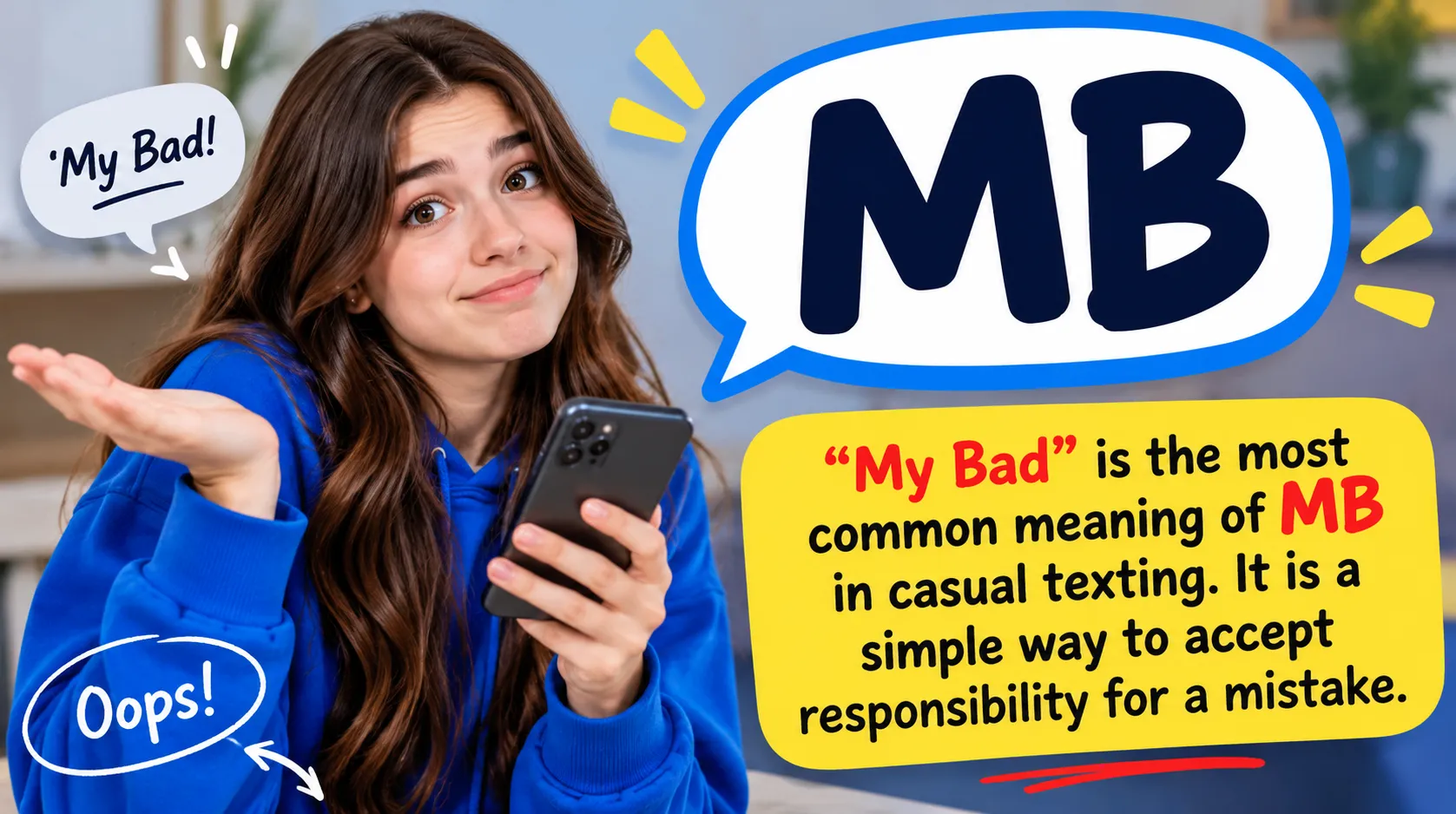
So, what does MB mean in text? In most everyday conversations, MB means “My Bad.” People use it to admit a small mistake, say sorry, or take responsibility for something. However, it can also mean “Maybe,” “Megabyte,” or other things in certain situations.
Understanding the message around these two letters can help you avoid confusion. In this guide, you will learn the most common meanings of MB, how people use it in different conversations, and how to respond naturally when someone sends it to you.
What Does “MB” Mean in Text?
MB most commonly means “My Bad” in text messages. It is a casual way to admit a mistake or apologize for something small. People use it with friends, family, and online contacts when they want to say sorry without writing a long message. Depending on the conversation, MB can also mean “Maybe” or “Megabyte.”
For example:
- My Bad: “MB, I forgot to call you.”
- Maybe: “MB I’ll come over later.”
- Megabyte: “The file is only 10 MB.”
The meaning depends on the topic and the words around it. If someone sends MB after making a mistake, they probably mean “My Bad.” If they are discussing plans, they might mean “Maybe.” If the conversation is about phones, computers, or file sizes, MB usually means “Megabyte.”
The Most Common Meanings of “MB”
MB has several meanings, but not all of them are used in the same situations. Here are the most common interpretations you may see in messages and online conversations.
1. MB Means My Bad
“My Bad” is the most common meaning of MB in casual texting. It is a simple way to accept responsibility for a mistake.
People use it when they forget something, send the wrong message, arrive late, or accidentally do something that affects another person.
It is usually a friendly and relaxed apology. It does not always mean the sender has done something serious.
Examples:
- Friend: “You sent me the wrong picture.”
- You: “MB, I picked the wrong one.”
Another example:
- Friend: “You forgot my birthday!”
- You: “MB, I honestly lost track of the date.”
In both examples, MB replaces “My Bad” and makes the apology shorter.
2. MB Means Maybe
Sometimes, MB is used as a shortened form of “Maybe.” It shows that someone is unsure about something or has not made a final decision.
This meaning often appears when friends are discussing plans, invitations, or future activities.
Examples:
- Friend: “Are you coming to the party?”
- You: “MB, I’ll let you know.”
Another example:
- Friend: “Will you join us tomorrow?”
- You: “MB, depends on my schedule.”
Here, the sender is not giving a definite yes or no. They are saying that something is possible.
One important thing to remember is that “Maybe” is less common than “My Bad” as an interpretation of MB in everyday texting. Always check the surrounding conversation.
3. MB Means Megabyte
MB also stands for “Megabyte,” a unit used to measure digital information and file sizes.
You may see this meaning in conversations about mobile data, photos, videos, applications, downloads, and computer storage.
Examples:
- Friend: “How large is that picture?”
- You: “It’s around 5 MB.”
Another example:
- Friend: “Can you send me the video?”
- You: “Sure, but it’s 50 MB.”
In these examples, MB has nothing to do with apologizing. It refers to the size of a digital file.
4. MB Can Have Other Meanings
In some conversations, MB may have a different meaning based on the subject, group, or platform.
For example, a gaming group, workplace, or online community may use MB as an abbreviation for a specific term.
Some people may also use it as personal shorthand that only their friends understand.
Examples:
- “Check the MB before downloading the game.”
- “MB, I didn’t see your last message.”
The first example may refer to megabytes, while the second clearly suggests “My Bad.”
If the meaning is unclear, it is better to ask the sender than to assume.
How “MB” Is Used in Real Conversations
People use MB in different ways depending on who they are talking to and where the conversation takes place. The following examples show how this short form works across popular platforms and everyday situations.
Friends & Casual Texting
Friends often use MB when they make small mistakes or want to apologize quickly.
It can make a conversation feel relaxed because the sender does not need to write a formal apology.
For example:
Conversation 1:
Friend 1: “You were supposed to bring my book.”
Friend 2: “MB, I left it at home.”
Conversation 2:
Friend 1: “Why didn’t you answer my call?”
Friend 2: “MB, I was sleeping.”
Conversation 3:
Friend 1: “You sent the same message twice.”
Friend 2: “MB, my phone was lagging.”
In these situations, MB means “My Bad.” It shows that the sender understands their mistake.
You can also use it when you accidentally interrupt someone, forget a plan, or misunderstand a message.
Instagram & Snapchat
On Instagram and Snapchat, people often use short forms to keep conversations quick. MB is useful when replying to stories, direct messages, snaps, or comments.
For example, someone might send you a message saying that you tagged the wrong account. You could reply with “MB, I’ll fix it.”
Here are a few more examples:
- “MB, I didn’t see your DM.”
- “MB, I thought you were someone else.”
- “MB, wrong story!”
- “MB, I forgot to reply.”
It can also appear in comments or group chats when someone wants to correct a small mistake.
On these platforms, the meaning is usually “My Bad” when the message follows an error or misunderstanding.
Dating Apps
MB can also appear in conversations on dating apps. People may use it when they reply late, forget to answer a question, or make a small mistake during a chat.
For example:
Conversation 1:
Person A: “You disappeared yesterday.”
Person B: “MB, I had a busy day.”
Conversation 2:
Person A: “You called me by the wrong name.”
Person B: “MB, that was an honest mistake.”
Conversation 3:
Person A: “You never answered my question.”
Person B: “MB, I missed that part.”
In dating conversations, MB is generally casual and friendly. However, it does not automatically show romantic interest.
If someone sends MB after replying late, it usually means they are acknowledging the delay. You should look at their overall communication style instead of treating one abbreviation as a sign of attraction.
Gaming & Online Communities
Gamers and online community members often use short abbreviations because they need to communicate quickly.
MB can mean “My Bad” when a player makes a mistake during a match, misses an important move, or causes a problem for the team.
Examples:
- Player 1: “You missed the target!”
- Player 2: “MB, my aim was off.”
Another example:
- Player 1: “You were supposed to cover that area.”
- Player 2: “MB, I got distracted.”
It can also appear in technical gaming discussions when players talk about game downloads, updates, or file sizes.
For example:
“That update is 800 MB.”
Here, it means megabytes, not an apology.
The topic of the conversation helps you understand which meaning makes sense.
Work or Professional Chat
In work chats, MB may appear when coworkers use casual language to acknowledge small mistakes.
For example:
- “MB, I attached the wrong document.”
- “MB, I missed your email.”
- “MB, I’ll correct that now.”
These messages are easy to understand, but MB may sound too informal in a professional setting.
When communicating with clients, managers, or people you do not know well, writing “My apologies” or “Sorry about that” is usually a better choice.
For example:
Instead of:
“MB, I sent the wrong file.”
Write:
“Sorry about that. I have attached the correct file.”
This sounds more professional and respectful.
Is “MB” Rude, Flirty, or Offensive?
MB is generally not rude, flirty, or offensive. Its most common meaning, “My Bad,” is a casual way to admit a mistake.
However, the tone can change depending on the conversation, relationship, and situation.
Is MB Rude?
Usually, no. It is a normal texting abbreviation used between friends and people who communicate casually.
However, it may sound careless if someone uses it after making a serious mistake.
For example:
Person A: “You shared my private information.”
Person B: “MB.”
In this situation, the reply may feel disrespectful because the problem is serious and deserves a proper apology.
A simple abbreviation may not show enough concern.
Is MB Flirty?
MB is not naturally a flirty abbreviation. It does not have a romantic meaning by itself.
However, someone may use it during a playful conversation with a person they like.
For example:
Person A: “You forgot to say good morning.”
Person B: “MB, I’ll make it up to you.”
The message may feel playful because of the situation, but the abbreviation itself is not romantic.
Look at the complete conversation to understand the sender’s intentions.
Is MB Offensive?
No, MB is not normally considered offensive.
It is commonly used to admit small mistakes or explain an error. However, using it in a serious or sensitive conversation can make the sender seem uninterested.
For example, if someone is upset because you hurt their feelings, replying only “MB” may not be enough.
A thoughtful apology would be better.
When Does MB Feel Positive or Negative?
The meaning is usually positive or neutral when someone uses it to accept responsibility.
It may feel negative when the sender uses it without showing concern, especially after a serious mistake.
The important thing is not just the abbreviation. The timing, relationship, and surrounding words also matter.
How to Respond When Someone Says “MB”
Your reply depends on what happened and how close you are to the person.
If someone uses MB to apologize, you can accept the apology, make a joke, or give a simple response.
Here are some natural replies you can use.
Casual Replies
These responses work well when a friend or someone you know sends MB after a small mistake.
- “No worries!”
- “It’s all good.”
- “You’re fine.”
- “Don’t worry about it.”
- “No problem.”
- “It happens!”
Example:
Friend: “MB, I forgot to call you.”
You: “No worries, it’s all good.”
Funny Replies
If you are chatting with a close friend, a funny response can keep the conversation light.
- “I’ll forgive you this time.”
- “Your apology has been accepted.”
- “Happens to the best of us.”
- “You’re officially forgiven.”
- “I’ll let it slide.”
Example:
Friend: “MB, I ate your last slice of pizza.”
You: “I’ll forgive you, but you owe me another one!”
These replies work best when the mistake is small and both people enjoy joking around.
Neutral Replies
If you do not want to sound too casual or too serious, use a simple response.
- “That’s okay.”
- “I understand.”
- “No worries.”
- “Thanks for letting me know.”
- “It’s fine.”
Example:
Person: “MB, I sent the wrong information.”
You: “That’s okay. Thanks for correcting it.”
Professional Replies
When someone uses MB in a work conversation, you can respond politely without using more slang.
- “No problem, thank you for correcting it.”
- “That’s fine. I appreciate the update.”
- “Understood. Thanks for letting me know.”
- “No worries. Please send the correct version.”
- “Thank you for clarifying.”
Example:
Coworker: “MB, I attached the wrong report.”
You: “No problem. Please send the updated report when ready.”
Choose a response that matches the seriousness of the mistake and your relationship with the sender.
Common Misunderstandings About “MB”
Although MB looks simple, people sometimes misunderstand it because the same letters can have different meanings.
Here are some common mistakes to avoid.
1. Thinking MB Always Means My Bad
“My Bad” is the most common meaning in casual texting, but it is not the only one.
If someone writes, “MB, I’ll come later,” they may mean “Maybe.”
If someone says, “The video is 20 MB,” they are talking about file size.
Never choose a meaning without checking the conversation.
2. Confusing MB With Other Short Forms
People sometimes confuse MB with similar abbreviations such as MYB, MBH, or MBB.
However, these forms do not automatically have the same meaning.
For example:
- MB: Commonly means My Bad.
- MYB: Can be used as a shortened form of My Bad, depending on the sender.
- MBH: May have different meanings in specific communities.
- MBB: Can be an abbreviation for something else depending on context.
Do not assume that similar-looking abbreviations mean the same thing.
3. Thinking MB Is Always an Apology
MB often works as an apology, but sometimes it expresses uncertainty.
For example:
“MB we can meet tomorrow.”
Here, the sender is suggesting a possibility rather than apologizing.
4. Misunderstanding the Sender’s Tone
A short message does not always show how someone feels.
If someone replies with “MB,” they may simply be typing quickly. It does not automatically mean they are angry, bored, or uninterested.
Look at their usual texting style and the full conversation before making a judgment.
5. Thinking MB Shows Romantic Interest
Some people think a short reply from someone they like must have a hidden meaning.
However, MB does not automatically show attraction.
It is usually just a casual way to acknowledge a mistake. Other messages and behavior provide a better idea of someone’s intentions.
Similar Slang Terms You Should Know
If you want to understand modern texting conversations, learning a few related abbreviations can make communication easier.
Here are 12 common short forms you may see in messages and online chats.
- NGL: Means “Not Gonna Lie.” People use it before sharing an honest opinion.
- TBH: Means “To Be Honest.” It introduces a personal thought or honest response.
- IDK: Means “I Don’t Know.” It shows that someone is unsure about something.
- BTW: Means “By The Way.” People use it when adding extra information.
- BRB: Means “Be Right Back.” It tells someone that the sender will return shortly.
- IMO: Means “In My Opinion.” It introduces a personal view or belief.
- FYI: Means “For Your Information.” It shares useful information with another person.
- LOL: Means “Laughing Out Loud.” It shows amusement or laughter.
- NP: Means “No Problem.” It is a quick way to say something is okay.
- TYSM: Means “Thank You So Much.” People use it to show appreciation.
- MYB: Can mean “My Bad.” It is another short form used to acknowledge a mistake.
- IDC: Means “I Don’t Care.” It can express a lack of interest or concern.
These abbreviations are common in casual messages, but their tone still depends on the situation.
When You Should Avoid Using “MB”
MB is useful for quick conversations, but there are times when writing the full words is a better choice.
Knowing when to avoid slang can help you communicate clearly and respectfully.
1. Professional Settings
Avoid using MB in formal emails, job applications, business reports, and important workplace messages.
Some people may not understand the abbreviation, while others may consider it too casual.
Instead of:
“MB, I forgot to send the document.”
Write:
“Sorry, I forgot to send the document. I have attached it now.”
This sounds clearer and more professional.
2. Cross-Cultural Chats
Not everyone understands internet slang.
If you are talking to someone from another country or someone who is learning English, MB may cause confusion.
Writing “My Bad” instead can make your meaning easier to understand.
Clear communication is more important than saving a few letters.
3. Sensitive Situations
Avoid using only MB when someone is upset, hurt, or dealing with a serious problem.
For example, if you break someone’s trust or cause a major issue, a two-letter apology may seem careless.
Instead, explain what happened and offer a proper apology.
For example:
“I’m really sorry. I should have been more careful, and I understand why you’re upset.”
A thoughtful response can show more respect than a short abbreviation.
4. Important Conversations
When discussing money, deadlines, personal problems, or important plans, avoid unclear abbreviations.
Use complete sentences so the other person understands exactly what you mean.
For example:
Instead of “MB, maybe tomorrow.”
Write:
“Sorry, I may not be available today. Can we meet tomorrow?”
This removes confusion and makes your message more useful.
FAQs
1. What does MB mean from a girl in text?
When a girl sends MB, it usually means “My Bad.” She may be apologizing for a mistake, replying late, or correcting something. It does not automatically mean she is flirting or showing romantic interest.
2. What does MB mean from a guy in text?
When a guy sends MB, it usually means “My Bad.” He may be admitting a small mistake or apologizing for something. The meaning depends on the conversation, not the sender’s gender.
3. Does MB mean maybe or my bad?
MB can mean both, but “My Bad” is more common in casual texting. When someone is discussing plans or possibilities, it may mean “Maybe.” The surrounding words help you understand the correct meaning.
4. What does MB mean on Instagram?
On Instagram, MB usually means “My Bad” in direct messages and comments. People use it when they make a mistake, forget to reply, or send something accidentally. It can also mean “Maybe” in conversations about plans.
5. What does MB mean on Snapchat?
On Snapchat, MB commonly means “My Bad.” Someone may use it after sending the wrong snap, missing your message, or making a small mistake. It is a quick and casual way to apologize.
6. How do you reply to MB in a text?
You can reply with “No worries,” “It’s okay,” “All good,” or “Don’t worry about it.” If the conversation is playful, you can use a funny response like “You’re forgiven this time!”
7. Is MB the same as sorry?
Not exactly, but MB is often used to apologize. It means “My Bad” and usually accepts responsibility for a mistake. “Sorry” is more direct and can be used in both casual and formal situations.
Final Thoughts
MB is one of those short forms that makes everyday texting quicker and easier. Its most common meaning is “My Bad,” which people use to admit mistakes or give a casual apology.
However, it can also mean “Maybe” when someone is unsure about plans, or “Megabyte” when discussing digital files and storage.
The easiest way to understand MB is to look at the complete message and the topic of the conversation. If someone sends it after making a mistake, they are probably saying “My Bad.” If they are discussing future plans, they may mean “Maybe.”
You can respond with simple phrases like “No worries,” “It’s all good,” or “That’s okay.”
Remember, not every short message has a hidden meaning. Understanding the context will help you avoid confusion and make your texting conversations easier, clearer, and more natural.

Ethan Parker is a creative content writer passionate about pets, animals, and unique name ideas. He loves creating fun and engaging content that helps readers discover the perfect names with ease.