
Have you ever received a text that says “SMFH” and wondered what the other person was trying to say? Maybe a friend sent it after hearing some bad news, or you saw it in an Instagram comment and could not understand the reaction.
If you do not know this slang term, it can be hard to understand the message.
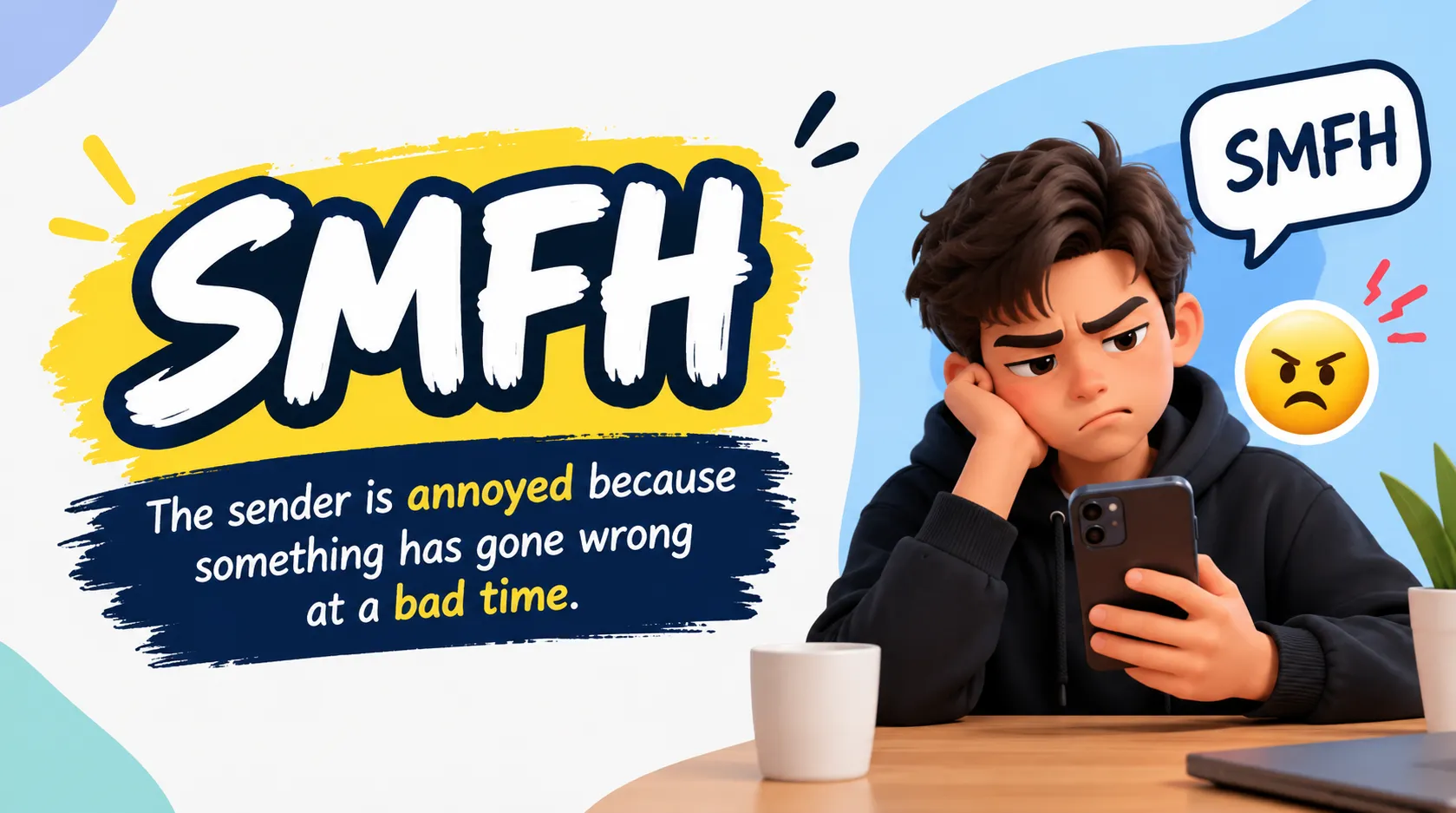
So, what does SMFH mean in text? It is a common internet abbreviation used to show strong disappointment, frustration, disbelief, or annoyance. People often use it when someone does something foolish, makes a bad choice, or creates an avoidable problem.
SMFH can look confusing because it is not a polite or formal expression. It can also sound stronger than the sender intends, especially when you read it without knowing the situation.
In this guide, you will learn the main meaning of SMFH, how people use it in everyday conversations, and how to reply when someone sends it to you.
You will also discover whether it is rude, how it differs from similar slang terms, and when you should avoid using it. By the end, you will understand this abbreviation and know when it fits a conversation.
What Does “SMFH” Mean in Text?
SMFH stands for “shaking my fucking head.” People use it in text messages and online conversations to show strong disappointment, frustration, disbelief, or annoyance about something.
It is a stronger version of SMH, which means “shaking my head.” The added word makes SMFH more intense and includes profanity. Depending on the situation, it can express anger, embarrassment, disappointment, or disbelief about someone’s actions.
For example:
- “You forgot your keys again? SMFH.”
- “SMFH, he lied to everyone.”
- “They canceled the event at the last minute. SMFH.”
In these examples, the sender is showing that they cannot believe what happened or feel disappointed by someone’s behavior.
The exact meaning depends on the conversation. Friends may use it jokingly when someone makes a silly mistake, while other people may use it to show genuine anger. Because it contains profanity, it is best suited to informal conversations.
The Most Common Meanings of “SMFH”
SMFH has one main expansion, but people use it to express several related feelings. Understanding the situation helps you identify the sender’s intended tone.
1. Strong Disappointment
One of the most common uses of SMFH is to show disappointment. A person may use it when someone makes a poor decision, breaks a promise, or fails to do something they should have done.
For example:
Friend: “He promised to help me, but he never showed up.”
You: “SMFH, that’s messed up.”
Here, SMFH shows that you are disappointed by the person’s behavior. It can also show support for the friend who was let down.
People often use it when they expect better behavior from someone but feel that the person has failed to meet those expectations.
2. Frustration or Annoyance
SMFH can also express frustration when something goes wrong. This could be a repeated mistake, a difficult situation, or a problem that could have been avoided.
For example:
“My internet stopped working during the meeting. SMFH.”
The sender is annoyed because something has gone wrong at a bad time.
Another example is:
“SMFH, the bus left just before I reached the stop.”
In this case, the sender is frustrated with the situation rather than necessarily blaming another person.
3. Disbelief or Shock
Sometimes, people use SMFH when they hear something surprising or difficult to believe. The abbreviation suggests that the news is so unexpected that they can only shake their head in disbelief.
For example:
“SMFH, he spent all his savings in one day.”
This message shows disbelief and may also suggest disappointment in the person’s decision.
Another example:
“SMFH, they actually believed that fake story.”
Here, the sender cannot believe that someone accepted information they consider false.
4. Disapproval of Someone’s Behavior
SMFH is also used when someone wants to show that they strongly disagree with another person’s actions.
For example:
“She made fun of her friend in front of everyone. SMFH.”
The sender thinks the behavior was wrong or unkind.
This use can sound judgmental because it shows that the sender does not approve of what happened. Depending on the situation, it may express moral disapproval, frustration, or anger.
5. Playful Frustration Between Friends
Not every use of SMFH is serious. Close friends sometimes use it to tease each other about small mistakes or silly choices.
For example:
Friend: “I watched the same movie twice because I forgot I had already seen it.”
You: “SMFH, your memory is gone.”
In this conversation, the expression is playful. The sender is joking rather than expressing real anger.
However, the relationship matters. The same words can feel funny between close friends but insulting when used by someone you do not know well.
How “SMFH” Is Used in Real Conversations
SMFH appears in different online spaces. Its meaning usually stays the same, but the tone can change depending on the platform and the people involved.
Friends & Casual Texting
Friends often use SMFH when talking about mistakes, frustrating events, or surprising news. It is a quick way to show a strong reaction without writing a long explanation.
Examples:
- “SMFH, you left your wallet at home again.”
- “He missed the train because he woke up late. SMFH.”
- “SMFH, why would you say that in front of everyone?”
In a close friendship, the expression may be teasing or supportive. If a friend tells you about a bad experience, SMFH can show that you understand why they are upset.
For example:
Friend: “My roommate ate the food I saved for dinner.”
You: “SMFH, they should have asked first.”
Here, the sender is showing sympathy and disapproval.
Still, you should consider your friend’s mood before using it. Someone who is already upset may not appreciate a joke, even if you intend it kindly.
Instagram & Snapchat
On Instagram and Snapchat, SMFH can appear in comments, captions, direct messages, and replies to stories. People use it to react to surprising posts, frustrating news, or behavior they find unreasonable.
Examples:
- “SMFH, people really believe anything online.”
- “You posted that without checking the facts? SMFH.”
- “SMFH, this comment section is getting out of hand.”
A person may also use SMFH in a private message after seeing a friend’s story.
For example, if someone posts about a frustrating experience, a friend might reply, “SMFH, you didn’t deserve that.”
The expression can communicate sympathy, disbelief, or criticism. However, a public comment can appear harsher than a private message because other people may see it without knowing the full context.
Before commenting, consider whether your words could embarrass someone or turn a small disagreement into a public argument.
Dating Apps
SMFH sometimes appears in dating app conversations when people discuss bad dates, confusing messages, or disappointing behavior.
For example:
Person A: “He canceled our date for the third time.”
Person B: “SMFH, you deserve someone who respects your time.”
Here, SMFH expresses disappointment and support.
It can also appear when someone hears about dishonest behavior or an awkward dating experience.
However, SMFH is not usually a romantic or flirty expression by itself. It does not mean that someone likes you or has romantic feelings for you. Its main purpose is to express a strong reaction.
If someone sends it during a disagreement, they may be annoyed or disappointed. Read the surrounding messages before deciding whether they are joking, supporting you, or criticizing something you said.
Gaming & Online Communities
Gamers and online community members use SMFH when reacting to poor decisions, unexpected losses, frustrating teammates, or unfair situations.
Examples:
- “SMFH, our teammate left before the final round.”
- “You sold all your rare items for that? SMFH.”
- “SMFH, we lost because nobody followed the plan.”
In gaming chats, the abbreviation can be a quick reaction to something that went wrong. It may show frustration with a teammate or disbelief about an opponent’s actions.
For example, a player might type “SMFH” after a teammate ignores an important instruction and causes the team to lose.
Gaming conversations can become emotional, so the phrase may sound more aggressive than it would in a relaxed chat. Some communities accept this language, while others prefer respectful communication.
Use it carefully when playing with strangers. A short message can easily be misunderstood as an insult, especially when the team is already frustrated.
Work or Professional Chat
SMFH is generally not suitable for professional conversations. It contains profanity and can make a message sound disrespectful, even when the sender is only frustrated with a situation.
For example, sending this to a coworker would be risky:
“SMFH, you forgot to attach the report again.”
The coworker may feel attacked or embarrassed, and the message could damage your working relationship.
A better option is to use clear, polite language:
“I noticed the report was missing from the email. Could you please send it again?”
If you need to discuss a repeated problem, explain the issue directly and focus on the next step.
For example:
“The report was missing from the last two emails. Please check the attachment before sending the next version.”
This approach communicates the problem without using profanity or making the conversation personal.
Is “SMFH” Rude, Flirty, or Offensive?
SMFH is generally considered informal and potentially rude because it contains a swear word. Whether it sounds offensive depends on the context, the relationship, and the way it is used.
Is SMFH Rude?
It can be. If someone sends SMFH after you make a mistake, they may be showing annoyance or disapproval.
For example:
“You forgot the appointment again. SMFH.”
This sounds critical because the sender is pointing out your mistake with frustration.
Among close friends, however, the same abbreviation may be part of casual teasing. The relationship and previous conversation can help you understand the intended tone.
Is SMFH Flirty?
SMFH is not normally a flirty abbreviation. It does not mean “I like you” or “I want to date you.”
Someone might use it playfully while talking to a person they like, but the word itself does not show romantic interest.
For example:
“You forgot what I told you yesterday? SMFH.”
This could be playful teasing between people who are flirting, but it could also be genuine annoyance. Look at the rest of the conversation rather than assuming it is romantic.
Is SMFH Offensive?
Some people consider SMFH offensive because it contains profanity. Others use it casually with friends who are comfortable with strong language.
It is more likely to cause problems when directed at someone during an argument, used to shame someone publicly, or sent to a person who dislikes swearing.
The abbreviation does not automatically mean that the sender is attacking you. They may be reacting to a situation, another person’s behavior, or something they saw online.
How Context Changes the Meaning
Consider these two examples:
Playful: “SMFH, you put your phone in the fridge again?”
Critical: “SMFH, you lied to everyone about what happened.”
The first message may be friendly teasing. The second shows stronger disapproval.
When interpreting SMFH, consider what happened before the message, your relationship with the sender, and whether the rest of their words sound friendly or angry.
How to Respond When Someone Says “SMFH”
Your reply depends on what caused the reaction. You do not need to use slang just because the other person did.
Casual Replies
Use a casual response when a friend is joking or reacting to an everyday problem.
Examples:
- “I know, right?”
- “Yeah, that was a bad move.”
- “Tell me about it.”
- “I can’t even argue with that.”
- “I know, I messed up.”
These replies keep the conversation natural and show that you understand the other person’s reaction.
If your friend is talking about a frustrating event, you can also ask what happened next.
Funny Replies
If you and the sender usually joke with each other, a funny reply can keep the mood light.
Examples:
- “My bad, my brain took a day off.”
- “I promise I’m trying my best.”
- “Don’t judge me too hard.”
- “That mistake deserves its own award.”
- “Even I don’t know what I was thinking.”
Use these responses only when the situation is suitable for humor. If the sender is genuinely angry, a joke may make things worse.
Neutral Replies
Neutral replies are useful when you are unsure what the sender means or do not want to use strong language.
Examples:
- “What happened?”
- “Why do you feel that way?”
- “I understand.”
- “That’s frustrating.”
- “Can you explain what you mean?”
These responses help you learn more before making assumptions about the sender’s mood.
If someone sends only “SMFH,” asking “What’s wrong?” is often a simple way to continue the conversation.
Professional Replies
If a coworker uses SMFH in a work-related chat, you can respond politely and focus on the issue.
Examples:
- “Could you clarify the problem?”
- “I understand your concern. Let’s work out a solution.”
- “Please let me know what needs to be corrected.”
- “I can review the issue and follow up.”
- “Let’s focus on how we can prevent this from happening again.”
If the message is directed at you and sounds disrespectful, stay calm. Address the actual problem without copying the sender’s language.
What If Someone Sends SMFH Directly to You?
First, consider what happened before the message. If you made a mistake, you can acknowledge it. If you do not understand the reaction, ask for clarification.
For example:
Them: “SMFH, you forgot again.”
You: “You’re right. I forgot, and I’m sorry. I’ll take care of it now.”
If the message seems unfair, you can ask:
“I’m not sure what upset you. Can you explain?”
This helps you understand the issue without turning the conversation into an argument.
Common Misunderstandings About “SMFH”
Although SMFH is easy to recognize once you learn it, people can still misunderstand its tone or purpose.
1. Thinking It Always Means Anger
SMFH can show anger, but it can also express disbelief, disappointment, or playful frustration.
For example, a friend might send it after hearing a funny story about a silly mistake. They may not be genuinely upset.
Do not assume that someone is angry with you based on the abbreviation alone.
2. Thinking It Is Always an Insult
SMFH can be directed at a person, but it can also be a reaction to an event or situation.
For example:
“SMFH, the store closed five minutes before I arrived.”
The sender is frustrated with the timing, not necessarily insulting anyone.
Look at the complete message to understand what the person is reacting to.
3. Confusing SMFH With SMH
SMFH and SMH have similar meanings, but they differ in strength.
SMH means “shaking my head.” SMFH means “shaking my fucking head.”
The second version contains profanity and usually expresses a stronger reaction. Both can show disappointment, frustration, or disbelief.
4. Assuming It Is a Romantic Signal
SMFH does not normally express love, attraction, or romantic interest. A person may use it while talking to someone they like, but that does not change its basic meaning.
If you want to understand someone’s romantic intentions, consider the wider conversation rather than focusing on one abbreviation.
5. Missing the Tone of a Short Message
Text messages do not always show facial expressions or voice tone. As a result, SMFH may seem harsher than intended.
A close friend might use it jokingly, while someone else may use it to express serious disappointment.
If the tone is unclear, ask what the sender means instead of guessing.
6. Forgetting That It Contains Profanity
Some people treat SMFH as ordinary internet slang and forget that the full phrase includes a swear word.
This can matter when messaging a teacher, manager, customer, or someone you do not know well.
When in doubt, use a less offensive expression such as “I’m disappointed,” “That’s frustrating,” or “I can’t believe it.”
Similar Slang Terms You Should Know
If you understand SMFH, learning a few related abbreviations can make online conversations easier to follow.
- SMH: “Shaking my head.” Used to express disappointment, disbelief, or disapproval.
- TF: “The fuck.” Used to express surprise, confusion, or anger, often in a strong or rude way.
- WTF: “What the fuck.” Shows strong surprise, confusion, or disbelief.
- FFS: “For fuck’s sake.” Expresses frustration or annoyance.
- ISTG: “I swear to God.” Used to show strong feelings, frustration, or sincerity.
- NGL: “Not gonna lie.” Used before an honest opinion or statement.
- FR: “For real.” Used to show agreement, seriousness, or disbelief.
- TBH: “To be honest.” Introduces an honest thought or opinion.
- LOL: “Laughing out loud.” Commonly used to show amusement or make a message feel light.
- IDC: “I don’t care.” Shows a lack of interest or concern.
- IDK: “I don’t know.” Used when someone does not have an answer.
- BRUH: An informal expression used to show disbelief, disappointment, surprise, or frustration.
These terms are not perfect replacements for SMFH. Some express surprise, while others show honesty, amusement, or indifference. Choose the abbreviation that matches the feeling you want to communicate.
When You Should Avoid Using “SMFH”
SMFH may be common in informal chats, but it does not fit every situation. Knowing when to avoid it helps you communicate clearly and respectfully.
Professional Settings
Avoid SMFH in work emails, job applications, business messages, and formal group chats.
The profanity can make you sound unprofessional or disrespectful. Even if you are frustrated, a clear statement is usually more effective.
Instead of writing “SMFH, this file is wrong,” try:
“This file contains errors. Could we review the information and correct it?”
This wording explains the problem without adding unnecessary tension.
Cross-Cultural Chats
People from different backgrounds may have different views about swearing. Some may see SMFH as normal internet slang, while others may find it offensive.
If you are messaging someone you do not know well, avoid assuming they are comfortable with profanity.
Use simple expressions such as “That’s disappointing” or “I can’t believe that happened” until you understand their communication style.
Sensitive Situations
Avoid using SMFH when someone is sharing serious news, discussing a personal loss, or asking for help with an emotional problem.
Even if you intend to show sympathy, the expression may sound dismissive or judgmental.
For example, if someone tells you they made a serious mistake, a better reply might be:
“I’m sorry that happened. Do you want to talk about it?”
A supportive response shows that you are listening rather than judging them.
Arguments and Conflicts
Using SMFH during an argument can make the other person feel mocked or attacked.
If your goal is to solve a problem, explain what concerns you and ask for a calm discussion.
For example:
“I’m frustrated because we agreed to do this differently. Can we talk about what happened?”
This approach is more likely to lead to a useful conversation than a message that relies on profanity.
FAQs
What does SMFH stand for in texting?
SMFH stands for “shaking my fucking head.” It is used to express strong disappointment, frustration, disbelief, or annoyance in informal conversations.
What does SMFH mean from a girl?
When a girl sends SMFH, it usually means she is disappointed, annoyed, or unable to believe something. It is not automatically a sign of flirting or romantic interest. The context determines her intended tone.
What does SMFH mean from a guy?
When a guy uses SMFH, he is generally expressing frustration, disbelief, or disapproval. He might be reacting to a mistake, a surprising event, or something he finds unreasonable.
Is SMFH stronger than SMH?
Yes. SMFH includes profanity, so it often sounds stronger than SMH. Both expressions can show disappointment or disbelief, but SMFH usually adds more intensity.
Is SMFH a bad word?
SMFH includes a swear word in its full form. It is common in informal online communication, but some people consider it rude or offensive. Avoid it in formal and sensitive conversations.
Can SMFH be used jokingly?
Yes. Friends sometimes use SMFH to tease each other about silly mistakes or funny situations. However, it can also express genuine frustration, so consider the relationship and context.
How should I reply to SMFH in a text?
You can reply with “I know, right?”, “What happened?”, or “I understand.” If you made a mistake, acknowledge it. If the meaning is unclear, ask the sender to explain rather than assuming they are angry.
Final Thoughts
SMFH means “shaking my fucking head.” People use it in text messages, social media comments, gaming chats, and other informal conversations to express strong disappointment, frustration, disbelief, or annoyance.
The abbreviation is similar to SMH, but it contains profanity and often sounds more intense. Depending on the situation, it can be a serious reaction or playful teasing between friends.
Remember that SMFH is not usually a romantic expression, and it does not always mean someone is angry with you. The surrounding conversation, your relationship with the sender, and the situation can help you understand the intended meaning.
If someone sends you SMFH, respond according to the situation. You can joke with a friend, offer support to someone who is frustrated, or ask for clarification if the message seems unclear.
Most importantly, think about your audience before using it yourself. SMFH may fit a casual conversation, but polite and direct language is usually better for work, sensitive discussions, and conversations with people you do not know well.
Once you understand its meaning and tone, you can recognize SMFH in everyday texting and respond with confidence.

Ethan Parker is a creative content writer passionate about pets, animals, and unique name ideas. He loves creating fun and engaging content that helps readers discover the perfect names with ease.