Have you ever received a text saying “OP is so funny” or seen someone write “OP needs to explain this” in a social media comment? If you are unsure what OP means, you are not alone. This short abbreviation can have different meanings depending on the conversation.
The meaning of OP can change between texting, Instagram, Snapchat, gaming, and online forums. In one conversation, it may refer to the person who started a discussion.
In another, it may describe something as overpowered in a video game. People may also use OP to mean “original poster,” “original post,” or “overpowered,” depending on the topic.
Understanding the message around OP is the easiest way to work out what someone means. You do not always need to ask the sender for an explanation. A few clues from the conversation can often make the meaning clear.
In this guide, you will learn what OP means in text, how people use it on different platforms, whether it is rude or friendly, and how to respond when someone uses it.
You will also discover related slang terms and common mistakes to avoid. By the end, you will know how to understand OP in everyday online conversations.
What Does “OP” Mean in Text?
In text messages and online conversations, OP most commonly means “original poster,” the person who first shared a post or started a discussion. Depending on the context, OP can also mean “original post” or “overpowered,” especially in gaming. In some communities, it may have other meanings, so the surrounding message matters.
Here are three common meanings of OP:
- Original Poster: The person who created a post, question, or discussion online.
- Original Post: The first post in a conversation or online thread.
- Overpowered: Something in a game that is considered too strong or effective.
For example, someone might comment, “OP explained everything clearly.” Here, OP refers to the person who created the original post.
In a gaming chat, someone might say, “That weapon is OP.” In this case, OP means the weapon is too powerful compared with other weapons.
The key is to look at the topic. If people are discussing a Reddit thread, OP probably means the original poster. If they are talking about a character, weapon, or game ability, overpowered is more likely.
The Most Common Meanings of “OP”
OP is a short abbreviation with several meanings. Although the exact definition depends on the situation, a few interpretations appear often in online conversations.
1. OP Means Original Poster
The most common meaning of OP on discussion platforms is “original poster.”
An original poster is the person who creates a post, asks a question, shares a story, or starts a discussion. Other people then reply to that person’s content.
This meaning is common on Reddit, online forums, and social media discussions.
Examples:
- “OP is right about this.”
- “I think OP needs some advice.”
- “Someone should answer OP’s question.”
- “OP gave more details in the comments.”
In these examples, OP refers to the person who started the discussion.
When should you use this meaning?
Use this interpretation when people are talking about a person who shared something online. If someone asks a question in a forum and another user replies, “OP should check the update,” they are referring to the person who asked the original question.
2. OP Means Original Post
OP can also stand for “original post.”
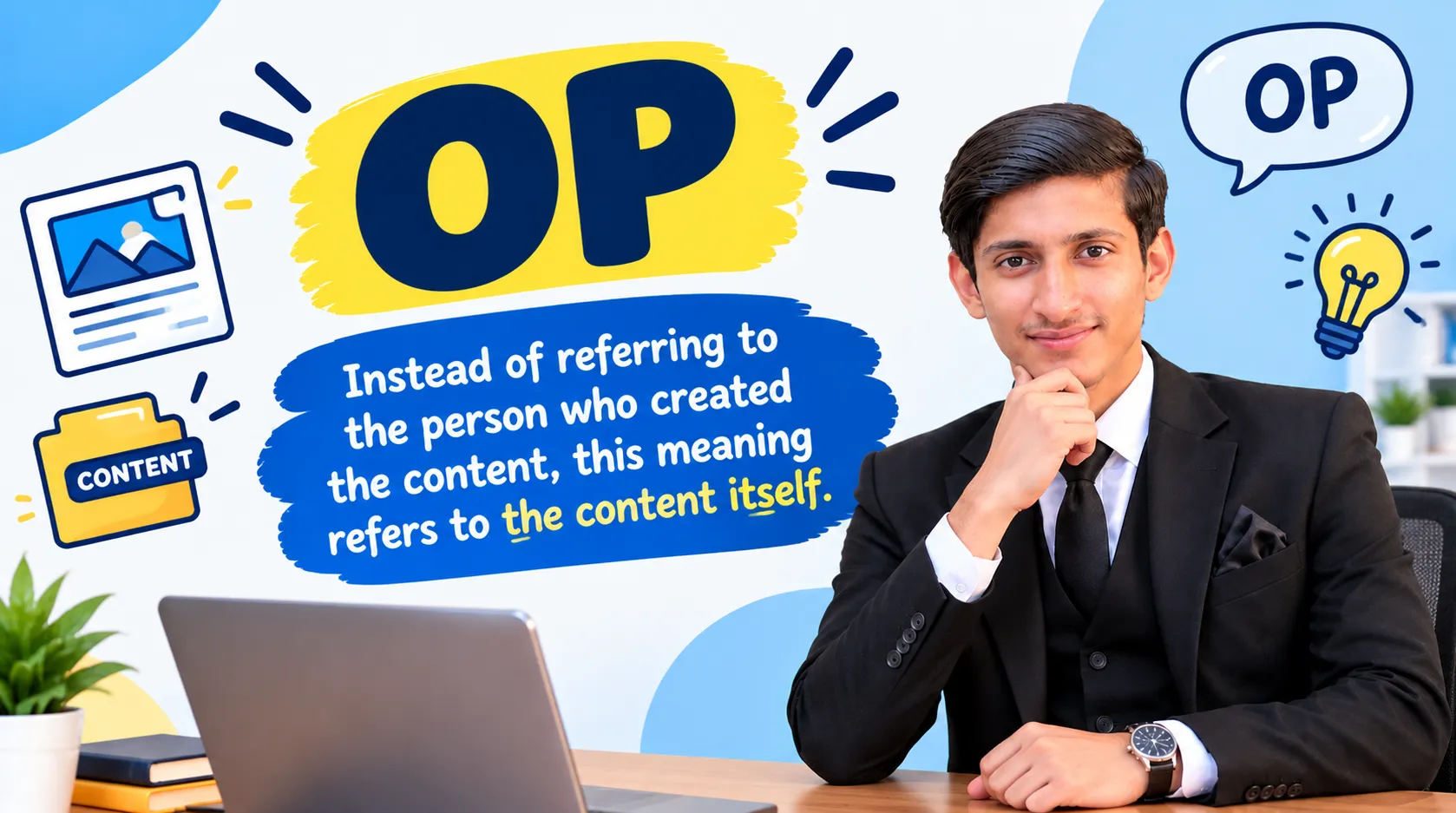
Instead of referring to the person who created the content, this meaning refers to the content itself.
For example, a person may share a photograph, story, question, or opinion. Later, someone might refer to that content as the original post.
Examples:
- “Check the OP for more information.”
- “The answer is already in the OP.”
- “I added the missing details to the OP.”
- “The OP explains why everyone is upset.”
Here, OP refers to the post rather than its creator.
The difference between original poster and original post can sometimes be unclear because both use the same abbreviation. However, the rest of the sentence usually helps you understand which meaning fits.
If someone says, “OP should reply,” they probably mean the person who posted. If they say, “Read the OP again,” they probably mean the original content.
3. OP Means Overpowered
In gaming, OP often means “overpowered.”
Players use this term when a character, weapon, skill, item, or ability seems much stronger than other options in a game.
Something may be called OP when it makes winning too easy or gives one player an unfair advantage.
Examples:
- “That character is OP.”
- “This weapon is way too OP.”
- “The new update made that ability OP.”
- “His team is OP in this game.”
In these messages, OP has nothing to do with an original post. It describes strength or power.
For example, if a player discovers a weapon that defeats opponents very quickly, they might tell their friends, “This weapon is OP.”
The word can be serious or playful. Sometimes players use it because an item is genuinely unbalanced. Other times, they simply mean that it is very strong or impressive.
4. OP Can Mean Other Things in Specific Communities
Some online communities use OP for other terms. The intended meaning depends on the subject, the group, and the way the abbreviation appears.
For example, in certain gaming discussions, people may use OP as shorthand for a character or player’s role, while in other communities it may refer to a specific feature or topic.
However, these meanings are not universal. You should not assume that an unfamiliar use of OP has one particular definition without checking the surrounding conversation.
Examples:
- “OP changed the settings again.”
- “Ask OP about the latest update.”
- “That OP build works well in this game.”
The first two examples may refer to the person who created a post, depending on the conversation. The third may involve gaming terminology, but more context is needed to know exactly what the sender means.
When OP appears in a specialized group, check how other members use it. If the meaning is still unclear, asking a simple question is better than guessing.
How “OP” Is Used in Real Conversations
OP appears in different types of online conversations. Its meaning often changes depending on where you see it.
Friends & Casual Texting
Friends may use OP when discussing a post, a funny video, or something they saw online.
For example, one friend may send a screenshot of a discussion and say that OP made a good point. Another might use OP while talking about a game.
Example 1:
Friend A: “Did you read that story about the school trip?”
Friend B: “Yeah, OP explained everything so well.”
Here, OP means the person who shared the story.
Example 2:
Friend A: “I finally unlocked the new character.”
Friend B: “That character is OP!”
Here, OP means overpowered.
In everyday texting, the abbreviation can make a message shorter and easier to type. However, people who do not spend much time in online communities may not recognize it immediately.
Instagram & Snapchat
On Instagram and Snapchat, OP may appear in comments, captions, group chats, and conversations about shared content.
For example, someone may post a video, and another user may refer to the person who uploaded it as OP.
Examples:
- “OP deserves more followers.”
- “OP made this video?”
- “The OP has the full story.”
- “That filter is OP.”
In the first three examples, OP may refer to the original poster or original post, depending on the sentence.
In the final example, OP could mean overpowered in a playful or unusual context, but the intended meaning depends on what the people are discussing.
Remember that OP is not a fixed Instagram or Snapchat abbreviation. It is an internet abbreviation that people may use across several platforms.
Dating Apps
OP is not a common romantic abbreviation by itself. However, it may appear in dating conversations when people discuss screenshots, profiles, shared posts, or online discussions.
Example 1:
Person A: “I found a discussion about first dates.”
Person B: “What did OP say?”
Here, OP means the person who started the discussion.
Example 2:
Person A: “Look at this dating profile.”
Person B: “OP has some good advice in the comments.”
Here, OP refers to the person who created the post.
If someone sends you OP in a dating conversation, do not automatically assume it is flirting. The abbreviation usually has a practical meaning related to the content being discussed.
The surrounding words and the relationship between the people matter more than the abbreviation itself.
Gaming & Online Communities
Gaming is one of the most important contexts for understanding OP because players often use it to describe something that is too powerful.
You may see OP in games involving characters, weapons, abilities, teams, or special items.
Examples:
- “This sword is OP.”
- “Your character is OP now.”
- “That ability needs a nerf because it is OP.”
- “The boss is OP for beginners.”
In these examples, OP means overpowered.
Gaming communities also use OP to refer to the original poster when discussing forum threads or asking questions about a game.
For example, someone might comment, “OP should share their settings.” This means the person who created the discussion should provide more information.
To identify the correct meaning, check whether the sentence describes a game feature or refers to the person who posted something.
Work or Professional Chat
OP is not always the best choice in workplace communication because it can have different meanings.
In a team discussion, it might refer to the original post in a project channel. In a gaming company, it might describe an overpowered character or feature. In other professional settings, it could have a specialized meaning known only to the team.
Examples:
- “Please check the OP for the full details.”
- “The OP contains the original request.”
- “That character seems OP after the update.”
These examples depend on the workplace and topic.
If you are writing to a client, manager, or someone unfamiliar with internet slang, it is safer to write “original post,” “person who posted the question,” or “overpowered” instead.
Clear wording helps prevent confusion, especially when a message involves a deadline, task, or important decision.
Is “OP” Rude, Flirty, or Offensive?
OP is generally not rude, flirty, or offensive by itself. Its meaning is usually neutral, but the surrounding message can change how it feels.
When OP Is Neutral
When someone uses OP to identify the person who created a post, there is usually no emotional meaning.
For example:
“OP shared the answer in the comments.”
This is simply a statement about the person who started the discussion.
When OP Is Positive
OP can have a positive meaning in gaming or casual conversations.
For example:
“That character is OP!”
The sender may be praising the character’s strength. Depending on the situation, they might be excited, impressed, or joking.
Similarly, someone might say, “OP gave great advice,” to praise the person who created a post.
When OP Feels Negative
OP may sound negative when someone uses it during an argument or complains about a game feature.
For example:
“OP has no idea what they are talking about.”
The abbreviation itself is neutral, but the full sentence criticizes the person who posted.
In gaming, saying that a weapon is OP may also be a complaint. A player may believe that the weapon is too strong and makes the game unfair.
Is OP Flirty?
OP is not normally a flirting term. If someone uses it in a romantic conversation, it usually refers to a post or another topic.
Do not assume that someone is interested in you simply because they use OP. Look at the full conversation, their behavior, and the words they use.
The main rule: OP does not have one emotional tone. The meaning and feeling depend on the situation, the sentence, and the relationship between the people talking.
How to Respond When Someone Says “OP”
Your response should depend on what the sender means by OP. If you understand the context, replying is usually simple.
Casual Replies
Use these replies when you are chatting with friends or discussing an online post.
Example 1:
Friend: “OP explained it really well.”
You: “Yeah, the explanation was clear.”
Example 2:
Friend: “OP is asking a good question.”
You: “True, I was wondering about that too.”
Example 3:
Friend: “That character is OP.”
You: “Yeah, it’s really strong.”
These replies work because they respond to the meaning rather than repeating the abbreviation unnecessarily.
Funny Replies
If your friend is talking about an overpowered game character or weapon, a playful response may fit.
Examples:
- “OP? More like impossible to beat!”
- “That weapon needs to calm down.”
- “The game is making this too easy.”
- “That character needs a serious nerf.”
Use humor only when you know the other person is comfortable with it.
If OP refers to a person who created a serious post, avoid joking about that person unless you understand the situation.
Neutral Replies
If you are unsure what OP means, ask for clarification.
Examples:
- “What does OP mean here?”
- “Do you mean the original poster?”
- “Are you talking about the post or the person?”
- “Do you mean overpowered?”
These questions are useful because OP can have more than one meaning.
Asking for clarification is especially helpful when a message contains little context.
Professional Replies
In a work conversation, respond to the actual information being shared.
Examples:
- “I’ll review the original post.”
- “Could you share the original request?”
- “I understand that the character may be too powerful.”
- “Could you clarify what OP refers to in this discussion?”
These responses are clear and polite. They also help avoid misunderstandings when different people use the same abbreviation in different ways.
You do not need to use slang just because another person uses it. A clear response is always appropriate.
Common Misunderstandings About “OP”
Although OP is short, it can cause confusion when people assume it has only one meaning.
1. Thinking OP Always Means Original Poster
Many people learn that OP means original poster and use that definition everywhere.
However, this is not always correct. In gaming, OP often means overpowered.
For example, “OP posted a question” probably refers to a person. “This gun is OP” refers to something powerful in a game.
The subject of the sentence helps you identify the meaning.
2. Confusing Original Poster With Original Post
These meanings are closely related but refer to different things.
The original poster is the person who created the content. The original post is the content itself.
For example:
- “OP needs to update the information.” This likely refers to the person.
- “The OP needs more details.” This likely refers to the post.
The exact interpretation can vary, so use the surrounding conversation as a guide.
3. Assuming OP Is an Insult
OP is not automatically an insult.
A person may use it simply to refer to someone who started a discussion. In gaming, it can describe a powerful item without attacking anyone personally.
However, the complete sentence may contain criticism or rude language.
Always read the whole message before deciding whether it is negative.
4. Assuming OP Is Romantic Slang
OP is not a standard abbreviation for love, attraction, or flirting.
If someone sends it to you, the most likely explanation is that they are discussing a post, a person who posted something, or a game feature.
Look for other signs of romantic interest instead of relying on this abbreviation alone.
5. Ignoring the Platform
Different online spaces have different habits.
On a discussion forum, OP often means original poster. In a gaming chat, it frequently means overpowered.
The platform can offer a helpful clue, but it does not guarantee the meaning. Always consider the actual sentence.
Similar Slang Terms You Should Know
Learning related internet abbreviations can make online conversations easier to understand.
Here are 10 useful terms:
- POV: Means “point of view” and is used to describe a particular perspective or situation.
- IMO: Means “in my opinion” and introduces a personal view.
- TBH: Means “to be honest” and is often used before a sincere statement.
- LOL: Means “laughing out loud” and often expresses amusement.
- NGL: Means “not gonna lie” and introduces an honest or direct comment.
- FR: Means “for real” and can show agreement or emphasize a statement.
- GG: Means “good game” and is commonly used after a gaming match.
- NPC: Means “non-player character” in gaming and can also describe someone acting predictably in internet slang.
- Nerf: Means to reduce the strength or effectiveness of a game feature.
- Buff: Means to increase the strength or effectiveness of a game feature.
These terms are useful because they often appear in the same online spaces as OP.
For example, a player might say, “That character is OP and needs a nerf.” This means the character is too powerful and should be weakened.
Someone else might write, “GG, that weapon is OP.” In this case, GG means “good game,” while OP means “overpowered.”
Understanding related terms helps you read the entire message instead of focusing on one abbreviation.
When You Should Avoid Using “OP”
Although OP is common online, there are times when writing the full phrase is a better choice.
Professional Settings
Avoid unexplained abbreviations in formal emails, reports, and messages to clients.
For example, instead of writing, “Check the OP,” write, “Please check the original post for the full details.”
This makes your message clearer to people who may not know the abbreviation.
If you work in gaming or another field where OP has a specific meaning, you can use it when everyone understands the terminology.
Cross-Cultural Chats
People from different countries and language backgrounds may interpret online abbreviations differently.
Some users understand OP as original poster, while others know it mainly as overpowered.
If you are chatting with someone who may not recognize the abbreviation, explain what you mean.
For example, write, “The original poster shared a useful answer,” instead of simply saying, “OP shared a useful answer.”
Clear language makes online conversations easier for everyone.
Sensitive Situations
Avoid using unclear abbreviations when discussing serious personal matters, disagreements, complaints, or important instructions.
A short message such as “OP is wrong” may sound confusing or unnecessarily harsh if the reader does not know what OP refers to.
Instead, explain your point directly.
For example, “I think the information in the original post is incorrect” makes your meaning clear.
In sensitive conversations, being respectful and specific is more important than using internet slang.
FAQs
What does OP mean in text messages?
OP can mean “original poster,” “original post,” or “overpowered.” The intended meaning depends on the conversation. In online discussions, it often refers to the person who created a post.
What does OP mean on Instagram?
On Instagram, OP may refer to the original poster or original post in comments and discussions. In gaming-related conversations, it can also mean overpowered.
What does OP mean on Snapchat?
On Snapchat, OP can refer to the person who shared a post or story, depending on the context. It may also appear in conversations about gaming or other online topics.
What does OP mean in gaming?
In gaming, OP usually means “overpowered.” It describes a character, weapon, ability, or item that is considered too strong compared with other options.
Does OP mean original poster or original post?
It can mean either one. “Original poster” refers to the person who started a discussion, while “original post” refers to the content they shared. The sentence usually provides clues.
Is OP a bad word?
No, OP is not a bad word by itself. It is a neutral abbreviation. However, the full sentence can be rude or critical depending on how it is used.
What should I reply when someone says OP?
Your response depends on the meaning. You can agree with their comment, discuss the game feature, or ask, “Do you mean the original poster or overpowered?” if you are unsure.
Final Thoughts
OP is a common internet abbreviation, but its meaning depends on where and how it appears.
In online discussions, OP usually means original poster, the person who started a conversation. It can also mean original post, referring to the content itself. In gaming, OP often means overpowered, describing something that is too strong or effective.
The easiest way to understand OP is to read the entire message and consider the topic. If someone is discussing a Reddit thread, they are probably referring to the original poster. If they are talking about a weapon or character in a game, they likely mean overpowered.
Remember that OP is not automatically rude, offensive, or flirty. Its tone depends on the words around it and the situation.
Once you understand these common meanings, you can recognize OP more easily and respond with confidence. When the meaning is unclear, asking a simple question is always a smart choice.
Ethan Parker is a creative content writer passionate about pets, animals, and unique name ideas. He loves creating fun and engaging content that helps readers discover the perfect names with ease.