
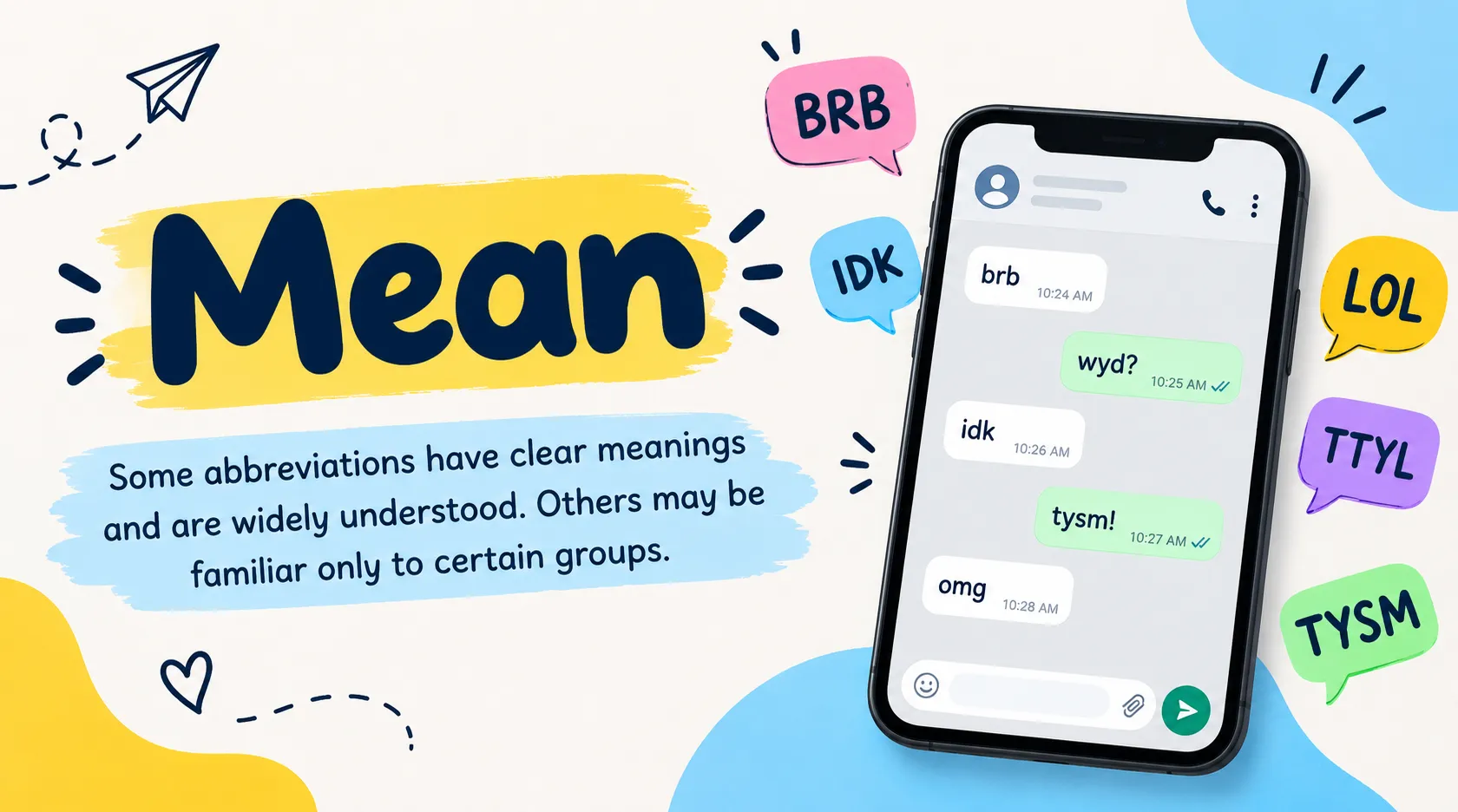
When you receive a text message with an unfamiliar word or short phrase, it can be hard to understand what the sender means.
You may read the message again, check the conversation, or search online for an answer. This is common because people use short forms, slang, and abbreviations when chatting with friends, posting on social media, or sending quick replies.
If you have searched for “what does mean in text,” you may be trying to understand a word, phrase, or abbreviation that someone used in a message.
However, this search does not include the specific word you want to understand. The meaning depends on the term, the sentence, and the situation.
For example, “LOL” usually means “laughing out loud,” while “BRB” means “be right back.” Other expressions can have more than one meaning, depending on who uses them and where they appear.
This guide explains how to find the meaning of texting slang, understand common abbreviations, and read messages with greater confidence. You will also learn how to recognize tone, avoid common mistakes, and choose a suitable reply when a message is unclear.
What Does “Mean in Text” Mean in Text?
The phrase “mean in text” refers to the meaning of a word, abbreviation, or expression used in a text message. People often search for this phrase when they see unfamiliar slang online. The exact answer depends on the term they are asking about. Common examples include abbreviations, casual expressions, playful phrases, and words with different meanings in different conversations.
The Most Common Meanings of “Mean in Text”
Texting language includes many short forms and expressions. Some save time, while others help people express feelings or communicate in a casual way. Understanding the main types can help you work out what a sender is trying to say.
1. Texting Abbreviations
Texting abbreviations are shortened forms of words or phrases. People use them to write messages quickly, especially when talking with friends.
Some abbreviations have clear meanings and are widely understood. Others may be familiar only to certain groups.
Common examples:
- LOL: Laughing out loud.
- BRB: Be right back.
- BTW: By the way.
- IDK: I don’t know.
- TTYL: Talk to you later.
- TYSM: Thank you so much.
Example conversation:
Person A: Are you coming to the party?
Person B: IDK yet.
Here, IDK means the person has not decided or does not know the answer yet.
When you see an abbreviation, read the full sentence before deciding what it means. This helps you avoid confusing one short form with another.
2. Internet Slang
Internet slang includes words and expressions that become popular through online conversations, videos, gaming, and social media. These terms may not follow formal English rules, but they can be easy to understand once you learn how people use them.
Common examples:
- NGL: Not gonna lie.
- TBH: To be honest.
- FR: For real.
- BTW: By the way.
- IMO: In my opinion.
Example conversation:
Person A: That movie was better than I expected.
Person B: FR, the ending was amazing.
In this example, FR means “for real.” The sender agrees with the other person’s opinion and emphasizes that they genuinely feel that way.
Internet slang can change over time. A term may become popular among teenagers or online communities before other people begin using it. Therefore, checking the surrounding conversation is often more useful than relying on a single definition.
3. Expressions That Show Feelings
Some texting expressions communicate emotions rather than simply shortening a sentence. They can show happiness, surprise, frustration, affection, or uncertainty.
Common examples:
- OMG: Oh my God.
- SMH: Shaking my head.
- Aww: A response to something sweet or touching.
- Yikes: A reaction to something awkward or uncomfortable.
- LOL: Laughter or a lighthearted reaction.
Example conversation:
Person A: I accidentally sent the message to the wrong group.
Person B: OMG, what did they say?
Here, OMG expresses surprise. It does not necessarily mean the sender is angry or upset.
The same expression can have different emotional effects depending on the situation. For example, LOL may show genuine amusement, soften a serious message, or make a sentence sound less formal.
4. Words With More Than One Meaning
Some short forms have several possible meanings. The sender’s age, location, interests, and conversation topic can affect how a term is understood.
For example, “PM” can mean “private message” in online conversations. In other situations, it can refer to the afternoon or evening time period, such as 6 PM.
Similarly, “OP” can mean “original poster” in an online discussion or “overpowered” in gaming.
Example conversation:
Person A: The OP explained everything in the comments.
Person B: I agree. The post was helpful.
In this context, OP most likely means “original poster,” the person who created the post.
Now consider a gaming conversation:
Person A: That weapon is too OP.
Here, OP means “overpowered,” suggesting that the weapon is stronger than it should be.
The important lesson is simple: never assume that every abbreviation has only one meaning. Look at the subject of the conversation and how the term is used.
How “Mean in Text” Is Used in Real Conversations
People use texting slang differently depending on where they communicate. A word that sounds normal between friends may feel confusing in a professional message. Understanding the setting can help you interpret the message correctly.
Friends & Casual Texting
Friends often use abbreviations because they already understand each other’s communication styles. Short forms make everyday messages quick and relaxed.
Common examples include LOL, IDK, BRB, NGL, and TTYL.
Example:
Friend A: Are we meeting at 7?
Friend B: IDK, I’ll ask Sam.
The reply means the person does not know the plan yet.
Friends may also use personal abbreviations, inside jokes, or expressions that only make sense to their group. These terms may not have a widely accepted definition.
If you receive an unfamiliar expression from a friend, consider the topic and your previous conversations. If it is still unclear, asking what they mean is perfectly normal.
Instagram & Snapchat
Instagram and Snapchat encourage quick communication through direct messages, stories, comments, and captions. Users often write in a casual style and use abbreviations to save space or create a particular tone.
Common examples include:
- DM: Direct message.
- TBH: To be honest.
- NGL: Not gonna lie.
- FR: For real.
- WYD: What are you doing?
Example:
Person A: NGL, your new profile picture looks great.
Person B: Thank you!
Here, NGL introduces an honest-sounding opinion or compliment.
On social media, the same abbreviation may appear in a caption, a private message, or a comment. Its basic meaning may stay the same, but its tone can change.
For example, “FR?” may be a request for confirmation, while “FR!” may show strong agreement. Punctuation and the rest of the conversation can provide useful clues.
Dating Apps
People often use texting slang on dating apps to keep conversations relaxed and friendly. Short forms can help start a conversation, show interest, or make a message sound playful.
Common examples include:
- WYD: What are you doing?
- HMU: Hit me up.
- ILY: I love you.
- NGL: Not gonna lie.
- WYA: Where are you at?
Example:
Person A: NGL, I like talking to you.
Person B: Same here. You’re fun to talk to.
In this conversation, NGL introduces a personal feeling. It may suggest interest, but it does not automatically mean romantic love.
A common mistake is assuming that every friendly abbreviation has a romantic meaning. Someone asking “WYD?” may simply be starting a conversation. The full message, previous interactions, and relationship between the people matter more than one abbreviation.
If a message seems flirty, look for a pattern of behavior instead of making a decision based on a single word.
Gaming & Online Communities
Gaming communities use abbreviations to communicate quickly during matches, group chats, and live streams. Messages often need to be short because players are busy playing.
Common examples include:
- GG: Good game.
- GLHF: Good luck, have fun.
- AFK: Away from keyboard.
- OP: Overpowered or original poster, depending on context.
- NPC: Non-player character in a game.
Example:
Player A: That boss is impossible to beat.
Player B: Your team needs a better strategy. GG if you win this round.
GG usually means “good game,” although its tone depends on the situation. It can be friendly, respectful, sarcastic, or used to signal that a match is effectively over.
Gaming slang can also have meanings that are uncommon outside the gaming world. If you see a term during a match, check whether it refers to a character, weapon, strategy, or player action.
Work or Professional Chat
People sometimes use abbreviations in workplace messages, especially when communicating through team chat apps. However, not every casual expression is suitable for formal communication.
Common workplace abbreviations include:
- FYI: For your information.
- ASAP: As soon as possible.
- ETA: Estimated time of arrival.
- EOD: End of day.
- OOO: Out of office.
Example:
Manager: Can you send me the report by EOD?
Employee: Yes, I’ll send it before the end of the day.
In this case, EOD refers to the end of the workday.
When communicating professionally, choose abbreviations that your colleagues are likely to understand. Avoid unfamiliar slang when writing to clients, managers, or people outside your team.
If an abbreviation could be unclear, write the full phrase the first time. Clear communication is more important than saving a few words.
Is “Mean in Text” Rude, Flirty, or Offensive?
The phrase “mean in text” is not itself rude, flirty, or offensive. It is a way of asking what a word or expression means in a message. However, the slang term you are trying to understand may carry a particular tone.
To understand the tone, consider three important factors: the words used, the situation, and the relationship between the people.
When Texting Slang Sounds Friendly
A casual abbreviation can make a message feel relaxed and warm.
Example:
Friend A: Thanks for helping me with my homework.
Friend B: Np!
Here, Np means “no problem.” It is a casual way to say that helping was not a problem.
When It Sounds Flirty
Some expressions may suggest interest when they appear in a romantic conversation. However, the same words may be completely ordinary between friends.
Example:
Person A: NGL, you looked really nice today.
Person B: Thank you! That’s sweet.
The message may be flirty because it contains a personal compliment. The abbreviation NGL does not create the romantic meaning on its own.
When It Sounds Rude
Short replies can sometimes appear cold, impatient, or dismissive. This may happen when the message lacks context or follows an argument.
Example:
Person A: Can you explain what happened?
Person B: IDK. Stop asking.
The phrase IDK is neutral by itself, but the full reply sounds annoyed because of the second sentence.
When It May Be Offensive
Some abbreviations refer to insults, sensitive topics, or language that is inappropriate in certain settings. Their meaning may also vary across cultures and online communities.
If you see a potentially offensive term, do not assume it is harmless simply because it is short. Check its meaning and consider who will read it before using it yourself.
The best approach is to interpret the whole message rather than judging a person by one abbreviation.
How to Respond When Someone Says “Mean in Text”
If someone sends you an unfamiliar abbreviation or expression, your reply depends on whether you understand the message and what kind of conversation you are having.
You do not need to know every slang term. Asking a simple question can prevent confusion.
Casual Replies
Use these replies when chatting with friends or people you know well.
- “What does that mean?”
- “Wait, explain that.”
- “I haven’t seen that one before.”
- “What do you mean by that?”
- “Oh, I get it now.”
Example:
Friend A: That was so random, ngl.
Friend B: Wait, what does ngl mean?
Friend A: Not gonna lie.
This keeps the conversation natural and helps you learn the expression.
Funny Replies
If the conversation is playful, you can ask for clarification in a lighthearted way.
- “Translate that into normal English.”
- “My slang dictionary needs an update.”
- “Hold on, I need subtitles for that.”
- “Teach me the internet language.”
Use humor only when it fits your relationship with the sender. A joke may not work well if the other person is upset or discussing something serious.
Neutral Replies
Neutral replies are useful when you want a clear answer without sounding overly casual.
- “Could you explain what that means?”
- “I’m not familiar with that abbreviation.”
- “Can you clarify your message?”
- “I want to make sure I understand correctly.”
These responses work in group chats, online discussions, and conversations with people you do not know well.
Professional Replies
In a work conversation, it is best to stay clear and polite.
- “Could you clarify that abbreviation?”
- “Would you mind writing out the full term?”
- “I want to make sure I understand your request correctly.”
- “Could you explain what you mean in this context?”
Example:
Colleague: Please send the files ASAP.
You: Certainly. Just to confirm, do you need them within the next hour?
This response focuses on the task rather than assuming what the sender means by ASAP.
Common Misunderstandings About “Mean in Text”
Texting slang can create confusion because messages often lack facial expressions, voice tone, and other clues that help people understand spoken language.
Here are some common mistakes to avoid.
1. Assuming Every Abbreviation Has One Meaning
An abbreviation may have several meanings across different communities.
For example, OP can mean “original poster” in a discussion forum and “overpowered” in gaming. Choosing the wrong definition can change the meaning of an entire message.
How to avoid it: Read the sentence and identify the topic before choosing a definition.
2. Thinking Short Replies Always Show Anger
A message such as “K” may look cold to one person but completely normal to another. Some people prefer short messages because they are busy or do not enjoy typing long replies.
How to avoid it: Consider the person’s usual texting style and the conversation before deciding they are upset.
3. Assuming Slang Always Means Something Romantic
Expressions such as ILY, WYD, or HMU can appear in friendly, family, or romantic conversations.
How to avoid it: Look at the full message and the relationship. Do not assume romantic interest without other signs.
4. Confusing Similar Abbreviations
Some short forms look alike but mean different things.
For example:
- IDK: I don’t know.
- IDC: I don’t care.
- IKR: I know, right?
- IMO: In my opinion.
Mixing these up can cause misunderstandings, especially when a conversation is moving quickly.
How to avoid it: Check the exact letters rather than guessing from memory.
5. Ignoring Punctuation and Context
“Really?” may express surprise, doubt, excitement, or annoyance. Similarly, “fine” can be sincere or frustrated.
How to avoid it: Read the messages before and after the expression. Look at the conversation as a whole instead of focusing on one word.
Similar Slang Terms You Should Know
Learning common abbreviations makes it easier to understand messages on social media, in group chats, and during everyday conversations.
Here are 12 useful terms:
- LOL: Laughing out loud; often used to show amusement or keep a message light.
- IDK: I don’t know; used when someone is unsure of an answer.
- TBH: To be honest; introduces an honest opinion or statement.
- NGL: Not gonna lie; often used before an honest-sounding comment.
- FR: For real; shows agreement or emphasizes that something is genuine.
- BRB: Be right back; tells someone that you will return shortly.
- TTYL: Talk to you later; a casual way to end a conversation.
- WYD: What are you doing?; often used to start or continue a chat.
- WYA: Where are you at?; asks about someone’s location.
- HMU: Hit me up; asks someone to contact you.
- IMO: In my opinion; signals that a statement reflects a personal view.
- SMH: Shaking my head; expresses disappointment, disbelief, or disapproval.
These definitions cover common uses, but context still matters. Some expressions can carry a different tone in a particular community or conversation.
If you encounter a new term, write down the full sentence and check how the abbreviation is used. This makes it easier to remember the correct meaning later.
When You Should Avoid Using “Mean in Text”
Understanding slang is useful, but there are situations where casual abbreviations may not be the best choice. Knowing when to use plain language can help you communicate more clearly and avoid unnecessary confusion.
Professional Settings
Avoid unfamiliar slang in formal emails, job applications, client messages, and important workplace discussions.
For example, instead of writing “Send it ASAP,” you might write, “Please send the file by 3 PM today.”
The second message gives a clearer deadline. It also reduces the chance that the recipient will misunderstand how urgently you need the file.
Common workplace abbreviations are fine when everyone understands them. However, spelling out an important instruction is often safer.
Cross-Cultural Chats
People from different countries and language backgrounds may understand English slang differently. An expression that is common in one online community may be unfamiliar or confusing in another.
For example, a regional abbreviation may not have the same meaning everywhere. Some slang terms may also sound rude when translated literally.
Use simple words when speaking with someone who may not know the expression. If confusion occurs, explain what you meant instead of expecting the other person to understand automatically.
Sensitive Situations
Avoid relying on slang when discussing serious topics, personal problems, health concerns, disagreements, or emotional situations.
A short reply such as “LOL” may appear dismissive when someone is sharing a difficult experience. Even if you intend to make the conversation less tense, the other person may feel that you are not taking them seriously.
In these situations, use clear and caring language.
For example, instead of replying “IDK” to someone asking for help, you could say, “I’m not sure, but I’ll try to help you find an answer.”
This response is more supportive and explains your uncertainty without ending the conversation.
FAQs
What does “mean in text” mean?
“Mean in text” refers to the meaning of a word, phrase, or abbreviation in a text message. To find the answer, you need to identify the specific term and consider the context in which it appears.
How do I find out what a texting abbreviation means?
Write the exact abbreviation into a search engine with the words “meaning in text.” Read the surrounding sentence and compare possible definitions. If you still cannot tell, ask the sender what they meant.
Why do people use slang in text messages?
People use slang to save time, sound casual, express feelings, and connect with friends or online communities. Abbreviations can make messages shorter, but unfamiliar terms may also cause confusion.
Can one texting abbreviation have multiple meanings?
Yes. Some abbreviations have different meanings depending on the topic, platform, or community. For example, OP may mean “original poster” in a discussion or “overpowered” in gaming.
Does texting slang always mean something rude or flirty?
No. Most texting abbreviations are neutral, but the tone depends on the words and situation. A term may sound friendly, sarcastic, flirty, or rude depending on how it is used.
Should I use texting slang at work?
Use common abbreviations only when you know your colleagues understand them. Avoid unfamiliar slang in formal emails and important messages. Clear wording helps prevent mistakes and misunderstandings.
What should I do if I do not understand a text message?
Ask the sender to explain the unclear word or phrase. You can say, “What does that mean?” or “Could you explain that abbreviation?” Asking politely is better than guessing and misunderstanding the message.
Final Thoughts
Understanding what a word means in text messages becomes easier when you pay attention to the exact expression, the surrounding sentence, and the relationship between the people talking.
Common abbreviations such as LOL, IDK, NGL, and BRB can make everyday conversations faster, while other expressions may have different meanings across social media, gaming, dating apps, and workplace chats.
Remember that slang does not always have one fixed definition. Tone can also change depending on the situation, punctuation, and the sender’s usual communication style.
If you see an unfamiliar term, check its meaning and read the whole conversation before deciding what the sender intends. When the meaning is still unclear, ask a simple question.
The goal is not to memorize every slang word. It is to understand messages accurately, respond naturally, and communicate with confidence.

Ethan Parker is a creative content writer passionate about pets, animals, and unique name ideas. He loves creating fun and engaging content that helps readers discover the perfect names with ease.