
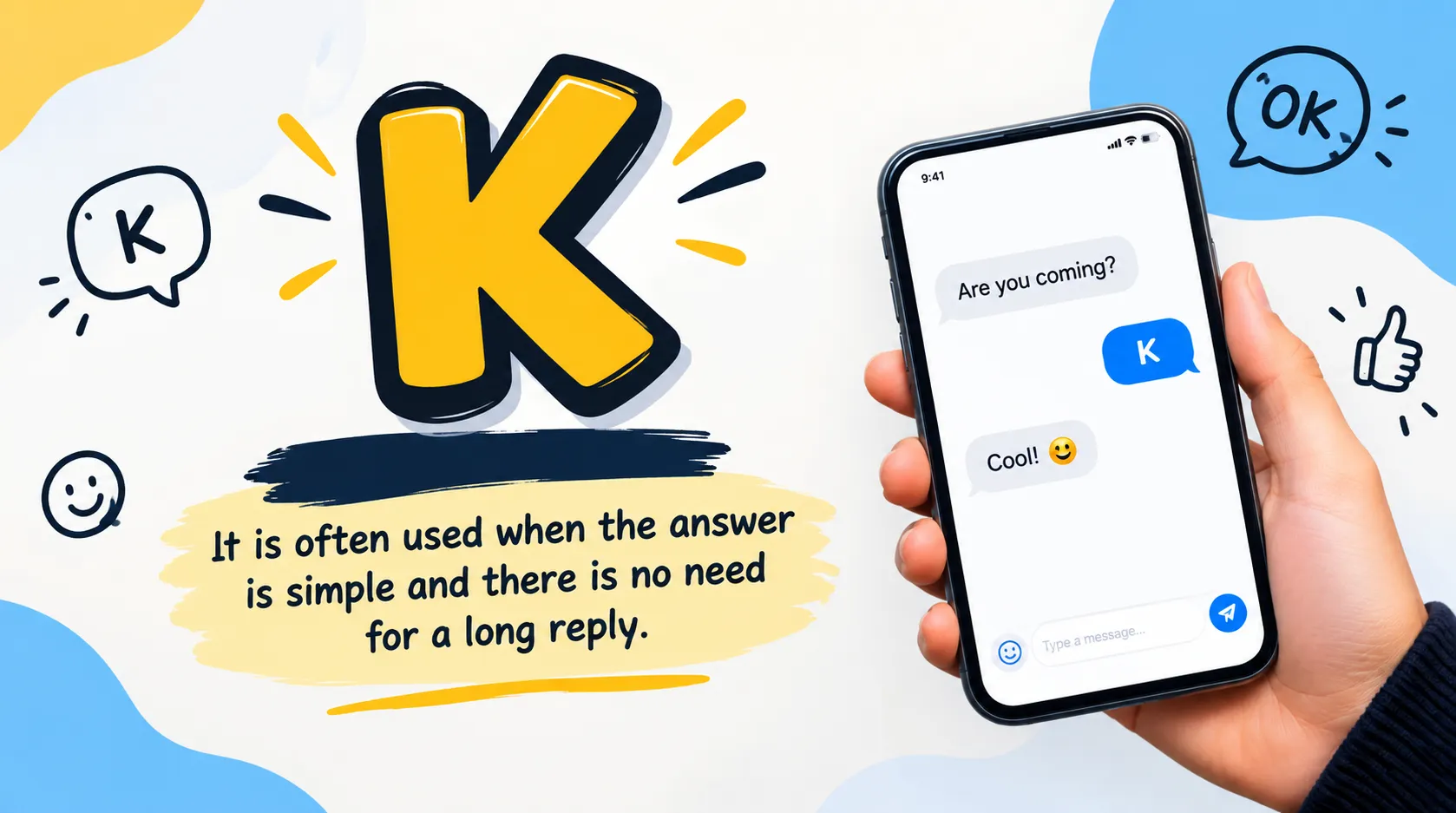
Have you ever sent someone a message and received only one letter in reply: “K”? It may look simple, but it can leave you wondering what the other person really means. Are they busy, upset, bored, or just saying okay? The answer depends on the conversation and the person sending it.
If you are searching for what does k mean in text, you are not alone. Many people use this short reply in text messages, Instagram DMs, Snapchat chats, dating apps, and online conversations.
Some people use it because typing one letter is quick. Others use it to end a conversation without saying much.
The tricky part is that “K” can sound different from “Okay” or “OK.” In some chats, it is a normal and friendly response. In others, it may feel cold, rude, or annoyed.
This guide explains the common meanings of “K,” how people use it in real conversations, and how to respond without making the wrong guess. You will also learn when this short reply is harmless and when it may be worth asking for clarification.
What Does “K” Mean in Text?
In text messages, “K” usually means “Okay.” It shows that someone has read your message, understood what you said, or agrees with a plan. Depending on the situation, it can also sound cold, impatient, or uninterested. The meaning depends on the conversation, the relationship, and the sender’s usual texting style.
For example, a friend may send “K” to confirm a meeting time. A partner may use it after an argument, making the reply feel distant. Someone who is busy may simply be trying to answer quickly.
The letter itself does not prove that the sender is angry. To understand it correctly, look at what happened before the message and how the person normally communicates.
The Most Common Meanings of “K”
Although “K” usually stands for “Okay,” it can express different feelings in everyday conversations. Here are the most common meanings and how to recognize them.
1. K Means Okay
The most common meaning of “K” is a short form of “Okay.” People use it to confirm information, accept a suggestion, or show that they understand.
It is often used when the answer is simple and there is no need for a long reply.
Example:
Person A: “I will meet you at 5 PM.”
Person B: “K.”
Meaning: The person has received the information and is likely confirming the plan.
This use is common among friends, classmates, siblings, and people who send short messages throughout the day.
2. K Means I Understand
Sometimes, “K” means that the person understands what you said. It does not always mean they agree with you. They may simply be acknowledging your message.
Example:
Person A: “Please bring your notebook tomorrow.”
Person B: “K.”
Meaning: The person understands the request.
In this situation, there is usually no reason to assume anything negative. The message is short because the reply does not need much detail.
3. K Can Sound Cold or Rude
A single “K” can feel cold when the conversation is emotional or when the sender usually writes longer replies. It may sound as if the person wants to end the conversation.
Example:
Person A: “I am sorry I could not come today. I had a problem at home.”
Person B: “K.”
Possible meaning: The person may feel disappointed, upset, or unsure how to respond.
However, this is only one possible interpretation. They might also be busy, tired, or unsure what to say. One short message is not enough to know how someone feels.
4. K Means Fine, Let’s Move On
People sometimes use “K” when they want to acknowledge something and move on. They may not want to discuss the topic any further.
Example:
Person A: “We can talk about this tomorrow instead.”
Person B: “K.”
Meaning: The person accepts the suggestion or is willing to leave the discussion for later.
This can be a normal way to finish a conversation. It may feel negative if the discussion involved a disagreement, but the surrounding messages matter more than the letter alone.
5. K Is a Quick Reply When Someone Is Busy
Some people prefer short messages because they are working, studying, traveling, or doing something else. For them, “K” is simply a fast way to reply.
Example:
Person A: “I am outside your house.”
Person B: “K, coming.”
Meaning: The person has seen the message and is responding quickly.
In this case, the additional words make the meaning clearer. The sender is not necessarily being rude; they may just be in a hurry.
How “K” Is Used in Real Conversations
The meaning of “K” can change depending on the platform and the relationship between the people chatting. Here is how it is commonly understood in different settings.
Friends & Casual Texting
Friends often use “K” to confirm plans, answer simple questions, or acknowledge a message. It can be especially common in chats where both people prefer short replies.
Example 1:
Friend A: “Movie at 7?”
Friend B: “K.”
Meaning: The friend is likely confirming the plan.
Example 2:
Friend A: “Send me the notes when you get home.”
Friend B: “K, I will.”
Meaning: The friend understands and agrees to do it.
Among close friends, a short reply may be completely normal. Some people rarely use full sentences when texting.
However, if your friend usually replies with detailed messages and suddenly starts sending only “K,” you may notice the change. Even then, consider the situation before assuming they are upset.
Instagram & Snapchat
On Instagram and Snapchat, “K” can appear in direct messages, replies to stories, and casual conversations. People often use short replies when reacting to updates or confirming information.
Example 1:
You: “I posted the pictures. Check them out.”
Friend: “K.”
Meaning: Your friend has acknowledged your message.
Example 2:
You: “I will send you the snap later.”
Friend: “K.”
Meaning: Your friend has understood what you said.
A short “K” may feel less friendly than a reply such as “Okay, thanks!” However, social media messages are often brief, and not everyone uses extra words or punctuation to show warmth.
Do not judge someone’s feelings based on one letter alone. Look at their other messages and how they interact with you over time.
Dating Apps
On dating apps, “K” can feel more personal because people often look for signs of interest, attraction, or a lack of effort.
Example 1:
You: “Would you like to meet for coffee this weekend?”
Match: “K.”
Possible meaning: They may be agreeing, but their reply does not clearly show excitement.
Example 2:
You: “I had a really nice time talking to you.”
Match: “K.”
Possible meaning: The reply may feel distant, or the person may not know how to continue the conversation.
In dating, it is better to look at the whole pattern. Does the person ask questions, make plans, and continue conversations? Or do they regularly send one-word replies without showing interest?
A single “K” cannot prove that someone likes or dislikes you. If their replies remain unclear, you can ask a simple question or give them space to respond.
Gaming & Online Communities
In gaming chats, group messages, and online communities, “K” is often used as a quick acknowledgment. Players may not have time to type full sentences while playing.
Example 1:
Player A: “Meet at the next checkpoint.”
Player B: “K.”
Meaning: The player has received the instruction.
Example 2:
Team member: “We start in two minutes.”
Player: “K, ready.”
Meaning: The player understands the plan and is preparing to start.
In fast-moving chats, short replies help people communicate quickly. They are not always meant to show emotion.
Still, tone can depend on the situation. During a disagreement or a heated game, “K” might sound dismissive. The message before it can help you understand why it was sent.
Work or Professional Chat
At work, “K” may be used to acknowledge a task, confirm a detail, or show that a message has been received. However, it can appear too casual or abrupt in formal communication.
Example 1:
Manager: “Please send the report before 3 PM.”
Employee: “K.”
Meaning: The employee has acknowledged the instruction.
Example 2:
Coworker: “The meeting has moved to Thursday.”
You: “K, thank you for letting me know.”
Meaning: You have understood the update.
In professional settings, “Okay,” “Understood,” or “Thanks for the update” often sounds more polite and clear than a single “K.” This is especially useful when communicating with managers, clients, customers, or people you do not know well.
Is “K” Rude, Flirty, or Offensive?
The letter “K” is not automatically rude, flirty, or offensive. Its tone depends on the situation, the relationship, and the way the sender usually texts.
When “K” Sounds Rude
“K” may feel rude when someone sends it after a serious message, an apology, or a personal question. It can sound like the person does not want to continue talking.
For example:
You: “I feel bad about what happened yesterday. Can we talk?”
Them: “K.”
This reply may feel cold because your message asks for an emotional response, but you receive only one letter.
Still, the sender may be upset, busy, or unsure how to respond. You cannot know the exact reason from the letter alone.
When “K” Is Completely Normal
“K” is usually harmless when the conversation is simple and practical.
For example:
You: “I will call you at 8.”
Them: “K.”
There is no strong reason to read this as a negative message. The person may simply be confirming the time.
Can “K” Be Flirty?
“K” is not usually a flirting term. It does not directly show romantic interest or attraction.
However, two people may have their own playful texting style. A short reply could be part of a joke, teasing, or a familiar pattern between them.
For example:
You: “You better save me a seat.”
Them: “K, only one.”
The playful part comes from the full conversation, not from the letter “K” itself.
Why Does “K” Feel Different From “Okay”?
Text messages do not include voice tone, facial expressions, or body language. As a result, people often use the length of a reply to guess how someone feels.
“K” is shorter than “Okay,” “Okay!” or “Okay, sounds good.” Because it contains little emotional detail, some readers may interpret it as distant or impatient.
But a short reply is not proof of anger. The sender’s normal habits and the situation are more useful clues.
How to Respond When Someone Says “K”
You do not need to send a long message every time someone replies with “K.” Choose your response based on the conversation.
Casual Replies
Use these replies when everything seems normal and you just want to continue chatting.
- “Okay, see you then.”
- “Cool, thanks!”
- “Sounds good.”
- “Alright, talk later.”
- “Great, see you soon.”
Example:
Them: “K.”
You: “Cool, see you at 5.”
This keeps the conversation simple and friendly.
Funny Replies
If you are close to the person and often joke with each other, you can respond playfully. Avoid teasing someone if they seem genuinely upset.
- “Just K? So many words!”
- “That was a very detailed reply.”
- “Okay, one-letter champion.”
- “Short and sweet, I see.”
- “Saving your keyboard energy?”
Example:
Friend: “K.”
You: “Wow, the full paragraph!”
This can work between friends who understand each other’s humor. It may sound sarcastic or annoying if the relationship is not that close.
Neutral Replies
If you are unsure about the tone, a neutral response is often the safest choice.
- “Alright.”
- “Got it.”
- “Okay, no problem.”
- “Understood.”
- “Thanks for confirming.”
Example:
Them: “K.”
You: “Got it. Let me know if anything changes.”
This avoids making assumptions about the sender’s mood.
Professional Replies
For work chats, choose clear and polite wording.
- “Understood, thank you.”
- “Okay, I will take care of it.”
- “Thanks for confirming.”
- “Noted. I will send the update shortly.”
- “Understood. Please let me know if you need anything else.”
Example:
Manager: “Please update the document today.”
You: “Understood, I will update it today.”
This makes your response clear and professional.
What If You Think They Are Angry?
If “K” comes after an argument or a sensitive conversation, you do not need to confront the person immediately.
You could say:
“Hey, I am not sure how you feel about our conversation. Are we okay?”
Or:
“I might be reading too much into your reply, but is something bothering you?”
These messages give the other person a chance to explain without accusing them of being rude. If they need time, allow them some space.
Common Misunderstandings About “K”
Because “K” is so short, it is easy to misunderstand. Here are some common mistakes to avoid.
1. Assuming the Person Is Angry
Many people believe that a single “K” means someone is mad. Sometimes it may carry that tone, but it can also be a normal acknowledgment.
Better approach: Look at the conversation before deciding what the person means.
2. Thinking “K” Always Means Disinterest
A short reply does not automatically mean someone is bored or no longer interested in talking to you.
Some people naturally send brief messages. Others may be busy or have little to add.
Better approach: Look for a repeated pattern rather than judging one message.
3. Confusing “K” With a Clear Agreement
“K” often means “Okay,” but it may only acknowledge that the person has seen your message. It does not always mean they strongly agree with every detail.
Example:
You: “I think we should change the whole plan.”
Them: “K.”
They may have understood your suggestion without fully agreeing to it.
Better approach: If the decision matters, ask a direct question such as, “Are you okay with this plan?”
4. Assuming “K” Is Always Passive-Aggressive
Passive-aggressive communication involves showing annoyance indirectly instead of stating it clearly. A short “K” can sometimes feel this way, especially after a disagreement.
However, the letter itself does not prove passive aggression.
Better approach: Consider the sender’s usual style and whether there are other signs of tension.
5. Believing Punctuation Always Reveals Emotion
People sometimes compare “K,” “K.” and “K!” as if each has one fixed emotional meaning. In real conversations, punctuation habits differ from person to person.
One person may use periods in every message. Another may use an exclamation mark to sound excited.
Better approach: Learn how the person normally texts before interpreting small differences.
Similar Slang Terms You Should Know
If you want to understand short replies in text messages, these related terms are useful.
- OK: A common way to show agreement, understanding, or acknowledgment.
- Okay: A standard version of “OK” that can sound neutral, friendly, or serious.
- KK: A casual form of “Okay,” often used to sound quick and friendly.
- Bet: Slang meaning “Okay,” “agreed,” or “you can count on it.”
- Sure: Shows agreement or willingness, depending on the context.
- Gotcha: Means “I understand” or “I get what you mean.”
- Aight: An informal form of “All right,” often used in casual conversations.
- Yep: A casual way to say “Yes.”
- Yup: Another informal version of “Yes.”
- NVM: Short for “Never mind,” used when something is no longer needed or important.
- IDC: Short for “I don’t care,” which can sound dismissive depending on the situation.
- Kk, thanks: A casual acknowledgment followed by an expression of thanks.
These terms are not perfect replacements for one another. For example, “Bet” can show confident agreement, while “NVM” means something different from “K.” Always consider the complete message.
When You Should Avoid Using “K”
Although “K” is common in casual texting, there are times when a fuller reply is a better choice.
Professional Settings
Avoid replying with only “K” when speaking to a client, manager, teacher, or customer. It may look rushed or disrespectful, even if you do not mean it that way.
Instead of:
“K.”
Try:
“Understood, thank you.”
Or:
“Okay, I will complete the task today.”
These replies show that you have understood the message and make your response sound more professional.
Cross-Cultural Chats
People from different backgrounds may understand short messages differently. Some may see “K” as a normal, efficient reply, while others may consider it cold or impolite.
If you are talking to someone you do not know well, use a clear and friendly response. “Okay, thank you” is usually easier to understand than a single letter.
Sensitive Situations
Avoid using only “K” when someone shares bad news, apologizes, or talks about a personal problem. The reply may make them feel ignored, even if that is not your intention.
For example, if a friend says they are having a difficult day, replying with “K” may sound uncaring.
A better response could be:
“I am sorry you are going through that. Do you want to talk about it?”
You do not need to write a long message every time. A few thoughtful words can show that you care.
FAQs
What does K mean in text from a girl?
When a girl sends “K,” she usually means “Okay.” She may be confirming something or acknowledging your message. It does not automatically mean she is angry, annoyed, or losing interest. Look at the conversation and her usual texting style.
What does K mean in text from a guy?
When a guy sends “K,” it usually means “Okay” or “I understand.” He may be replying quickly or keeping the conversation short. The letter alone cannot tell you whether he is upset, interested, or uninterested.
Does K mean someone is mad at you?
Not always. “K” can sound cold after an argument, but it is also a common short reply. Consider what happened before the message and whether the person usually communicates this way. If you are worried, ask politely instead of guessing.
Is K rude in texting?
“K” is not automatically rude. It can seem abrupt because it is shorter than “Okay” or “Thanks.” In casual chats, it is often normal. In professional or emotional conversations, a longer response may sound more respectful.
What is the difference between K and KK?
Both “K” and “KK” can mean “Okay.” Some people use “KK” because it feels more casual or friendly, while “K” may seem more direct. However, these are personal texting habits, not fixed rules.
What does K mean after an argument?
After an argument, “K” may suggest that someone wants to end the conversation, feels upset, or does not know what to say. It may also mean they have understood your message. If the issue matters, give them time and ask calmly whether they want to talk later.
How should I reply when someone texts K?
Your reply depends on the situation. You can say “Sounds good,” “Got it,” or “Okay, see you then” in a normal conversation. If the message seems cold, avoid reacting immediately. Ask a polite question if you need to understand how the person feels.
Final Thoughts
The most common meaning of “K” in text is “Okay.” People use it to acknowledge messages, confirm plans, and show that they understand something. It is popular because it is short, simple, and easy to type.
However, the tone can change with the situation. A single “K” may feel cold after an argument, but it can be completely normal when confirming a meeting or replying to a simple question. It is not automatically rude, flirty, or a sign that someone has lost interest.
The best way to understand this reply is to look at the full conversation, the relationship, and the sender’s usual texting habits. If the meaning is unclear and the issue matters, ask a calm and direct question instead of assuming the worst.
Remember, one letter cannot explain every feeling. Understanding the context will help you read messages more clearly, avoid unnecessary misunderstandings, and communicate better with friends, partners, and coworkers.

Ethan Parker is a creative content writer passionate about pets, animals, and unique name ideas. He loves creating fun and engaging content that helps readers discover the perfect names with ease.