Have you ever received a text that says, “ima call you later” or “ima be there soon”? If you have never seen this slang before, you may wonder what the person is trying to say.
The good news is that IMA is a common texting abbreviation that is easy to understand once you know its meaning.
People often search for “what does ima mean in text” because they see it in messages, social media comments, online chats, or conversations with friends. Since texting uses many short forms, it can be hard to understand every expression, especially when someone writes in a casual style.
In most conversations, IMA means “I’m going to” or “I’m about to.” It is a shortened, informal way of saying that someone plans to do something soon. For example, “ima eat” means “I’m going to eat.”
However, the exact meaning can depend on the sentence and the situation. Someone might use IMA to share a plan, explain what they are doing next, or make a quick promise.
In this guide, you will learn what IMA means, how people use it in real conversations, how to respond, and when you should avoid using it.
What Does “IMA” Mean in Text?
IMA usually means “I’m going to” or “I’m about to” in texting and online conversations. It is an informal spelling of “I’m a-gonna,” often written to show a future action or plan. People use it with friends, on social media, and in casual chats. Its exact meaning depends on the words around it.
For example, “ima text you” means “I’m going to text you.” Similarly, “ima leave now” means “I’m about to leave now.”
IMA is popular because it is short, quick to type, and common in informal online language. You may also see it written as “Imma,” which is another widely used form.
Although IMA is easy to understand in most casual messages, it is not suitable for every situation. Formal writing, school assignments, and professional emails usually require standard English.
The Most Common Meanings of “IMA”
IMA has a few possible interpretations, but the meaning depends on the context. Here are the most common ways to understand it.
1. IMA Means “I’m Going To”
This is the main meaning of IMA in everyday texting. People use it when they want to explain what they plan to do.
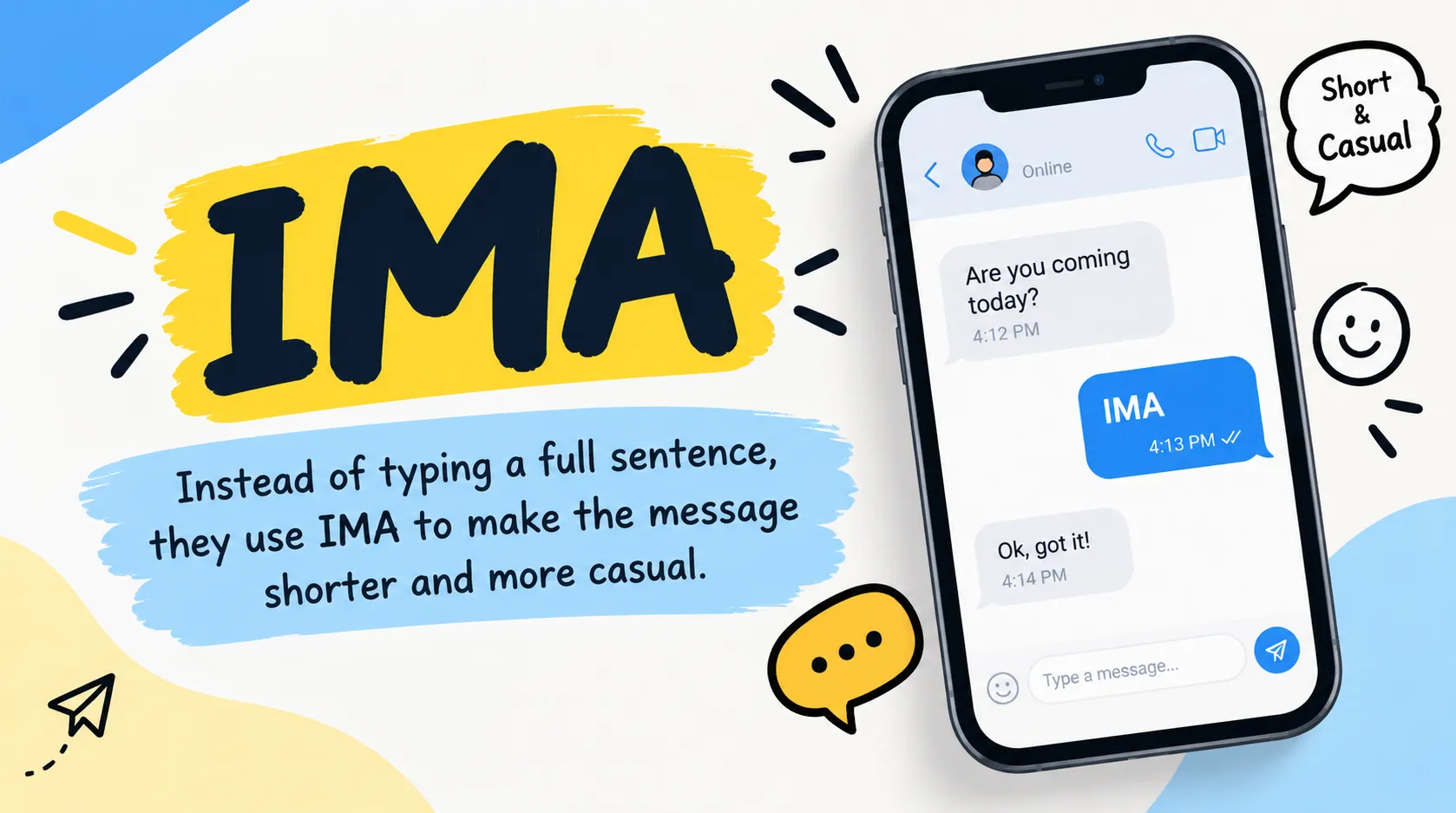
Instead of typing a full sentence, they use IMA to make the message shorter and more casual.
Examples:
- “ima call you tonight” means “I’m going to call you tonight.”
- “ima finish my homework” means “I’m going to finish my homework.”
- “ima buy that shirt” means “I’m going to buy that shirt.”
In each example, the sender is talking about a future action. The person may have already made a plan or may simply be saying what they intend to do next.
2. IMA Means “I’m About To”
IMA can also suggest that an action will happen very soon. This meaning is common when someone is getting ready to do something.
Examples:
- “ima leave” means “I’m about to leave.”
- “ima eat rn” means “I’m about to eat right now.”
- “ima start the game” means “I’m about to start the game.”
The difference is small but useful. “I’m going to leave” can describe a general plan, while “I’m about to leave” often suggests that the action is very close.
However, IMA does not always mean that something will happen immediately. Read the full sentence to understand the timing.
3. IMA Can Express an Intention or Decision
Sometimes, people use IMA to show that they have decided to do something. It can make their message sound direct and confident.
Examples:
- “ima tell her the truth” means “I’m going to tell her the truth.”
- “ima try again tomorrow” means “I’m going to try again tomorrow.”
- “ima focus on myself” means “I’m going to focus on myself.”
The sender is sharing an intention rather than asking for permission. Depending on the situation, the message may sound serious, determined, or relaxed.
For example, “ima focus on myself” might appear in a conversation about personal goals or moving on from a difficult relationship.
4. IMA May Have Other Meanings in Special Contexts
In some conversations, IMA may stand for something else, such organization names, job titles, or technical terms. These meanings are less common in ordinary texting and depend on the topic.
For example, someone discussing a professional association might use IMA as its official abbreviation. A person chatting about a group or project may also use the letters as a name.
Examples:
- “I have an IMA meeting today.” The meaning depends on the organization being discussed.
- “Check the IMA website.” The abbreviation may refer to a specific group or service.
If the message does not describe an action, do not automatically assume that IMA means “I’m going to.” Check the surrounding conversation or ask the sender what they mean.
How “IMA” Is Used in Real Conversations
IMA appears in different types of online communication. Its meaning usually stays close to “I’m going to,” but the tone can change depending on who is using it and what they are discussing.
Friends & Casual Texting
Friends often use IMA when talking about everyday plans. It helps them send quick messages without writing complete sentences.
Examples:
Friend 1: “ima come over at 6.”
Friend 2: “okay, see you then.”
Here, the first friend means they plan to visit at 6.
Another example:
Friend 1: “ima get some food.”
Friend 2: “get me something too.”
In this conversation, IMA makes the message sound natural and relaxed.
People also use it when talking about studying, sleeping, shopping, meeting friends, or making plans for the weekend. You do not need to use perfect grammar in every casual text, but the meaning should remain clear.
Instagram & Snapchat
IMA is also common on platforms such as Instagram and Snapchat. People may use it in direct messages, comments, captions, or replies to stories.
Examples:
- “ima post this later.”
- “ima reply to everyone tonight.”
- “ima take a break from socials.”
On these platforms, IMA helps users express plans in a short and informal way.
Imagine someone posts a story about going to a concert. You might reply, “ima go next time.” This means you plan to attend a future concert.
The abbreviation can also appear in captions about personal goals or daily activities. It is not limited to one platform, age group, or type of conversation.
Dating Apps
On dating apps, IMA can appear when two people discuss meeting, calling, or spending time together. The abbreviation itself is not automatically romantic or flirty. The rest of the message provides the important clues.
Examples:
- “ima text you when I get home.”
- “ima take you to that place someday.”
- “ima call you after work.”
These messages may show interest, but their tone depends on the relationship and conversation.
For example, “ima take you out this weekend” sounds like a plan for a date if the two people are discussing romance. In another situation, it might simply refer to spending time together.
Do not assume that someone likes you romantically just because they use IMA. Pay attention to their words, actions, and overall communication.
Gaming & Online Communities
Gamers and members of online communities often use IMA to share their next move or explain what they plan to do.
Examples:
- “ima join your lobby.”
- “ima switch characters.”
- “ima play one more match.”
In these situations, IMA helps keep messages short while the conversation moves quickly.
A player might say, “ima push from the left,” to tell teammates that they plan to move toward the left side. The phrase can communicate a decision during a game.
You may also see IMA in group chats about streaming, online events, or gaming sessions. The meaning remains informal and usually refers to an intended action.
Work or Professional Chat
IMA is less suitable for formal workplace communication. Coworkers may still use it in friendly team chats, especially when they already know one another well.
For example:
- “ima send the file in a few minutes.”
- “ima check that report today.”
These messages may be understood in a relaxed team conversation. However, they can sound too informal in a message to a manager, client, or new business contact.
For professional communication, use standard wording instead.
Instead of writing “ima send the report,” write “I’ll send the report shortly.”
Instead of writing “ima check this,” write “I’ll review this and get back to you.”
Clear, standard English helps your message sound professional and avoids confusion.
Is “IMA” Rude, Flirty, or Offensive?
IMA is not normally rude, flirty, or offensive by itself. It is a casual abbreviation that people use to talk about future actions. Its tone depends on the sentence, the relationship between the people, and the situation.
When IMA Sounds Friendly
IMA often sounds friendly when people use it in relaxed conversations.
For example:
“ima come help you later.”
This message suggests that the sender plans to help. It sounds positive because of the helpful action being discussed.
Similarly, “ima call you after dinner” is usually a simple way to share a plan.
When IMA Sounds Flirty
IMA may sound flirty when it appears in a romantic conversation.
For example:
“ima come see you soon.”
If two people are already flirting, this message may suggest that one person wants to spend time with the other.
However, the same sentence can also be friendly or practical. The abbreviation does not prove romantic interest.
When IMA Sounds Rude
IMA can appear in a rude message if the surrounding words are angry, dismissive, or threatening.
For example:
“ima block you if you keep doing that.”
The warning may sound harsh, but the negative tone comes from the whole sentence, not from IMA itself.
Another example is “ima do what I want.” Depending on the conversation, this could sound confident or disrespectful.
How Context Changes the Meaning
People often judge a text by its wording, punctuation, and previous messages. A short message can feel cold when someone expects a longer answer, but that does not always mean the sender is upset.
Before deciding how a message feels, consider:
- What was being discussed?
- Does the sender normally use slang?
- Is the sentence friendly, serious, or angry?
- What happened earlier in the conversation?
These clues help you understand the intended tone without making quick assumptions.
How to Respond When Someone Says “IMA”
Your response depends on what the person plans to do. You usually do not need to mention the abbreviation itself. Simply reply to the message.
Casual Replies
Use these responses when chatting with friends or family.
Message: “ima call you later.”
Possible replies:
- “Okay, talk to you later.”
- “Sounds good.”
- “Cool, I’ll wait.”
- “Alright, no problem.”
Message: “ima come over soon.”
Possible replies:
- “Okay, see you soon.”
- “Bet, I’ll be here.”
- “Cool, just let me know when you’re close.”
These replies are simple and natural.
Funny Replies
If the conversation is playful, you can answer with a joke.
Message: “ima eat everything.”
Possible replies:
- “Save me one bite.”
- “Not the whole kitchen!”
- “Leave something for the rest of us.”
Message: “ima become famous.”
Possible replies:
- “Don’t forget me when you’re rich.”
- “I’ll be waiting for my VIP pass.”
- “Autograph first, please.”
Use funny replies only when you know the other person will understand your humor.
Neutral Replies
Neutral replies work when you want to acknowledge the message without adding much emotion.
Examples include:
- “Okay.”
- “Understood.”
- “Thanks for letting me know.”
- “Alright, keep me updated.”
For example, if someone says, “ima leave in ten minutes,” you can reply, “Okay, thanks for letting me know.”
Professional Replies
In workplace conversations, focus on the plan rather than the slang.
Message: “ima send the report today.”
Possible replies:
- “Thank you. I’ll look out for it.”
- “Sounds good. Please send it when it’s ready.”
- “Thanks for the update.”
If a coworker writes IMA, you do not need to correct them unless you are responsible for formal communication standards. Responding clearly is usually enough.
Common Misunderstandings About “IMA”
Although IMA is easy to understand, readers can still misunderstand it. Here are a few common mistakes to avoid.
Assuming IMA Has Only One Meaning
The most common meaning is “I’m going to” or “I’m about to,” but context matters. In a conversation about an organization, project, or technical subject, IMA may refer to something else.
Always read the complete message before deciding what the letters mean.
Confusing IMA With IMMA or IMMA
People may write “ima,” “imma,” or “I’ma” to express a similar idea. These forms are informal spellings related to “I’m going to.”
For example:
- “ima sleep.”
- “imma sleep.”
- “I’ma sleep.”
All three may mean “I’m going to sleep.” Spelling and personal style vary between users.
Thinking IMA Is Always About the Immediate Future
IMA can refer to something happening soon, but it does not always mean right now.
For example, “ima visit you next month” describes a future plan that is not immediate.
The time reference in the rest of the sentence tells you when the action may happen.
Assuming IMA Is Romantic
If someone writes, “ima call you tonight,” it does not automatically mean they are flirting. They may simply want to discuss something or stay in touch.
Look at the overall conversation instead of judging the abbreviation alone.
Believing It Is Correct in Every Type of Writing
IMA works in informal messages, but it is not standard formal English. Using it in a job application, academic essay, or business proposal may make the writing seem less professional.
Choose your words based on the audience and purpose.
Similar Slang Terms You Should Know
If you understand IMA, learning a few related texting expressions can make online conversations easier to follow.
- IMMA: An informal spelling of “I’m going to,” used in casual texts.
- GONNA: A casual form of “going to,” often used to describe a future action.
- FINNA: A slang expression meaning “getting ready to” or “about to,” especially in African American English and related online speech.
- GON: An informal spelling sometimes used for “going to” or “going,” depending on the speaker and context.
- BRB: “Be right back,” used when someone will return shortly.
- BTW: “By the way,” used to add information or change the subject.
- RN: “Right now,” used to describe the present moment.
- IDK: “I don’t know,” used when someone does not have an answer.
- LMK: “Let me know,” used to ask someone to share information.
- OTW: “On the way,” used when someone is traveling toward a place.
- WYA: “Where you at?” used to ask someone’s location.
- TTYL: “Talk to you later,” used as a casual goodbye.
These expressions serve different purposes. For example, IMA tells someone what you plan to do, while OTW often tells them that you are already on your way.
When You Should Avoid Using “IMA”
IMA is useful in casual texting, but there are situations where another expression is a better choice.
Professional Settings
Avoid IMA in formal emails, job applications, business reports, and messages to people you do not know well.
For example, instead of writing “ima finish the task today,” write “I plan to finish the task today.”
The second version is clearer and more professional. It also works better for readers who are unfamiliar with internet slang.
Cross-Cultural Chats
Not everyone speaks English in the same way. Some people may understand common abbreviations, while others may have never seen them.
If you are speaking with someone who is learning English or comes from a different language background, use simple, complete sentences when clarity matters.
For example, “I’m going to call you later” is easier for most readers to understand than “ima call u l8r.”
Sensitive Situations
Avoid relying on slang when discussing serious topics, sharing important news, making promises, or explaining something that could affect another person’s feelings.
For example, “ima be there for you” may sound supportive to a friend, but a more direct message such as “I’m here for you, and I’ll help however I can” may feel more thoughtful.
In sensitive situations, clear language helps prevent misunderstandings and shows that you are taking the conversation seriously.
FAQs
What does IMA mean in text messages?
IMA usually means “I’m going to” or “I’m about to.” People use it in casual messages to describe something they plan to do.
What does IMA mean from a girl?
When a girl uses IMA, it usually has the same meaning as when anyone else uses it: “I’m going to.” The phrase itself does not indicate romantic interest.
What does IMA mean from a guy?
A guy usually uses IMA to share a plan or explain what he intends to do. The meaning depends on the sentence, not the sender’s gender.
Is IMA the same as IMMA?
Yes, in most casual texting situations, IMA and IMMA express the same idea: “I’m going to.” Both are informal spellings, and people may prefer one over the other.
Does IMA mean I’m about to do something?
Yes, it can. For example, “ima leave” often means “I’m about to leave.” However, it can also describe a plan for a later time.
Is IMA rude or disrespectful?
No, IMA is not rude by itself. It is a casual abbreviation. A message may sound rude because of its wording or situation, but the abbreviation alone is generally neutral.
Can I use IMA in professional messages?
It is better to avoid IMA in formal workplace messages, business emails, and official documents. Use “I’m going to,” “I plan to,” or “I will” instead.
Final Thoughts
IMA is a common abbreviation in casual texting that usually means “I’m going to” or “I’m about to.” People use it to share plans, describe their next action, and keep conversations short and relaxed.
You may see IMA in messages between friends, Instagram comments, Snapchat chats, gaming conversations, and dating app messages. Its meaning is usually simple, but the full sentence helps you understand the timing and tone.
Remember that IMA is not automatically rude, romantic, or offensive. It is an informal expression, and its meaning depends on how someone uses it. You may also see similar forms, such as IMMA and I’ma, in everyday online conversations.
Now that you know what IMA means in text, you can understand it more easily and respond with confidence. Use it with friends when the situation is casual, and choose standard English when communicating professionally.

Ethan Parker is a creative content writer passionate about pets, animals, and unique name ideas. He loves creating fun and engaging content that helps readers discover the perfect names with ease.