
Have you ever received a text that says “dk” and wondered what the person was trying to tell you? Maybe you asked a friend about their plans, and they replied with just two letters.
Or perhaps you saw “dk” in an Instagram comment, Snapchat message, or online conversation and could not figure out its meaning.
The good news is that “dk” is usually simple to understand once you look at the conversation around it. People often use short forms in text messages because they want to reply quickly without typing full sentences.
However, the same letters can have different meanings depending on the person, platform, and topic.
If you are searching for what does dk mean in text, the most common answer is “don’t know.” It is a short way to say that someone does not have an answer or is unsure about something.
In some situations, DK can also refer to a person’s initials, a gaming term, or another meaning linked to a specific community.
This guide explains the common meanings of DK, how people use it in real conversations, how to respond, and how to understand its tone without making the wrong assumption.
What Does “DK” Mean in Text?
In text messages, DK most commonly means “don’t know.” People use it when they are unsure about something or do not have an answer. For example, someone might reply “dk” when asked what time they will arrive. Depending on the context, DK can also represent initials, gaming terms, or other specialized meanings.
The Most Common Meanings of “DK”
The meaning of DK depends on the message, the topic, and the people talking. Here are the most common interpretations you may come across.
1. DK Means “Don’t Know”
The most common meaning of DK in casual texting is “don’t know.” It is a quick way to say that you do not know the answer to a question.
People often use it when chatting with friends, replying to a simple question, or discussing plans. Instead of typing a complete sentence, they use two letters to save time.
Examples:
- Friend: “What time does the movie start?”
- You: “dk, check the website.”
Another example:
- Person A: “Is Sarah coming today?”
- Person B: “dk, she hasn’t replied yet.”
In both examples, DK means the person does not know the answer. It does not automatically mean they are ignoring the question or refusing to help.
You may also see it written as “idk,” which means “I don’t know.” Although the two forms are closely related, IDK is more widely recognized as a common texting abbreviation.
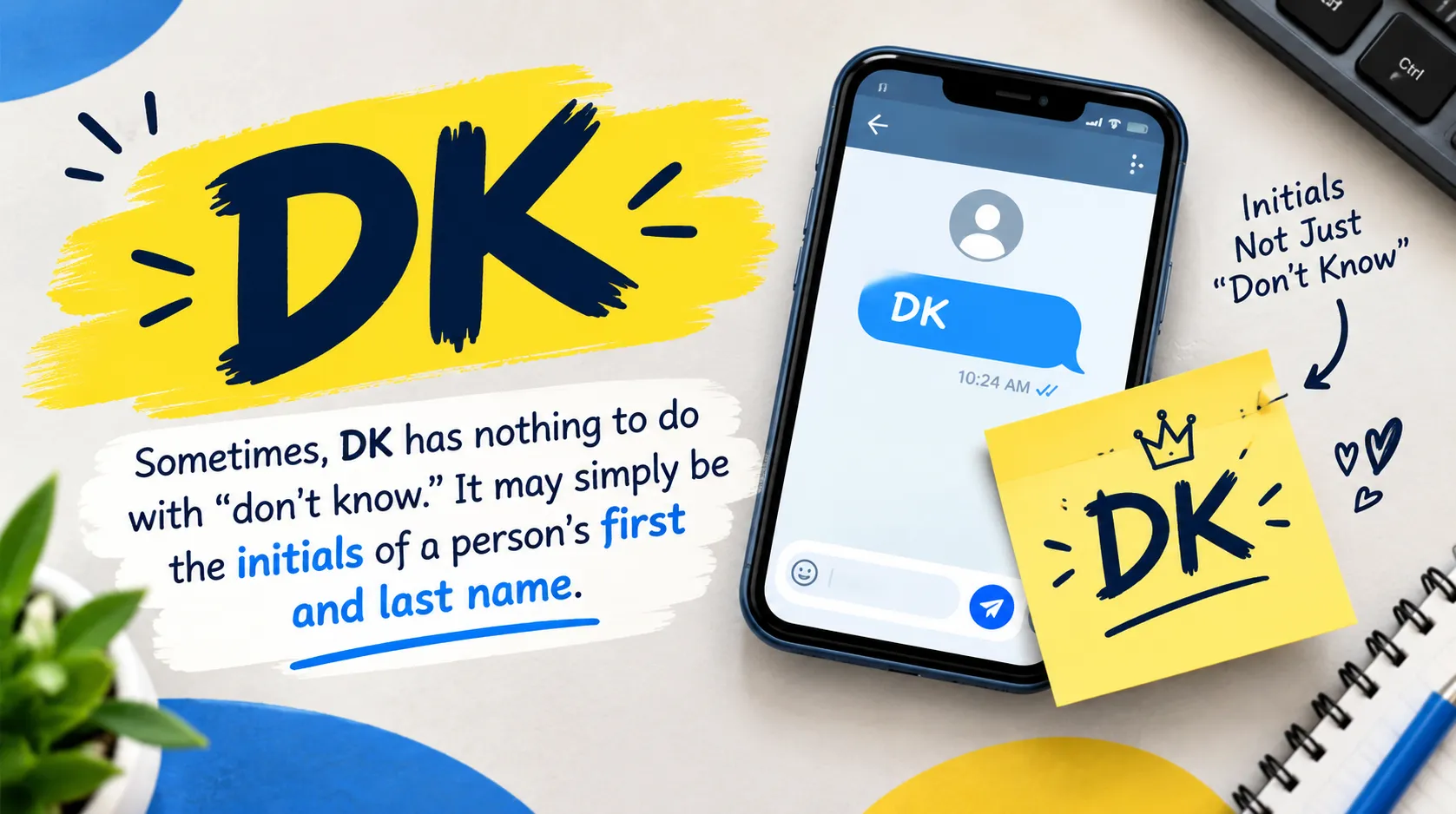
2. DK Can Refer to Initials or a Name
Sometimes, DK has nothing to do with “don’t know.” It may simply be the initials of a person’s first and last name.
For example, someone named Daniel Khan might use DK as a username, profile name, gaming name, or nickname. The same can happen with many other names.
Examples:
- “DK just joined the group.”
- “Follow DK for more updates.”
- “My username is DK_24.”
In these situations, the surrounding conversation makes it clear that DK refers to a person or account.
If someone writes “DK is online,” they are probably talking about a user rather than saying that they do not know something.
3. DK Can Mean Donkey Kong in Gaming
In gaming conversations, DK may stand for Donkey Kong, a well-known video game character and gaming franchise.
Players sometimes use DK as a short name when discussing the character, games, or related content. This meaning is especially likely when the conversation involves Nintendo, gaming videos, or game characters.
Examples:
- “DK is my favorite character.”
- “I’m playing a DK game tonight.”
- “DK has a strong move in this match.”
Here, DK is a gaming reference, not a way to express uncertainty.
However, do not assume this meaning every time you see DK in a gaming chat. Some players may also use it as a username or for another game-specific term.
4. DK Can Have a Special Meaning in a Specific Community
Online communities often create their own abbreviations. DK may have a specialized meaning in a particular game, group, workplace, or hobby.
For example, a group may use DK as a nickname for a member or as shorthand for a term that regular members understand.
Examples:
- “Ask DK about the next event.”
- “Our team needs a DK for the game.”
- “DK will explain the rules in the group.”
These examples do not have one fixed meaning without more information. You need to understand the community and the subject being discussed.
If you cannot tell what DK means, asking the sender is often the easiest solution.
How “DK” Is Used in Real Conversations
DK can appear in many types of online communication. The meaning may stay the same, but the tone can change depending on where it appears.
Friends & Casual Texting
Friends often use DK when they want to reply quickly. It can answer questions about plans, school, food, events, or everyday problems.
For example:
Conversation 1
- You: “What should we eat tonight?”
- Friend: “dk, you choose.”
Here, your friend does not have a food preference or has not decided yet.
Conversation 2
- You: “Do you know where Ali is?”
- Friend: “dk, I haven’t seen him.”
The friend is simply saying they do not know Ali’s location.
Conversation 3
- You: “Are we meeting at 5?”
- Friend: “dk yet.”
In this example, the friend is still unsure about the time.
In casual chats, DK is usually harmless. It can sound short or slightly uninterested, but the letters alone do not prove that someone is annoyed.
Instagram & Snapchat
On Instagram and Snapchat, DK may appear in direct messages, comments, story replies, or conversations about plans.
People often use short forms because social media chats move quickly. A person might use DK to answer a question about a post, an event, or something another person shared.
Examples:
- “Who posted this picture?” — “dk.”
- “Are you going to the party?” — “dk yet.”
- “What’s the name of that song?” — “dk, sorry.”
These messages show uncertainty rather than a special Instagram or Snapchat meaning.
You should also consider the post or profile itself. If DK appears as a username, tag, or account name, it may refer to a person instead.
For example, a comment such as “DK looks great here” could be talking about someone whose initials are DK.
Dating Apps
On dating apps, DK can mean “don’t know” when someone is unsure about a question or has not made a decision.
For example:
- “What are you looking for on this app?”
- “dk yet, just seeing what’s out there.”
This answer suggests that the person has not decided what kind of connection they want.
Another example:
- “Do you want to meet this weekend?”
- “dk, maybe Saturday.”
The person may still be checking their schedule or deciding whether they want to meet.
In dating conversations, it is important not to read too much into a short reply. DK does not automatically mean someone is uninterested, shy, flirting, or trying to reject you.
Look at their other messages and whether they make an effort to continue the conversation. If their answer matters to you, ask a clear follow-up question instead of guessing.
Gaming & Online Communities
Gaming chats often contain abbreviations, so DK may have a different meaning from its use in everyday texting.
One recognizable meaning is Donkey Kong. In other gaming communities, DK could be a player name or a specialized abbreviation used by members.
Examples:
- “DK is available in this game.”
- “I picked DK for this round.”
- “Ask DK to join the team.”
The exact meaning depends on the game and the conversation.
If a player writes “dk” in response to a question such as “Which character should we choose?”, they might mean “don’t know.” If they write “DK is my main,” they may be referring to a character or username.
The words around the abbreviation help you understand the intended meaning.
Work or Professional Chat
DK may occasionally appear in workplace messages, especially in informal team chats. Someone might use it to show that they do not know the answer to a question.
For example:
- “Do we have the final meeting time?”
- “dk, waiting for the manager’s reply.”
Although the meaning is understandable, writing “I don’t know yet” would be clearer in a professional setting.
Better professional examples:
- “I don’t know the confirmed time yet.”
- “I’m not sure. I’ll check and let you know.”
- “I haven’t received that information yet.”
These replies sound more complete and helpful. They also tell the other person whether you plan to find the answer.
In a formal email, report, or message to a client, it is usually better to avoid unexplained abbreviations like DK.
Is “DK” Rude, Flirty, or Offensive?
DK is not usually rude, flirty, or offensive by itself. When it means “don’t know,” it simply expresses uncertainty. However, the way someone uses it can affect how the message feels.
When DK Sounds Neutral
DK usually sounds neutral when someone is answering a simple question.
For example:
- “What time is the match?”
- “dk, maybe around 7.”
The sender is giving an honest answer and may not have the information yet.
A short reply is not always a sign of a bad mood. Some people naturally use abbreviations because they prefer quick messages.
When DK May Sound Rude
DK may sound dismissive if the sender uses it to end a conversation or avoids answering a question that matters.
For example:
- You: “Can you please tell me what happened?”
- Them: “dk.”
If the person knows the answer but refuses to explain, the reply could feel cold. However, you cannot know their intention from those two letters alone.
They may be busy, confused, distracted, or unwilling to discuss the subject.
Can DK Be Flirty?
DK does not have a standard flirty meaning. Still, it can appear in a playful or romantic conversation.
For example:
- You: “Do you miss me?”
- Them: “dk, maybe a little.”
The playful tone comes from the full message, not from DK itself.
If someone uses DK while talking about feelings, attraction, or dating plans, focus on the complete conversation instead of assuming the abbreviation signals romantic interest.
Is DK Offensive?
DK is not generally an offensive abbreviation when it means “don’t know.” It is a normal expression of uncertainty.
The tone could still become unpleasant if someone uses it to mock another person or dismiss a serious question. In that case, the surrounding words and behavior matter more than the abbreviation.
The safest rule is simple: understand the message before judging the sender.
How to Respond When Someone Says “DK”
Your reply should depend on what you asked, how well you know the person, and whether you need a real answer.
Casual Replies
Use a simple response when you are chatting with a friend.
- “Okay, no problem.”
- “Alright, let me know when you find out.”
- “Same, I’m not sure either.”
- “No worries, I’ll check.”
Example:
- You: “Do you know when the store closes?”
- Friend: “dk.”
- You: “No worries, I’ll look it up.”
This keeps the conversation friendly and natural.
Funny Replies
If you are close to the person and the topic is not serious, a playful response may work.
- “Your guessing skills are needed.”
- “We’re both clueless then.”
- “Mystery of the day!”
- “Guess we’ll find out together.”
Example:
- You: “Who ate the last slice of pizza?”
- Friend: “dk.”
- You: “A very mysterious case.”
Use humor only when you know the other person will understand it. A joke may not be suitable when someone is discussing an important or sensitive matter.
Neutral Replies
Choose a neutral response when you want more information without making the conversation awkward.
- “Okay, let me know if you find out.”
- “Could you check when you get a chance?”
- “No problem. I’ll ask someone else.”
- “Thanks for letting me know.”
These replies work well with classmates, acquaintances, and people you do not know very well.
Professional Replies
In a work conversation, respond clearly and politely.
- “Understood. Please let me know when you have an update.”
- “No problem. Could you confirm with the team?”
- “Thanks. I’ll check with the relevant person.”
- “Please share the information once it is available.”
Example:
- You: “Do we have approval for the new design?”
- Colleague: “dk.”
- You: “Thanks. Could you check with the manager and update me?”
This response focuses on the next step instead of criticizing the short answer.
Common Misunderstandings About “DK”
Even though DK is short, it can cause confusion when people assume it always means the same thing.
Assuming DK Always Means “Don’t Know”
“Don’t know” is the common texting interpretation, but it is not the only one.
If DK appears as a person’s name, username, or gaming reference, it may mean something else.
For example, “DK joined the server” probably refers to a person or account. The phrase “What time is it?” followed by “dk” is more likely to mean “don’t know.”
Always check the sentence before deciding.
Confusing DK With IDK
DK and IDK are closely related, but IDK is the more common abbreviation for “I don’t know.”
For example:
- “dk what to do.”
- “idk what to do.”
Both may express uncertainty in casual texting. However, IDK clearly includes the word “I,” making its meaning more explicit.
If you are writing to someone who may not understand short forms, use the complete phrase instead.
Thinking DK Means Someone Is Angry
A one- or two-letter reply can feel cold, especially when you expected a longer answer. Still, a short message does not automatically mean the sender is angry.
They may be busy, using their phone quickly, or genuinely unsure of the answer.
Look for other clues, such as the previous conversation, their usual texting style, and whether they continue replying.
Assuming DK Is a Secret or Romantic Code
DK does not have one widely accepted secret or romantic meaning in everyday texting. A person might use it in a playful exchange, but that does not give the abbreviation a special romantic definition.
If you are unsure, ask what they mean. A quick question is often better than spending time guessing.
Ignoring the Context
The same two letters can mean different things in different situations.
For example, DK in a gaming discussion might refer to Donkey Kong, while DK in a conversation about tomorrow’s plans may mean “don’t know.”
Context is the best way to understand abbreviations accurately.
Similar Slang Terms You Should Know
If you want to understand everyday texting more easily, these related abbreviations are useful to learn.
- IDK — I Don’t Know: Used when someone does not know the answer or is unsure about something.
- IK — I Know: A short way to show that you already know something.
- IDC — I Don’t Care: Used to show that something does not matter to the sender, although it can sound dismissive.
- IDKTBH — I Don’t Know, To Be Honest: A less common combination that expresses uncertainty honestly.
- TBH — To Be Honest: Used before sharing an honest thought or opinion.
- NGL — Not Gonna Lie: Often used to introduce a candid statement.
- IMO — In My Opinion: Shows that the message expresses a personal view.
- IMHO — In My Humble Opinion: A polite or informal way to introduce a personal opinion.
- WYD — What You Doing?: A casual way to ask what someone is doing.
- WYA — Where You At?: Used to ask where someone is or where they are going.
- FR — For Real: Used to show agreement, seriousness, or surprise.
- NVM — Never Mind: Used when someone no longer needs an answer or wants to cancel a request.
These abbreviations can make texting faster, but their tone still depends on the conversation. For example, IDC may sound harsher than IDK because it can suggest that the sender does not care about the subject.
Learning common terms like these helps you understand messages without guessing what each person intends.
When You Should Avoid Using “DK”
DK is useful in casual messages, but it is not the best choice in every situation.
Professional Settings
Avoid using DK in formal emails, job applications, client messages, business reports, and other professional communication.
A short reply such as “dk” may sound incomplete or unhelpful, even when you do not mean it that way.
Instead of writing:
“dk when the file will be ready.”
Write:
“I’m not sure when the file will be ready. I’ll confirm the timing and update you.”
The second message is clearer and gives the other person a useful next step.
Cross-Cultural Chats
Not everyone understands the same texting abbreviations. Someone who speaks English as a second language may not recognize DK or may interpret it differently.
If you are communicating with someone from another country or someone unfamiliar with internet slang, use simple, complete words.
For example, “I don’t know yet” is easier to understand than “dk yet.”
Clear language reduces confusion and helps conversations move forward.
Sensitive Situations
Avoid replying with only DK when someone asks an important question about their feelings, safety, health, or a serious personal problem.
For example, if a friend asks whether you can help them, replying only “dk” may make them feel ignored.
A more thoughtful answer could be:
“I’m not sure yet, but I’ll try to help.”
Or:
“I don’t know the answer, but we can figure it out together.”
You do not need to pretend you know something when you do not. The goal is to communicate honestly while showing care and respect.
FAQs
1. What does DK mean in text messages?
DK usually means “don’t know.” People use it as a quick reply when they are unsure about something or do not have an answer.
2. What does DK mean from a girl?
When a girl sends DK, she usually means “don’t know.” It does not automatically mean she is angry, uninterested, or flirting. The conversation helps explain her intended tone.
3. What does DK mean from a guy?
When a guy texts DK, it generally means “don’t know.” He may be unsure about a question, a plan, or a decision. You need context to understand whether he is being casual or dismissive.
4. Is DK the same as IDK?
They can express the same idea, but IDK means “I don’t know” and is more widely recognized. DK is a shorter form that some people use informally.
5. Does DK mean Donkey Kong?
Yes, DK can stand for Donkey Kong in gaming conversations. This meaning is especially likely when people are discussing the character, related games, or gaming content.
6. Is DK rude in texting?
DK is not usually rude. It is a simple way to express uncertainty. However, it may sound dismissive if someone uses it to avoid an important conversation or responds without considering the other person’s feelings.
7. How should I reply when someone texts DK?
You can respond with “Okay, no problem,” “Let me know when you find out,” or “I’ll check.” If you need a definite answer, ask a follow-up question politely.
Final Thoughts
DK is a short abbreviation that most often means “don’t know” in text messages. People use it when they are unsure about an answer, have not made a decision, or want to reply quickly.
You may also see DK used as someone’s initials, a username, or a reference to Donkey Kong in gaming conversations. The correct meaning depends on the words around it and the situation in which it appears.
Remember that DK does not automatically mean someone is angry, rude, or flirting. A short reply can have many explanations, so avoid making assumptions based on two letters alone.
When you receive DK in a message, read the conversation, consider the topic, and ask for clarification if needed. When you use it yourself, remember that complete words are often better for professional or sensitive conversations.
Understanding simple abbreviations like DK can make texting easier and help you communicate with more confidence in everyday chats, social media messages, and online communities.

Ethan Parker is a creative content writer passionate about pets, animals, and unique name ideas. He loves creating fun and engaging content that helps readers discover the perfect names with ease.